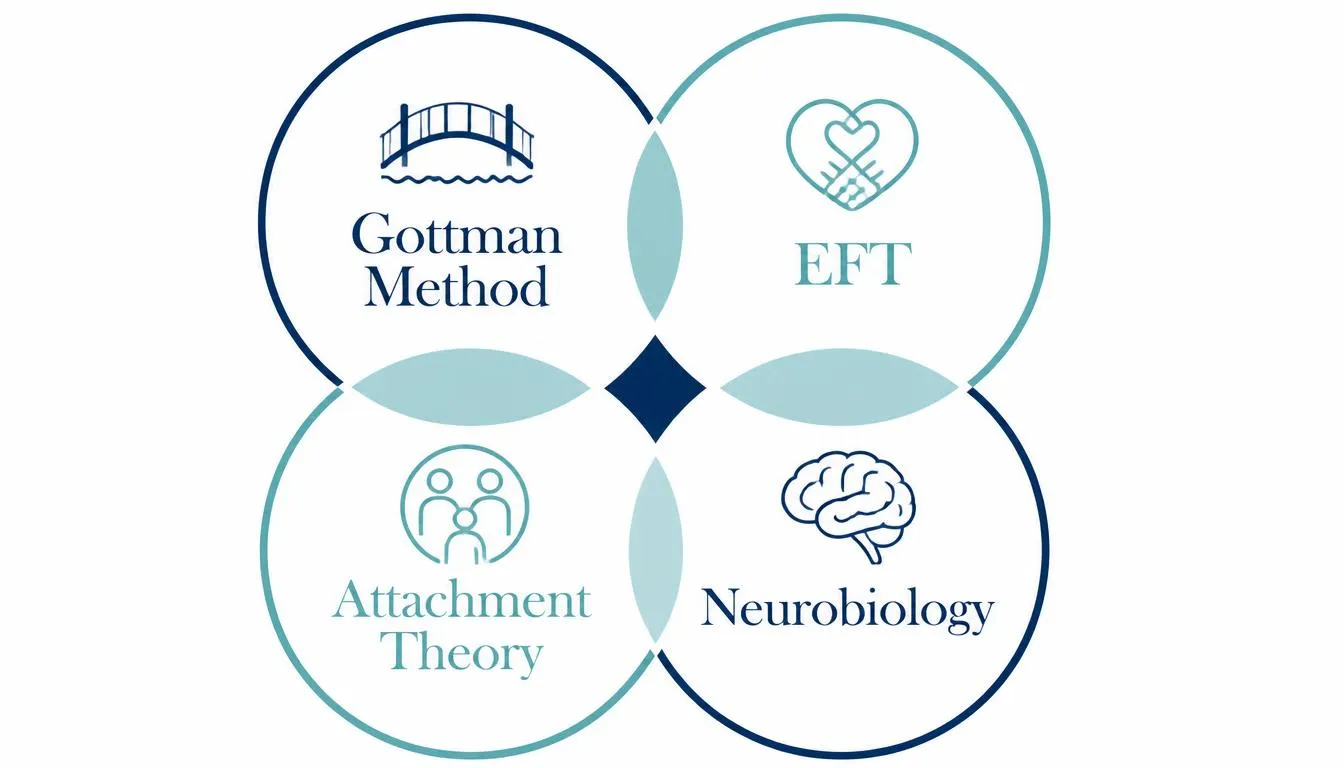
Talk to any licensed couple’s therapist long enough, and a familiar list of book titles surfaces, dog-eared paperbacks recommended between sessions, assigned as “homework,” or quietly gifted to partners stuck in the same argument for the tenth time. The best couples counseling books do more than comfort; they translate decades of clinical research, Gottman Method science, Emotionally Focused Therapy (EFT), Attachment Theory, and the neurobiology of love, into language couples can actually use at the kitchen table.
This isn’t a generic “best relationship books” roundup pulled from a bestseller list. It’s a working reading list built the way a psychiatrist or licensed marriage and family therapist (LMFT) would build one: organized by clinical use case, mapped to the theory it’s rooted in, and honest about what a book can and cannot do. Some titles teach conflict resolution skills. Others help partners decode their attachment style, process relational trauma, or rebuild intimacy after betrayal. A few are the literal textbooks clinicians study in graduate school.
Quick Answer: The Best Couples Counseling Books, At a Glance
| QUICK ANSWER
The best couples counseling books blend clinical theory with practical exercises. Top picks therapists recommend include The Seven Principles for Making Marriage Work (Gottman Method), Hold Me Tight (Emotionally Focused Therapy), Attached (Attachment Theory), and Wired for Love (neurobiology of love). Together, this reading list covers conflict resolution, communication skills, attachment repair, and healing from relational trauma or infidelity. Books can teach the frameworks therapists use in session, but research consistently shows they work best as a supplement to, not a replacement for, structured couples counseling with a licensed clinician. |
What Makes a Book “Therapist-Recommended”?
Not every relationship book earns a place on a clinician’s shelf. Therapists tend to gravitate toward titles that meet a few specific criteria: the framework is empirically studied (not just anecdotal), the exercises are things a therapist would actually assign, and the author is a licensed clinician or researcher with a track record, not just a public figure with an opinion on love.
That’s why this list leans heavily on a small set of clinical traditions you’ll see repeated throughout: the Gottman Method (four decades of observational research on what predicts divorce), Emotionally Focused Therapy (EFT) (rooted in adult attachment science), Attachment Theory more broadly, and an emerging body of work on the neurobiology of love, how the nervous system, not just the mind, drives connection and conflict.
The 15 Books at a Glance
| # | Book | Core Framework | Best For |
| 1 | The Seven Principles for Making Marriage Work | Gottman Method | Conflict patterns & friendship |
| 2 | Hold Me Tight | Emotionally Focused Therapy | Emotional disconnection |
| 3 | Attached | Attachment Theory | Anxious/avoidant dynamics |
| 4 | Wired for Love | Neurobiology of love | Nervous system regulation |
| 5 | Eight Dates | Gottman Method | Structured communication |
| 6 | The State of Affairs | Relational trauma | Healing after infidelity |
| 7 | Mating in Captivity | Depth psychology | Desire & domesticity |
| 8 | Come As You Are | Sexual science | Mismatched libido |
| 9 | Nonviolent Communication | Communication theory | De-escalating conflict |
| 10 | The 5 Love Languages | Communication theory | Feeling appreciated |
| 11 | Us | Relational-Life Therapy | Repeating family patterns |
| 12 | Fighting for Your Marriage | PREP Method | Preventing divorce |
| 13 | Polysecure | Attachment Theory | Non-monogamous couples |
| 14 | The Body Keeps the Score | Neurobiology of trauma | Trauma-informed healing |
| 15 | Getting the Love You Want | Imago Relationship Therapy | Childhood-wound repair |
Now, the deep dive, all 15, in the order a therapist might actually assign them.
The 15 Couples Counseling Books Therapists Actually Recommend
1. The Seven Principles for Making Marriage Work, Dr. John Gottman
This is the closest thing the field has to a foundational text. Built on more than 40 years of Gottman Method research at the “Love Lab,” it identifies the behaviors that predict relational breakdown with striking accuracy.
How it rewires conflict patterns: Gottman’s research isolated four communication styles, criticism, contempt, defensiveness, and stonewalling, that reliably predict divorce. The book teaches couples to replace these with repair attempts and a “culture of appreciation,” which lowers physiological flooding (elevated heart rate and cortisol) during disagreements.
| EXPERT INSIGHT
In session, I use this book’s “Four Horsemen” framework as a shared vocabulary. Once partners can name contempt instead of just feeling attacked by it, the conflict itself becomes less charged, naming is the first step in regulating it. |
Key takeaways:
- Introduces the “Sound Relationship House” model of lasting partnership
- Teaches couples to turn toward, not away from, everyday bids for connection
- Offers concrete couples counseling exercises for building shared meaning
2. Hold Me Tight, Dr. Sue Johnson
Written by the psychologist who developed Emotionally Focused Therapy (EFT), this book distills decades of clinical work into “Seven Conversations” designed to interrupt the negative cycles that quietly erode intimacy.
How it targets the attachment bond: EFT treats conflict as a symptom of attachment insecurity, not a communication failure. Instead of teaching scripts, it helps partners access and voice the vulnerable, primary emotions (fear of abandonment, need for reassurance) hiding underneath reactive anger or withdrawal, reducing the “amygdala hijack” that fuels escalation.
| EXPERT INSIGHT
Most couples I see aren’t fighting about the dishes, they’re fighting about whether they can count on each other. This book helps partners name that underlying fear out loud, which is often the first real breakthrough. |
For couples untangling more layered patterns, where old wounds keep resurfacing inside new arguments, this book is often paired with structured sessions that address broader complex relationship dynamics that a book alone can’t fully resolve.
Key takeaways:
- Maps the “Demon Dialogues” that trap couples in negative cycles
- Reframes conflict as an attachment signal, not a character flaw
- Widely used as an adjunct text alongside formal EFT-based couples counseling
3. Attached, Amir Levine, MD & Rachel S.F. Heller, MS
Arguably the most accessible entry point into Attachment Theory for a general audience. Levine and Heller translate John Bowlby’s original research into three practical relational styles: secure, anxious, and avoidant.
How it decodes relational wiring: The book argues that early attachment experiences shape a template for how adults seek closeness and respond to distance in relationships. Recognizing whether you or your partner leans toward an anxious attachment style, or an avoidant one, reframes recurring conflict as a mismatch in nervous-system needs rather than a character flaw.
| EXPERT INSIGHT
This book gives couples language before they’ve done any real clinical work, and that language alone often reduces shame. “I’m anxiously attached” lands very differently than “I’m needy” or “clingy.” |
Recognizing whether you or your partner leans toward an anxious attachment style, or an avoidant one, reframes recurring conflict as a mismatch in nervous-system needs rather than a character flaw.
Key takeaways:
- Offers a self-assessment for identifying your dominant attachment style
- Explains why anxious-avoidant pairings are common and especially conflict-prone
- Provides scripts for expressing needs without triggering a partner’s defenses
4. Wired for Love, Stan Tatkin, PsyD
Tatkin, developer of the Psychobiological Approach to Couple Therapy (PACT), grounds this book firmly in the neurobiology of love, treating the couple as a two-person nervous system rather than two separate individuals.
How it calms the nervous system: Drawing on neuroscience, Tatkin distinguishes between the brain’s “primitive” survival responses (fight, flight, freeze) and its “ambassador,” or mature, functioning. He argues that most couple conflict happens when both partners’ primitive brains are triggered simultaneously, and teaches specific co-regulation techniques to de-escalate before real conversation can happen.
| EXPERT INSIGHT
I recommend this to couples who say “we know what we’re doing wrong, we just can’t stop.” That’s a nervous-system problem, not a knowledge problem, and this book addresses the body, not just the mind. |
Key takeaways:
- Introduces “islands, waves, and anchors” as attachment styles under stress
- Teaches couples to recognize their own physiological triggers in real time
- Bridges neuroscience and Attachment Theory in an unusually practical way
5. Eight Dates, John Gottman, Julie Schwartz Gottman, Doug Abrams & Rachel Carlton Abrams
A structured, workbook-style follow-up to the Gottmans’ earlier research, built around eight guided conversations couples can have over eight actual dates, no calendar block required.
How it structures difficult conversations: Each “date” tackles a high-stakes topic, trust, conflict, money, family, intimacy, adventure, growth, and dreams, using scripted, low-stakes conversation-starter questions. The structure itself lowers defensiveness, since couples know exactly what’s coming and can prepare emotionally.
| EXPERT INSIGHT
This is one of the few books I assign as literal homework. The built-in structure removes the guesswork that derails a lot of well-intentioned “let’s talk about our relationship” conversations. |
Key takeaways:
- Doubles as a set of ready-made couples counseling worksheets
- Covers money and family-of-origin topics many couples avoid
- Works well for both new relationships and long-term partnerships doing a “reset”
6. The State of Affairs, Esther Perel
Perel’s clinical work on infidelity reframes affairs not as a simple morality tale, but as a complex rupture that often involves grief, identity, and relational trauma on both sides.
How it addresses relational trauma: The book treats betrayal as a trauma response, partners who’ve experienced infidelity often display hypervigilance, intrusive thoughts, and emotional flooding consistent with trauma symptoms, not just anger or sadness. Perel’s framework helps both partners understand the affair’s meaning without minimizing the pain it caused.

| EXPERT INSIGHT
Infidelity recovery is rarely just a “couples issue”, the betrayed partner is often processing something closer to trauma. When I see those symptoms persist, I’ll often recommend additional trauma-focused support alongside the couples work this book supports. |
When those symptoms persist beyond the couples work, many clinicians recommend pairing this reading with online trauma and PTSD therapy to address the trauma response directly.
Key takeaways:
- Reframes infidelity as a rupture requiring both grief work and meaning-making
- Offers language for both the betrayed and the betraying partner
- Useful preparation before entering formal betrayal trauma therapy
7. Mating in Captivity, Esther Perel
Perel’s earlier and equally influential work tackles a different tension entirely: how couples sustain desire once domestic routine and security set in.
How it protects erotic intimacy: The central argument is that love needs closeness, while desire needs distance and mystery, and long-term couples often unconsciously trade eroticism for the safety of routine. The book offers reframes rather than rules, encouraging partners to protect a sense of separateness inside commitment.
| EXPERT INSIGHT
Couples often come in worried something is “wrong” because desire has faded. This book normalizes that shift and gives them permission to actively rebuild it, rather than treating it as a symptom of a failing relationship. |
Key takeaways:
- Challenges the assumption that closeness always increases desire
- Explores cultural and psychological roots of the “sexual boredom” couples describe
- Pairs well with structured conflict resolution work, since low desire often masks unresolved tension
8. Come As You Are, Emily Nagoski, PhD
A sex-education-meets-therapy title grounded in the “dual control model” of arousal, a framework increasingly used in clinical settings to address sexual mismatch between partners.
How it demystifies desire: Nagoski explains “arousal nonconcordance”, the gap between physical arousal and subjective desire, and shows why willpower-based approaches to low libido often backfire. The book replaces shame-based narratives with a science-based understanding of what accelerates and inhibits sexual response.
| EXPERT INSIGHT
This book helps couples stop pathologizing mismatched desire. Once partners understand that “the brakes” and “the accelerator” are separate systems, the conversation shifts from blame to curiosity. |
Key takeaways:
- Introduces the “dual control model” (accelerators and brakes) of arousal
- Reduces shame around differing libido levels between partners
- Frequently recommended alongside broader intimacy-focused couples counseling
9. Nonviolent Communication, Marshall B. Rosenberg, PhD
Though not written specifically for couples, this remains one of the most frequently assigned conflict resolution texts in couples work, thanks to its simple four-step communication model.
How it de-escalates conflict: Rosenberg’s model, observation, feeling, need, request, separates factual observation from judgment, which research suggests reduces the defensiveness that fuels escalating arguments. It’s essentially a script for expressing a need without triggering a partner’s threat response.
| EXPERT INSIGHT
I use a simplified version of this framework constantly in session. Most couples aren’t bad communicators, they just haven’t separated the feeling from the accusation, and this book teaches exactly that distinction. |
Key takeaways:
- Offers a repeatable four-step framework for high-stakes conversations
- Widely used as a foundational communication skills text beyond couples work
- Complements Gottman Method and EFT approaches rather than competing with them
10. The 5 Love Languages, Gary Chapman
A cultural phenomenon that, despite its simplicity, remains a therapist-recommended entry point for couples who’ve never explicitly discussed how they each experience love.
How it closes the appreciation gap: Chapman’s framework, words of affirmation, quality time, acts of service, physical touch, and receiving gifts, gives couples shared vocabulary for a common problem: both partners are expressing love, just in a language the other doesn’t fluently receive.
| EXPERT INSIGHT
This book isn’t a clinical framework, but it’s an excellent icebreaker. I often use it in early sessions to get couples talking about connection before we move into deeper attachment or conflict work. |
Key takeaways:
- Simple, low-barrier starting point for couples new to relationship education
- Useful for identifying communication mismatches, not just romantic gestures
- Best used as a supplement to, not a substitute for, deeper clinical frameworks
11. Us: Getting Past You and Me to Build a More Loving Relationship, Terrence Real
Real’s Relational Life Therapy (RLT) model focuses on how childhood family patterns resurface inside adult partnerships, often as the exact dynamic a person swore they’d never repeat.
How it interrupts inherited patterns: The book identifies an “adaptive child” mode, reactive, defensive behavior learned in childhood, versus a “wise adult” mode that couples can consciously choose to access. Real argues most relational conflict is really two adaptive children arguing, not two adults.
| EXPERT INSIGHT
This framework is powerful for couples who keep saying “I don’t know why I reacted that way.” It usually traces back to a much older pattern than the current argument. |
Key takeaways:
- Explains why partners often repeat family-of-origin dynamics unconsciously
- Introduces the “harmony–disharmony–repair” cycle as a normal relational rhythm
- Direct, confrontational tone that resonates with couples who want blunt feedback
12. Fighting for Your Marriage, Howard Markman, Scott Stanley & Susan Blumberg
The book behind PREP (Prevention and Relationship Enhancement Program), one of the most heavily researched relationship education curricula in the country, with decades of longitudinal data behind it.
How it prevents escalation before it starts: The centerpiece is the “Speaker-Listener Technique,” a structured format that prevents interruption and cross-complaining during high-conflict conversations. It’s a couples counseling technique many therapists teach nearly verbatim from this text.
| EXPERT INSIGHT
This is the most “evidence-based” book on this list in the strictest sense, PREP has been studied extensively. I recommend it for couples who want data behind the method, not just theory. |
Key takeaways:
- Grounded in longitudinal research on what predicts marital success
- Teaches a structured technique for de-escalating hot-button topics
- Addresses “hidden issues”, control, caring, recognition, beneath surface arguments
13. Polysecure, Jessica Fern
A more contemporary addition to this list, extending Attachment Theory beyond the monogamous-couple framework most classic texts assume, increasingly relevant as clinicians see more consensually non-monogamous (CNM) and polyamorous clients.
How it applies attachment beyond monogamy: Fern argues secure attachment isn’t inherently tied to exclusivity, it’s tied to consistency, responsiveness, and communication, regardless of relationship structure. The book offers frameworks for managing jealousy and building security across multiple attachment bonds simultaneously.
| EXPERT INSIGHT
Most attachment literature assumes monogamy by default. This book fills a real gap for couples and networks whose relationship structure doesn’t fit that mold, the underlying attachment science still applies. |
Key takeaways:
- Extends core Attachment Theory concepts to non-monogamous relationship structures
- Offers tools for processing jealousy through an attachment lens, not a moral one
- Increasingly assigned by therapists working with modern relationship configurations
14. The Body Keeps the Score, Bessel van der Kolk, MD
Not written specifically about couples, but essential for understanding how unresolved individual trauma shapes relational patterns, a book many therapists consider required reading before deeper couples work begins.
How it heals the HPA axis: Van der Kolk explains how trauma dysregulates the hypothalamic-pituitary-adrenal (HPA) axis and the body’s stress response, meaning triggers inside a relationship can activate a full physiological threat response, not just an emotional one. Somatic, body-based interventions (rather than talk alone) are often needed to fully regulate this system.
| EXPERT INSIGHT
When a partner’s reaction seems wildly disproportionate to the moment, this book explains why, the body may be responding to an old threat, not the current conversation. That distinction changes how I frame the work with a couple entirely. |
Key takeaways:
- Explains the neurobiology of trauma in accessible, clinically grounded terms
- Clarifies why “just talking about it” often isn’t enough to resolve trauma responses
- Foundational text for couples where one or both partners carry unresolved relational trauma
15. Getting the Love You Want, Harville Hendrix, PhD & Helen LaKelly Hunt, PhD
The foundational text of Imago Relationship Therapy, built on the theory that we unconsciously choose partners who resemble our early caregivers, flaws included, in an attempt to heal old wounds.
How it repairs childhood wounds through partnership: Imago theory argues that recurring conflict is often an unconscious attempt to finish unfinished business from childhood. The book’s signature “Imago Dialogue”, mirroring, validating, and empathizing with a partner’s experience before responding, slows reactivity and builds genuine understanding.
| EXPERT INSIGHT
The Imago Dialogue is deceptively simple but hard to do under stress. I’ve watched it de-escalate arguments in real time once couples commit to the structure, even when they’re skeptical going in. |
Key takeaways:
- Introduces the structured “Imago Dialogue” for validating a partner’s experience
- Frames partner selection as an unconscious attempt at emotional healing
- One of the longest-standing couples therapy modalities still actively taught today
How to Choose the Right Book for Your Relationship
Not every couple needs the same starting point. A few clinical rules of thumb:
- If you’re stuck in the same fight on repeat: start with The Seven Principles for Making Marriage Work or Fighting for Your Marriage, both target conflict resolution patterns directly.
- If you feel emotionally distant, not just “in conflict”: Hold Me Tight and Attached address the attachment-level disconnection underneath surface arguments.
- If you’re healing after infidelity or a breach of trust: The State of Affairs, paired with professional support, addresses the relational trauma involved far more directly than general relationship advice.
- If desire or physical intimacy has quietly disappeared: Mating in Captivity and Come As You Are tackle this without shame or blame.
When Books Aren’t Enough
These 15 titles reflect the frameworks therapists actually use, but a book, however well-researched, can’t read a room, adjust in real time, or hold a couple accountable to change between sessions. Reading is often the first step; structured, guided online couples and relationship counselling is usually the step that turns insight into lasting change, especially when conflict has become entrenched, trust has broken down, or trauma responses are driving the disconnection rather than simple miscommunication.
Frequently Asked Questions
What is the best couples counseling book for beginners?
The 5 Love Languages by Gary Chapman and Eight Dates by the Gottmans are the most accessible starting points. Both use simple, low-barrier frameworks that don’t require prior knowledge of psychological theory, making them ideal first reads before moving into deeper clinical texts like Hold Me Tight or Attached.
Can couples counseling books replace therapy?
No. Couples counseling books can teach frameworks, vocabulary, and exercises used in real therapy sessions, but they cannot adapt in real time, identify blind spots, or hold both partners accountable the way a licensed therapist can. Books work best as a supplement to, not a substitute for, professional couples counseling.
What is the Gottman Method, and which book explains it best?
The Gottman Method is a research-based approach to couples therapy developed by Dr. John Gottman, based on decades of observational studies on what predicts relationship success or divorce. The Seven Principles for Making Marriage Work is the definitive introductory text, with Eight Dates offering a more exercise-driven follow-up.
What are the best books for healing after infidelity?
The State of Affairs by Esther Perel is the most widely recommended text specifically on infidelity, addressing both the betrayed and betraying partner’s experience. Because betrayal often produces trauma symptoms, many clinicians pair this reading with formal trauma-informed couples counseling rather than relying on the book alone.
Do couples counseling books actually work?
Research on bibliotherapy, using structured reading as a therapeutic tool, shows it can meaningfully improve relationship satisfaction, particularly when paired with active exercises rather than passive reading. Books grounded in evidence-based frameworks like the Gottman Method or Emotionally Focused Therapy tend to show the strongest outcomes.
What’s the difference between Attachment Theory and Emotionally Focused Therapy books?
Attachment Theory books, like Attached, focus on identifying an individual’s relational style (anxious, avoidant, or secure). Emotionally Focused Therapy books, like Hold Me Tight, apply that same attachment science specifically to interrupting negative interaction cycles between two partners. The two frameworks are closely related, and many EFT-based texts assume a working knowledge of attachment concepts.
How do I get my partner to actually read a couples counseling book with me?
Start with shorter, structured formats like Eight Dates, which breaks reading and reflection into small, scheduled sessions rather than an entire book upfront. Framing it as a shared project, one conversation at a time, tends to see far higher follow-through than assigning a full book to read independently.
| Medical Disclaimer & E-E-A-T AttributionThis article is for educational purposes and does not replace personalized medical or psychological advice. If you are recovering from a brain injury, trauma, or a mental health condition, work with a licensed clinician to build a plan suited to your situation.
Written by: Adil Farooq, Psychiatry Magazine Medically reviewed by: [Dr. Adil Farooq MS · PhD] · Updated: 2026 |