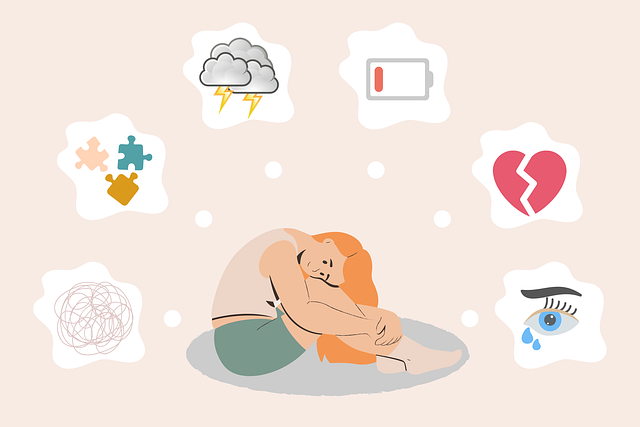
Quick AnswerRelationship counselling for men looks different because effective therapeutic approaches favor structured, action-oriented tools over open-ended emotional dialogue. Frameworks like the Gottman Method and Emotionally Focused Therapy convert abstract feelings into concrete communication skills, work alongside men’s socialized problem-solving styles, and build emotional vocabulary gradually instead of demanding instant vulnerability. |
What “Relationship Counselling for Men” Actually Means
Relationship counselling for men is not a completely separate clinical specialty; rather, it is standard couples or individual therapy delivered through a lens that actively accounts for common patterns in male emotional socialization. The clinical goals rebuilding trust, repairing communication, and resolving recurring conflict stay the same. The entry point and the pacing change.
Clinicians who work extensively with male clients report a consistent pattern during intake: many men can describe exactly what is wrong in a relationship the arguments, the physical distance, the specific incident long before they can describe what they feel about it. This is not a resistance to the therapeutic process. It reflects how emotional vocabulary was, or was not, built over decades of social conditioning that rewarded composure and heavily discouraged open distress.
Effective relationship counselling for men starts from that reality instead of treating it as an obstacle to clear before the “real work” begins. A therapist who expects immediate emotional fluency from a client who has rarely been asked to practice it will misread caution as disengagement. A therapist who builds vocabulary alongside actionable skills gets a measurably different result.
Why It Looks Different: The Male Socialization Effect
Many men are raised inside a socialization framework that rewards extreme self-reliance and problem-solving over emotional disclosure. Therefore, a therapy model built around open, unstructured emotional narration can initially feel foreign, frustrating, or unproductive. Relationship counselling for men works better when it is built around this pattern rather than against it.
This conditioning shows up in specific, observable ways during sessions. A man might arrive ready to treat a conflict as a problem with a definitive solution. She wants more affection, so tell me what to do rather than as a feeling to sit with. That instinct toward action is not a deficiency. It is a massive strength that counselling can redirect toward better communication instead of avoidance.
The same conditioning affects how quickly a man recognizes his own emotional state in the moment, a pattern clinicians sometimes describe using the term alexithymia difficulty identifying and naming internal feelings as they occur. It is not exclusive to men, but it appears more frequently among men raised with strong self-reliance norms, and it directly shapes how early counselling sessions should be structured.
These mismatched emotional processing styles are exactly why modern relationship dynamics feel increasingly complicated to navigate. Two people, each fluent in a different emotional language, are trying to build one shared vocabulary under immense stress.
Traditional Talk Therapy vs. Action-Oriented Therapy
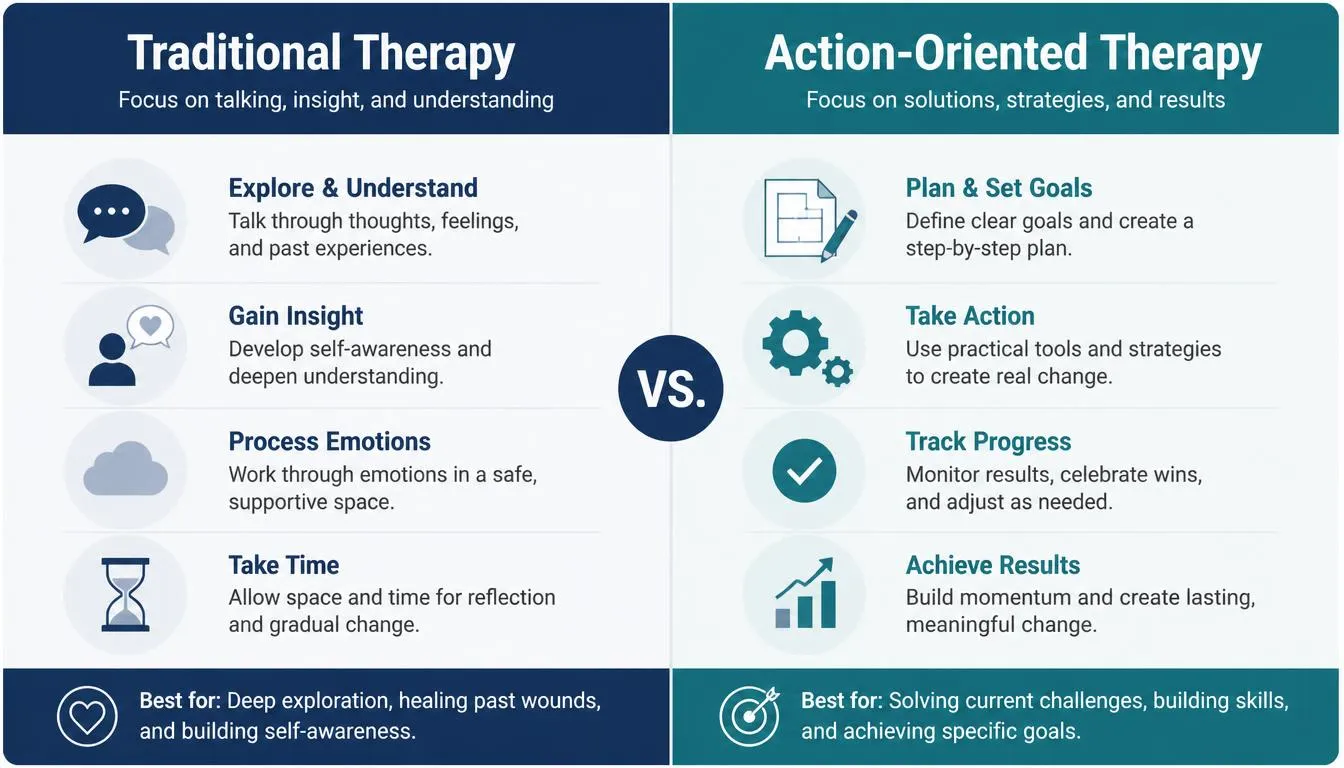
Traditional insight-oriented talk therapy centers on open emotional narrative, while the action-oriented approaches used heavily in relationship counselling for men prioritize structured exercises and measurable behavioral change. Neither model is objectively superior; the right fit depends entirely on the client and the presenting problem.
The table below disambiguates the two approaches across the dimensions that matter most when deciding which format to start with:
| Therapeutic Dimension | Traditional Talk Therapy | Action-Oriented Therapy (Male-Responsive) |
| Primary Focus | Open emotional narrative and insight. | Concrete skills and behavioral change. |
| Session Structure | Loosely guided, client-led. | Structured, therapist-guided exercises. |
| Pacing of Vulnerability | Emotional disclosure encouraged early. | Vulnerability built gradually through practice. |
| Common Techniques | Free association, reflective questioning. | Role-play, homework, communication drills. |
| Progress Markers | Increased self-insight over time. | Observable changes in communication patterns. |
The Clinical Frameworks That Actually Work for Men
Three evidence-informed frameworks account for most effective relationship counselling for men: the Gottman Method, Emotionally Focused Therapy, and Solution-Focused Brief Therapy. Each converts emotional material into something a man can practice and observe, rather than only discuss.
Gottman Method Couples Counseling The Gottman Method is built on decades of observational research into how couples argue, and it gives men something concrete to watch for: recurring patterns of criticism, defensiveness, contempt, and stonewalling, referred to collectively as the “Four Horsemen”. Learning to spot these patterns in real time, in one’s own behavior, turns an abstract goal like communicating better into a specific, highly trainable skill.
Emotionally Focused Therapy (EFT) Emotionally Focused Therapy takes a different route, mapping the repeating cycle a couple falls into during conflict frequently, one partner pursuing connection while the other withdraws. For men who default to withdrawal under stress, this framework reframes that instinct not as a failure, but as an outdated protective strategy that can be updated with practice.
Solution-Focused Brief Therapy (SFBT) SFBT focuses on immediate, practical change. Through goal-setting and scaling questions, it is highly effective for men who want measurable progress quickly and prefer to focus on future solutions rather than unpacking past traumas.
Underneath all three frameworks sits the exact same underlying skill: noticing a feeling, naming it accurately, and choosing a healthy response instead of reacting automatically. That is, in clinical terms, an exercise in developing high emotional intelligence, and it is fully trainable at any age with consistent practice.
From Shutdown to Self-Regulation: Anger, Flooding, and Communication
A significant share of relationship counselling for men centers on regulating anger and physiological flooding, the state in which a racing heart rate and stress hormones make calm conversation biologically difficult. Learning to recognize and interrupt flooding is frequently the single most useful skill a man takes from counselling.
Flooding is a physiological event, not a character flaw. Once a heart rate crosses a certain threshold during a conflict, the parts of the brain responsible for careful listening and measured speech become far less available. A raised voice or a complete shutdown becomes the default survival response rather than a conscious choice.
Men who default to raising their voice during an argument are frequently not choosing anger over care; they are skipping a nervous-system step that counselling can teach them to recognize and interrupt. Exploring why yelling happens and effective ways to stop it is essential for restoring psychological safety in the home.
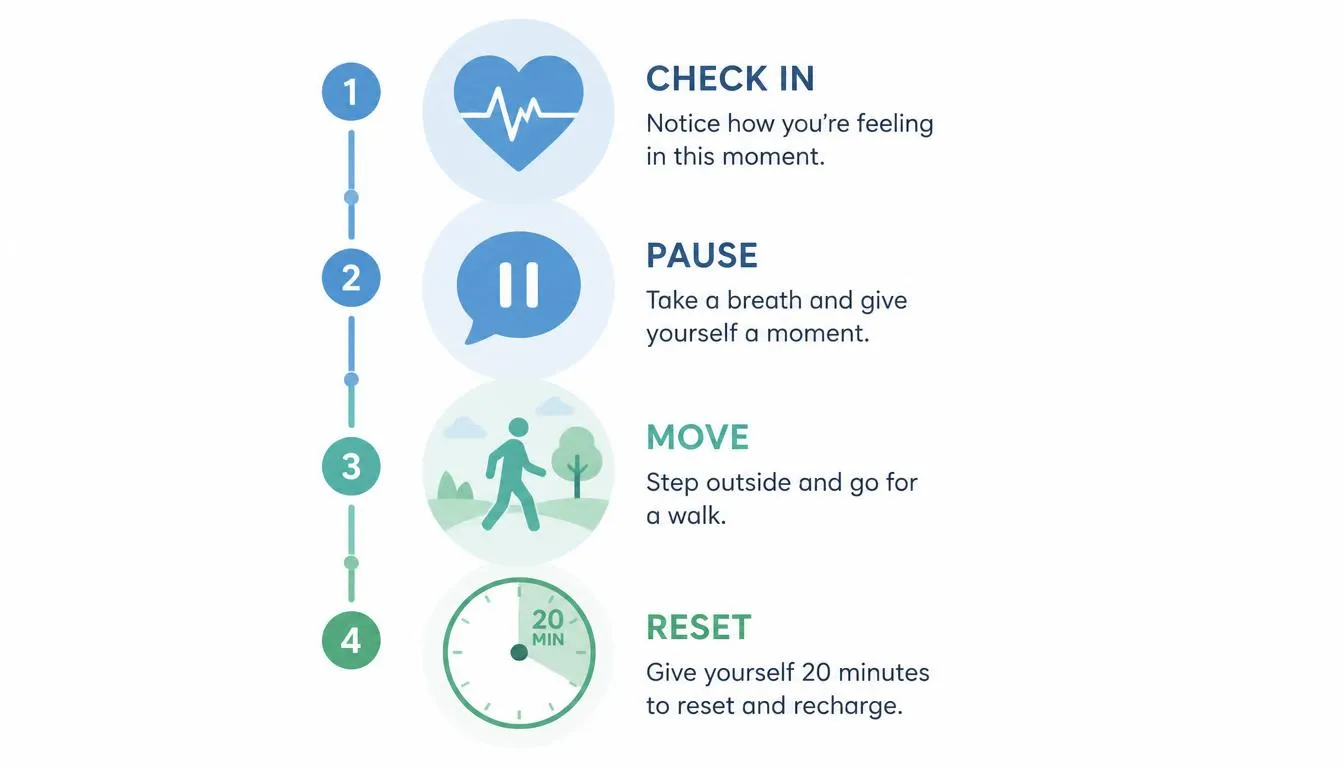
Actionable Protocol: The 20-Minute Reset
- Notice the Physical Signal: Identify a racing heart, a clenched jaw, or the urge to raise your voice or leave the room.
- Name the Timeout Out Loud: State clearly, without blame: “I need twenty minutes. I’m not leaving the relationship, I’m resetting.”
- Physically Separate & Self-Soothe: Do something calming and non-ruminative, such as a short walk. Do not replay the argument mentally.
- Return on Time: You must return at the time you agreed to, even if the only goal for that conversation is to schedule a longer one later. Twenty minutes reflects the approximate time most bodies need for stress hormones to return to a baseline.
Individual Counseling, Couples Therapy, or Discernment Counseling?
Men entering relationship counselling generally choose among three formats: individual relationship counseling to prepare for a partnership, joint couples therapy, and discernment counseling for couples who are unsure whether to repair the relationship or end it. Choosing the right format at the outset prevents wasted sessions.
Individual relationship counseling is appropriate when a man wants to understand his own patterns, a tendency to withdraw, a short fuse, a conflict theme that repeats across relationships before or instead of bringing a partner into the room.
Couples therapy is the standard format when both partners are actively committed to the relationship and want to rebuild it together.
Discernment counseling is a distinct, shorter-term format for couples where one or both partners are genuinely unsure whether to stay. It deliberately avoids deep repair work until that basic decision is clearer. Naming which of these three formats a couple actually needs saves time and reduces the chance either partner feels ambushed.
Taking the Next Step: The Shift Toward Online Therapy
The clearest signal that it is time to move from considering counselling to scheduling it is a repeating pattern: the same argument, the same shutdown, the same unresolved resentment resurfacing every few weeks. Waiting for one dramatic breaking point is rarely necessary, and often costly.
Historically, logistical barriers kept many men out of the therapist’s office. Today, online therapy for men makes that first step significantly lower-risk. Because you can attend sessions from the privacy of your own home, the friction of commuting to a clinic or sitting in a public waiting room is completely eliminated.
If a recurring argument is damaging your partnership, booking a secure session of online couples relationship counselling converts a vague intention into a concrete, action-oriented first step toward permanent repair.
Frequently Asked Questions (FAQ)
Does relationship counselling for men actually work for skeptics?
Yes, in most structured programs. Skepticism at intake is incredibly common and does not predict poor outcomes. Consistent attendance and completion of between-session exercises are far stronger predictors of improvement than initial enthusiasm.
Is relationship counselling worth it if only one partner is willing to attend?
Individual relationship counselling can still produce meaningful change. One partner adjusting their communication style, conflict response, and emotional regulation often dramatically shifts the relationship’s overall dynamic, even without the other partner in the room.
What is the difference between couples therapy and marriage counseling?
The terms are largely used interchangeably in clinical practice. Marriage counseling historically implied a legally married couple, while couples therapy and relationship counselling describe the same clinical work for any committed partnership regardless of marital status.
What should I expect from my first relationship counselling session?
Expect a structured intake focused on relationship history, current concerns, and specific recent conflicts, rather than an open-ended conversation about your deepest feelings. Most therapists working with men use this first session to identify one or two concrete goals and outline a measurable plan of action.
| Medical Disclaimer & E-E-A-T AttributionThis article is for educational purposes and does not replace personalized medical or psychological advice. If you are recovering from a brain injury, trauma, or a mental health condition, work with a licensed clinician to build a plan suited to your situation.
Written by: Adil Farooq, Psychiatry Magazine Medically reviewed by: [Dr. Adil Farooq MS · PhD] · Updated: 2026 |