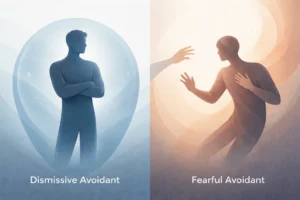
Maya and Sam both say that closeness makes them want to run, yet the way they run could not be more different. This is the heart of dismissive avoidant vs fearful avoidant attachment. When Maya feels intimacy deepening, she goes quiet, buries herself in work, and feels almost relieved when the other person backs off. When Sam feels it, he reaches out desperately one week and disappears the next, then lies awake wondering why he keeps sabotaging the people he loves.
If you have ever wondered which pattern is yours, or why a partner pulls you close and pushes you away, you are in the right place. In this guide, you will learn how each style forms, how it feels from the inside, how the two differ in dating and conflict, and what healing realistically looks like. Nothing here is a diagnosis. Attachment styles are learned patterns, which means they can be understood and changed.
Quick Answer: A dismissive avoidant person suppresses emotional needs and values independence, so they pull away when closeness feels like pressure. A fearful avoidant person craves intimacy but fears being hurt, so they swing between reaching out and retreating. Both avoid vulnerability, but dismissive avoidants feel calm doing it, while fearful avoidants feel conflicted and anxious.
What Is Avoidant Attachment and Where Does It Come From?
Attachment theory began with John Bowlby, a British psychiatrist who argued that children are biologically wired to seek closeness with a caregiver because it keeps them safe. Later, Mary Ainsworth observed how toddlers reacted when a parent left a room and came back, and she identified patterns that researchers now call secure, anxious and avoidant. Mary Main and Judith Solomon added a fourth pattern, disorganized, for children whose caregiver was both a source of comfort and a source of fear. When Kim Bartholomew and Leonard Horowitz studied adult relationships, they described four styles: secure, preoccupied, dismissive avoidant and fearful avoidant. That model is the foundation of this article.
Avoidant patterns tend to form when a child’s need for comfort is regularly met with distance, irritation, ridicule or absence. A child in that situation learns a quiet lesson: showing need makes people pull away, so it is safer to rely only on myself. This strategy is clever and protective in childhood. The trouble begins when it follows a person into adult love, where closeness is exactly what they need and exactly what feels unsafe.
Where the two styles part ways is in what the child went through. Dismissive avoidant patterns often grow in homes that were emotionally cold, highly achievement-focused, or where feelings were treated as weakness or a nuisance. Fearful avoidant patterns more often grow in homes that were frightening or unpredictable, where the person who was supposed to protect the child was also the person the child feared. Experiences such as childhood trauma effects and parentification, where a child becomes the family’s little adult, are common threads in both stories, though they appear especially often in the fearful avoidant one.
Dismissive Avoidant Attachment: Independence as Armor
A dismissive avoidant person has learned to treat independence as armor. On the surface they look calm, capable and self-sufficient. They rarely ask for help, they tend to keep their feelings private, and they often describe themselves as “just not a needy person.” In the Bartholomew and Horowitz model, this style combines a positive view of the self with a negative view of others, which is why a dismissive avoidant person can feel quite comfortable alone while finding other people’s needs a bit overwhelming.

Inside, the experience is less about not caring and more about switching feelings down. Psychologists describe this as deactivation, an automatic habit of pushing away emotions and attachment needs the moment they get strong. Picture Maya after a wonderful weekend with her partner. Instead of feeling warmer, she notices a sudden urge for space. Her partner’s small habits, which seemed charming last week, start to feel irritating. She tells herself the relationship is not right, when in truth her nervous system has registered closeness as a threat.
Dismissive avoidant people often struggle to name what they feel. When asked, they may say “I’m fine” and mean it, even while their body shows signs of stress. They tend to value logic over emotion, handle conflict by withdrawing, and feel more secure when they control how much time and intimacy a relationship involves. Many also remember their childhood in vague or overly positive terms, because the painful details were never processed. None of this makes them cold people. It makes them people who learned early that comfort had to come from within.
Fearful Avoidant Attachment: Wanting Closeness While Fearing It
A fearful avoidant person wants love just as much as anyone, and fears it just as much as a dismissive avoidant person does. In the adult model, this style pairs a negative view of the self with a negative view of others, which creates a painful bind: “I need you, but you will hurt me, and maybe I deserve it.” Many clinicians treat fearful avoidant attachment as the adult version of disorganized attachment in adults, because the underlying childhood experience was a caregiver who was both the safe harbor and the storm.
The hallmark is a push and pull. Take Sam. He texts a new partner all day, shares his deepest memories on the third date and feels hopeful for the first time in years. Then she is slow to reply, and something in him floods with dread. He becomes cold, picks a fight or disappears for several days. When she finally steps back, he is flooded again, this time with a longing so sharp it feels like grief, and he reaches out. The cycle repeats, leaving both people exhausted and confused.
Unlike the calm exterior of the dismissive style, the fearful avoidant experience is usually loud on the inside. These individuals scan constantly for signs of rejection, feel intense emotions that rise and fall quickly, and often carry a deep fear of abandonment alongside a fear of being smothered. Because trust feels dangerous, they may test partners without meaning to, or leave first to avoid being left. Many also live with symptoms of trauma, and the overlap with complex PTSD and relationships is common enough that a trauma-informed therapist is often a good first step.
Dismissive Avoidant vs Fearful Avoidant: The Key Differences
If both styles avoid vulnerability, how do you tell them apart? The simplest way is to look at what is happening inside the person when closeness increases. A dismissive avoidant person tends to feel less, while a fearful avoidant person tends to feel too much.
The first difference is emotional experience. A dismissive avoidant person suppresses feelings so efficiently that they may seem unbothered even during a breakup. A fearful avoidant person feels emotions at full volume and often cannot switch them off, which is why their behavior can look impulsive or contradictory.
The second difference is self-image. Dismissive avoidant individuals usually believe they are fine and that others are too demanding. Fearful avoidant individuals tend to believe they are flawed or unlovable, and that others will eventually confirm it. This is why the fearful style carries more shame and self-doubt.
The third difference is how each handles intimacy. A dismissive avoidant person keeps distance steadily, like a thermostat set to a low temperature. A fearful avoidant person swings between extremes, like a thermostat that cannot decide. The first is predictable in its distance, and the second is unpredictable in both closeness and distance.

The fourth difference appears in conflict. When an argument heats up, a dismissive avoidant person tends to shut down, leave the room or change the subject. A fearful avoidant person may lash out, panic, plead, or move through all of these in a single conversation.
Finally, there is the question of awareness. Many dismissive avoidant people do not feel they have a problem and enter therapy only when a partner leaves. Many fearful avoidant people know something is wrong, which is a painful insight but also a strong starting point for change.
Dismissive Avoidant vs Fearful Avoidant in Relationships
The differences become most visible once another person is involved. Here is how each style tends to show up at different stages of a relationship.
In the Early Dating Stage
A dismissive avoidant person often keeps things light. They may be charming and fun, but they avoid labels, protect their schedule and become uneasy when talk turns to the future. Texts may be sparse and plans may stay vague. A fearful avoidant person can be the opposite at first: warm, intense and quick to open up, then abruptly distant once the connection feels real. Some people mistake that early intensity for love bombing, when in truth it is often a sincere burst of longing followed by fear.
In Long-Term Relationships
Over time, a dismissive avoidant partner may seem emotionally unavailable, handling stress alone and treating requests for connection as criticism. Their partner often feels lonely inside the relationship. A fearful avoidant partner may crave deep intimacy yet react strongly to small signs of distance, creating cycles of closeness, conflict and withdrawal. Both can show habits that resemble signs of emotional immaturity in a partner, such as avoiding accountability or struggling to discuss feelings, but it helps to remember that these are protective habits, not proof of a bad character.
During Conflict
In an argument, the dismissive avoidant partner says less and less, and may calmly insist that nothing is wrong while physically leaving the room. The fearful avoidant partner may escalate, accuse, cry or go cold, then feel crushing guilt afterward. What helps both is the same: a calm pause with a promise to return, rather than a silent disappearance.
After a Breakup
After a breakup, dismissive avoidant people often appear to recover quickly, throwing themselves into work or new routines. Feelings may arrive weeks or months later, sometimes as sudden nostalgia, partly because it can be hard to hold someone’s emotional presence once they are out of sight, a pattern sometimes discussed as emotional permanence issues. Fearful avoidant people tend to feel the loss immediately and intensely, may reach out repeatedly and then pull back, and often struggle to forgive themselves. Neither is faking it. They simply process loss on different schedules.
What Happens When Avoidant Styles Meet Other Attachment Styles
The most famous pairing is the anxious and dismissive avoidant duo. The anxious partner seeks closeness, which triggers the dismissive partner’s need for space, which makes the anxious partner pursue harder. If you recognize this dance, reading about the signs of an anxious attachment style can help you see your own side of it.
A fearful avoidant paired with an anxious partner can feel intensely passionate and equally unstable. Two dismissive avoidant partners may live comfortably side by side with little emotional depth, until a crisis demands support that neither knows how to ask for. A dismissive and a fearful avoidant together often look like one person retreating while the other chases, and then the roles switch. A secure partner can be a steadying influence, but they cannot fix an avoidant person, and they need healthy boundaries of their own.
Common Myths About Avoidant Attachment
The first myth is that avoidant people do not love. They do, often deeply, but love and safety are tangled together in their nervous systems, so affection can feel like a risk. The second myth is that avoidant attachment is permanent. Attachment researchers describe something called earned security, in which people move toward a more secure pattern through therapy, healthy relationships and self-awareness.
The third myth is that avoidant attachment is the same as narcissism or a personality disorder. Attachment style is a relationship pattern, not a diagnosis, and many avoidant people are sensitive, empathic and harshly self-critical. The fourth myth is that every problem is the avoidant person’s fault. Every attachment style contributes to a relationship’s dynamics, and blame rarely helps anyone heal.
How to Tell Whether You Are Dismissive or Fearful Avoidant
Ask yourself what happens in your body when someone you care about gets closer. If you feel flat, restless or suddenly irritated, and your first instinct is to create space, your pattern may lean dismissive. If you feel a rush of longing followed by panic, and your reactions swing between clinging and fleeing, it may lean fearful.
Then ask what happens when they pull away. A dismissive person often feels relief, while a fearful person often feels fear and anger together. Keep in mind that many people show features of more than one style, and your pattern can shift depending on the partner. Online quizzes can start the conversation, but only a trained clinician can properly assess your history.
How to Heal Avoidant Attachment
The encouraging news is that avoidant patterns respond well to the right support. Attachment-focused therapy helps you understand your history and practice new ways of connecting inside a safe relationship. EMDR can help when unresolved trauma sits underneath the pattern. Schema therapy targets deep, long-standing life patterns, and Internal Family Systems therapy helps you meet the protective parts of yourself that push people away. When a relationship is at stake, online couples counseling can give both partners a structured space to ask for what they need.
Daily habits matter too. If you lean dismissive, try naming one feeling a day, even a small one, and stay in closeness a little longer than feels comfortable. Instead of vanishing, say something like “I need an hour to myself, and I will come back to talk tonight.” If you lean fearful, practice pausing before you react, grounding your body with slow breathing, and slowing intimacy down so it matches the trust that has actually been built. Self-compassion is essential, because shame keeps the cycle running.
If you are the partner of an avoidant person, speak calmly, make clear and specific requests, and avoid chasing. Keep your own boundaries and ask for consistency rather than perfection. You cannot heal someone else’s attachment style, but you can create conditions in which change feels safer.
When to Seek Professional Help
Consider speaking with a licensed therapist if your patterns cause repeated heartbreak, panic, emotional numbness, trauma memories or substance use, or if you simply feel stuck. If you ever feel unsafe or have thoughts of harming yourself, contact your local emergency services right away, or call or text 988 (Suicide and Crisis Lifeline) in the U.S.
Frequently Asked Questions
Which is worse, dismissive avoidant or fearful avoidant?
Neither is worse. They are different survival strategies with different costs. Dismissive avoidant people often lose out on closeness and may not notice until a relationship ends. Fearful avoidant people usually feel more emotional pain but are often more aware of it, which can make them more open to change.
Can a fearful avoidant become secure?
Yes. With consistent therapy, supportive relationships and practice, many people develop what researchers call earned security. The process takes time and often involves working through trauma, learning to regulate emotions and gradually trusting that closeness can be safe.
Do dismissive avoidants miss their ex?
Often they do, but later than you might expect. Because they suppress feelings in the moment, grief can surface weeks or months after a breakup. Missing someone does not always mean they will reach out, since the same defenses that delayed the feelings may keep them quiet.
Can two avoidants have a healthy relationship?
It is possible, but it requires effort. Two avoidant partners can easily drift into emotional distance, so they need deliberate habits such as regular check-ins, honest conversations about needs and, ideally, support from a couples therapist.
Is fearful avoidant the same as disorganized attachment?
They are closely related and often used interchangeably. Disorganized attachment is the term used for children, while fearful avoidant is the common label for the adult version, though researchers sometimes draw fine distinctions between the two.
Is avoidant attachment a mental illness?
No. Avoidant attachment is a pattern of relating, not a diagnosis. However, it can overlap with anxiety, depression or trauma-related conditions, and a mental health professional can help sort out what is attachment and what may need additional treatment.
Conclusion
Understanding dismissive avoidant vs fearful avoidant attachment is not about putting yourself or someone you love into a box. It is about seeing the logic behind patterns that once protected you. The dismissive avoidant learned to stay safe by needing no one, and the fearful avoidant learned to stay safe by expecting pain. Both strategies made sense once, and both can be softened with patience, honesty and the right support. If you recognized yourself in these pages, treat that recognition as the first step of healing rather than a verdict. Take your time, be kind to yourself, and consider reaching out to a licensed therapist who can walk with you toward more secure, satisfying connection.