You get the group chat invitation for a weekend trip, and before you even finish reading the message, your stomach tightens. You already know you can’t afford it, and you already know you’re going to say no, but the thought of typing that response and hitting send feels somehow harder than the actual financial sacrifice ever could. You draft three different versions of the message, each one softer and more apologetic than the last, before finally sending something that explains far more about your finances than anyone actually asked for.

This particular knot of dread, the one that shows up specifically around openly declining spending, has become common enough to have its own name, and it is loud budgeting anxiety.
Loud budgeting anxiety describes the tension, self-consciousness, and social fear that can accompany the otherwise financially healthy practice of openly and unapologetically declining spending that doesn’t align with your goals. It sits at an uncomfortable intersection between doing something objectively responsible and still feeling exposed, judged, or embarrassed while doing it.
Understanding why a genuinely good financial habit can produce such a strong emotional reaction is the first step toward loosening its grip, and toward building the kind of confidence around money boundaries that the trend was originally meant to represent.
What makes this particular anxiety so disorienting is the mismatch between the outcome and the feeling. You are, in almost every measurable sense, doing the right thing for your future financial security, and yet the body responds as though something is going wrong.
That disconnect between rational assessment and emotional experience is worth taking seriously rather than dismissing, because it usually points to something meaningful happening beneath the surface of the specific financial decision itself.
What Loud Budgeting Actually Is
Loud budgeting, as a concept, describes a deliberate shift away from quietly declining expenses with vague excuses and toward openly stating a financial boundary as the real reason behind a decision. Rather than saying “I’m busy that weekend” when the truth is simply that a trip isn’t in the budget, loud budgeting encourages saying exactly that, directly and without embarrassment, treating financial limits as valid and unremarkable as any other kind of personal boundary.
The term resonated widely because it named something many people had already been quietly practicing in private, giving public language and a sense of collective permission to a habit that had previously felt like something to hide.
Part of why the trend spread so quickly is that it offered a genuine counterpoint to years of social pressure around visible spending, particularly on social media, where curated posts of trips, dinners, and purchases had quietly normalized a certain baseline of consumption as simply what a normal, fulfilling life looked like. Loud budgeting pushed back against that normalization, reframing financial restraint not as something to apologize for, but as an act of self-respect and intentional living. For many people, the idea landed as genuinely liberating, at least in theory.
The trend also arrived at a particular economic moment, one marked by widespread conversation about the cost of living, inflation, and a growing sense that the traditional markers of financial stability had become harder to reach than they once were. Against that backdrop, loud budgeting offered something more than just a communication technique; it offered a shared framework for talking about financial limitation without shame, at a time when many people were quietly struggling with very similar constraints and craving permission to say so out loud.
Why a Financially Healthy Habit Can Still Feel Anxiety-Inducing
In practice, though, actually saying the words out loud often turns out to be far harder than the concept suggested it would be, and this gap between theory and lived experience is exactly where loud budgeting anxiety tends to take root.
Declining an invitation for financial reasons requires making something usually private, your income, your savings goals, your sense of what you can and cannot afford, suddenly visible to another person, and that visibility can feel exposing in a way that a vague, unexplained decline never did. The anxiety isn’t really about the money itself; it’s about the discomfort of being seen clearly in a moment that feels vulnerable.
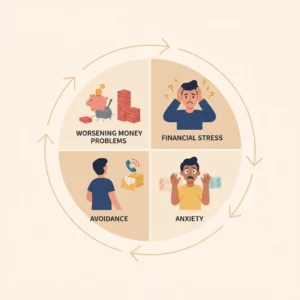
This paradox, feeling anxious about doing something objectively responsible, makes sense once you consider that financial decisions have never been purely rational or purely private. Money carries enormous social and emotional weight, tied up with status, belonging, and self-worth in ways that go well beyond simple arithmetic.
Choosing to set a financial boundary out loud means confronting all of that emotional weight directly, rather than allowing a vague excuse to quietly absorb it on your behalf, which is precisely what makes the practice feel so much more difficult than simply managing a budget privately ever did.
The Social Comparison Mechanism at Play
Visible spending has functioned as a social signal for a very long time, communicating status, belonging, and shared values within a group long before social media existed to amplify it. Choosing to publicly opt out of that signal, by declining an expensive outing or naming a financial limit directly, can trigger a very old and very deep fear of social exclusion, one rooted in genuine evolutionary stakes around group belonging.
For most of human history, being excluded from a group carried real survival consequences, and while modern social exclusion rarely carries the same literal stakes, the underlying fear response hasn’t updated to reflect that shift.
This is part of why loud budgeting, even when handled calmly and confidently, can still trigger a disproportionate wave of anxiety beforehand. The nervous system isn’t just weighing the financial trade-off of an expensive dinner; it’s also, often unconsciously, weighing the social risk of being perceived as different from the group, of potentially being seen as less fun, less successful, or less included going forward.
Recognizing that this fear has deep evolutionary roots, rather than reflecting anything true about your actual social standing, can make it easier to tolerate the discomfort without automatically treating it as an accurate signal that something is genuinely wrong.
Social media has almost certainly intensified this dynamic, since visible spending is no longer limited to in-person gatherings but is now broadcast continuously through photos, stories, and posts that create an ambient sense of what everyone else seems to be doing and affording.
This constant visibility raises the perceived stakes of any single decision to opt out, since declining one invitation can start to feel, however irrationally, like a visible departure from a norm that appears to be shared by an entire social circle, even when that appearance is itself a curated distortion rather than an accurate reflection of anyone’s actual finances.
Money Shame and Where It Often Comes From
For many people, loud budgeting anxiety doesn’t emerge from nowhere; it draws on earlier experiences and messaging around money that shaped how spending and saving came to feel emotionally loaded in the first place.
Someone who grew up in a household where money was a frequent source of tension or conflict may carry an association between financial limitation and instability, making any public acknowledgment of a budget feel less like a neutral fact and more like an admission of vulnerability. Someone who experienced genuine financial hardship at some point in adulthood may carry a similar association, even after their circumstances have since improved, since the emotional imprint of past scarcity tends to linger well beyond the practical resolution of the original situation.
Family messaging around money also plays a significant role, often operating below conscious awareness. A family that treated money as something private and even slightly taboo to discuss openly can pass that discomfort down, making any direct conversation about financial limits feel like a violation of an unspoken rule, regardless of how reasonable the boundary itself actually is.
Understanding where this discomfort originated doesn’t make it disappear instantly, but it does help separate the present-day anxiety from an accurate read of present-day risk, which is often a meaningful first step toward loosening its hold.
Cultural background can also shape how loud budgeting anxiety is experienced, since attitudes toward openly discussing money vary considerably across different communities and upbringings. In some cultural contexts, direct conversation about financial limits is entirely ordinary and unremarkable, while in others, money is treated as an intensely private matter, discussed only in hushed tones if at all.
Someone raised in the latter environment may find loud budgeting requires unlearning a much deeper and more longstanding norm than the trend itself acknowledges, which helps explain why the practice can feel considerably harder for some people than the simple, breezy framing often suggests.
How Loud Budgeting Anxiety Shows Up in the Body and Mind
The anticipation leading up to declining an invitation is often where loud budgeting anxiety is felt most intensely, sometimes more intensely than the actual moment of declining itself. Racing thoughts frequently precede the conversation, running through various phrasings, anticipating possible reactions, and rehearsing responses to questions that may never even come up.

This anticipatory anxiety can consume disproportionate mental energy relative to the actual financial stakes involved, since a modestly priced dinner invitation can trigger the same kind of internal rehearsal usually reserved for genuinely high-stakes conversations.
An urge to over-explain often follows close behind, showing up as a tendency to offer far more detail than the situation actually calls for, providing context about savings goals, recent expenses, or broader financial circumstances that nobody explicitly requested.
This over-explaining often functions as a kind of preemptive defense, an attempt to justify the boundary so thoroughly that it becomes unquestionable, even though a simple, brief statement would usually suffice. After the conversation ends, a lingering worry about how the decision landed frequently persists, sometimes for hours or even days, with the mind replaying the other person’s tone or facial expression, searching for confirmation that the boundary was received badly, whether or not any such confirmation actually exists.
Physical sensations often accompany this mental pattern as well, including a tightening in the chest or stomach in the moments before declining an invitation, a racing heartbeat while typing out a message, or a wave of relief so strong once the message is finally sent that it becomes clear, in retrospect, just how much tension had been building beforehand.
These physical responses are a useful signal in their own right, since their intensity often reveals just how much emotional weight has quietly attached itself to what is, functionally, a fairly ordinary financial decision.
The Difference Between Loud Budgeting and Financial Avoidance
It’s worth distinguishing genuine, confident loud budgeting from a pattern that can look similar on the surface but actually reflects something quite different underneath: financial avoidance dressed up in the trend’s language. Confident financial boundaries tend to come from a place of clarity, a person genuinely knows their financial goals and communicates limits calmly, without excessive apology or defensiveness, because the decision feels settled rather than fraught.
Anxiety-driven financial avoidance, by contrast, often involves declining spending not from a place of clear values but from a place of underlying fear, sometimes generalized financial anxiety that has little to do with the actual affordability of any specific expense in question.
The distinction matters because the two require somewhat different responses. Genuine loud budgeting generally just needs practice and repetition to feel more natural over time.
Financial avoidance rooted in anxiety often benefits from examining the underlying fear more directly, sometimes with professional support, since simply repeating the boundary-setting behavior without addressing the anxiety underneath it can leave the emotional discomfort largely unchanged even as the external behavior becomes more consistent.
When Financial Anxiety Points to Something Deeper
For some people, the anxiety generated by loud budgeting conversations doesn’t stay contained to those specific moments, but instead reflects a broader pattern of financial anxiety that shows up across many areas of daily life, from checking bank balances compulsively to feeling persistent dread about routine expenses that are genuinely well within budget.
When financial anxiety becomes disproportionate to actual financial circumstances, and when it begins interfering with sleep, concentration, or overall quality of life, it’s worth considering whether something broader than a single social skill is at play.
This isn’t a suggestion that everyone who feels nervous about loud budgeting has an underlying anxiety disorder, since discomfort with a genuinely new social skill is entirely normal and typically improves with practice alone. But if the anxiety feels persistent, disproportionate, and resistant to improvement even after repeated practice, a conversation with a therapist can help clarify whether something deeper, perhaps rooted in past financial trauma or a broader anxiety pattern, deserves more focused attention.
It’s also worth paying attention to whether financial anxiety tends to cluster around specific triggers, such as group social settings, or whether it appears more broadly across nearly all financial decisions, including ones made entirely alone.
A more clustered, situation-specific pattern often responds well to the practical boundary-setting strategies discussed here. A more pervasive pattern, one that colors nearly every financial decision regardless of social visibility, more often points toward a broader relationship with money and scarcity that may benefit from deeper exploration, ideally with professional support that can address the root pattern rather than just its most visible symptom.
Building Genuine Confidence Around Financial Boundaries
Confidence around financial boundaries tends to grow most reliably when boundary-setting gets reframed internally as an act of self-respect rather than an act of deprivation.
This reframing takes real repetition to settle in, and it rarely happens simply by hearing the idea once and deciding to believe it. Each time a boundary is stated and the anticipated disaster fails to materialize, the nervous system collects a small piece of new evidence that the fear was larger than the actual outcome warranted. Over enough repetitions, this accumulated evidence gradually recalibrates the automatic anxious response, even if no single instance feels like a dramatic turning point on its own.
This shift in framing isn’t just a motivational slogan; it reflects a genuine difference in how the nervous system processes the decision, since a boundary experienced as self-respecting tends to generate far less anxiety than the same exact boundary experienced as a painful sacrifice being forced upon you by unfortunate circumstances.
Practicing brief, non-defensive responses in advance can also help significantly, since having a simple, prepared phrase ready reduces the cognitive load of having to construct an explanation in the moment, which is often where anxiety tends to spike the most.
Separating self-worth from spending choices is perhaps the deepest and slowest piece of this work, but it’s also the piece that ultimately makes the most lasting difference. This means gradually internalizing the understanding that declining an expensive outing says absolutely nothing meaningful about your value as a friend, partner, or person, even though the anxious part of the brain may insist otherwise in the moment.
Building this kind of internal security often takes repeated practice and, for many people, genuinely benefits from the outside perspective of a therapist, particularly one experienced in the psychology of money, self-worth, and social anxiety. Over time, though, what once felt like a terrifying admission tends to become simply a fact stated plainly, no more emotionally loaded than mentioning any other personal preference.
It can also help to remember that most people, when they actually stop to consider it, respect direct honesty about financial limits far more than they respect a vague excuse they can sense isn’t quite true. A calmly stated boundary tends to model a kind of confidence that others often quietly admire, even if they don’t say so explicitly in the moment, and it frequently gives other people in the group implicit permission to be more honest about their own financial limits as well, creating a small ripple effect that makes the entire social circle a little easier for everyone to navigate honestly.
FAQ
Is loud budgeting actually good for mental health? Yes, in the long run, since openly communicating financial limits tends to reduce the chronic stress of financial avoidance and overspending, even though the practice can feel uncomfortable at first while confidence is still developing.
Why do I feel guilty saying no to spending? Guilt often stems from deep-rooted associations between spending and social belonging, along with earlier messaging about money from family or past financial hardship, rather than reflecting anything actually wrong with the boundary itself.
Is loud budgeting anxiety a form of social anxiety? It can overlap with social anxiety, particularly the fear of judgment or exclusion, though it’s a more specific response tied directly to the visibility and vulnerability of financial disclosure rather than social interaction in general.
How do I set financial boundaries without over-explaining? Practicing a brief, simple phrase in advance, such as directly stating that something isn’t in the budget right now, reduces the pressure to justify the decision extensively in the moment.
Can financial anxiety affect friendships? It can, particularly if unaddressed anxiety leads to either overspending to avoid discomfort or withdrawing from social plans altogether, so addressing the anxiety directly often protects relationships rather than straining them.
Is it normal to feel judged for budgeting openly? Some initial discomfort is common given how socially loaded money has historically been, but most people find that reactions to a calmly stated financial boundary are far less negative in reality than anticipated beforehand.
Conclusion
If declining spending has been quietly stressing you out more than the actual expense ever would, that reaction makes complete sense given how deeply money is tied to social belonging, family history, and self-worth. The anxiety you feel isn’t a sign you’re doing something wrong; it’s a sign you’re doing something that genuinely takes courage, even when it’s also the financially responsible choice. With practice, and often with a good deal of self-compassion along the way, stating a financial boundary can shift from feeling like a confession to feeling like exactly what it always should have been: a simple, ordinary fact about your life that requires no apology at all.