Quick Answer: What is Perseverative Cognition?Perseverative cognition is the continuous, uncontrollable replaying of negative thoughts, fears, or past conversations without reaching a resolution.
|
Perseverative cognition is the clinical term for a mind that continuously replays distressing thoughts, conversations, or fears long after the triggering event has passed. Unlike standard problem-solving, which moves the mind toward a resolution, perseverative cognition traps the brain in a rigid, repetitive mental loop.
First formalized in 2006 by health psychologists Jos Brosschot, Wilmar Gerin, and Julian Thayer, the perseverative cognition hypothesis revolutionized how clinical psychology views stress. They argued that it is not just the stressful event itself that damages physical and mental health, but the continuous mental rerun of that event, which keeps the body’s stress response chronically activated. Today, this mechanism sits at the center of psychiatric research into anxiety, depression, trauma, and autonomic nervous system dysfunction.
Understanding the Loop: Rumination vs. Worry vs. Cognitive Perseveration
People often use the terms “rumination” and “overthinking” interchangeably, but clinical psychology draws distinct lines between these concepts. Understanding which specific cognitive loop you are experiencing is the critical first step toward effective treatment.
| Term | Time Orientation | Core Emotion | Primary Clinical Association |
| Worry | Future-oriented (“What if?”) | Anxiety, Fear | Generalized Anxiety Disorder (GAD) |
| Rumination | Past-oriented (“Why did I?”) | Regret, Sadness, Shame | Major Depressive Disorder (MDD) |
| Cognitive Perseveration | Present/Ongoing | Frustration, Rigidity | OCD, ASD, ADHD |
A clear real-world example of worry involves replaying an upcoming job interview for days, mentally rehearsing every answer, and inventing new ways it could go badly. Conversely, dwelling on a past argument with a partner and obsessing over what you should have said is a classic example of what are rumination thoughts. Both of these cycles are typically sustained by cognitive distortions—such as catastrophizing and black-and-white thinking—making the thought feel incredibly urgent even though revisiting it resolves nothing.
The Physiological Impact of Repetitive Thinking
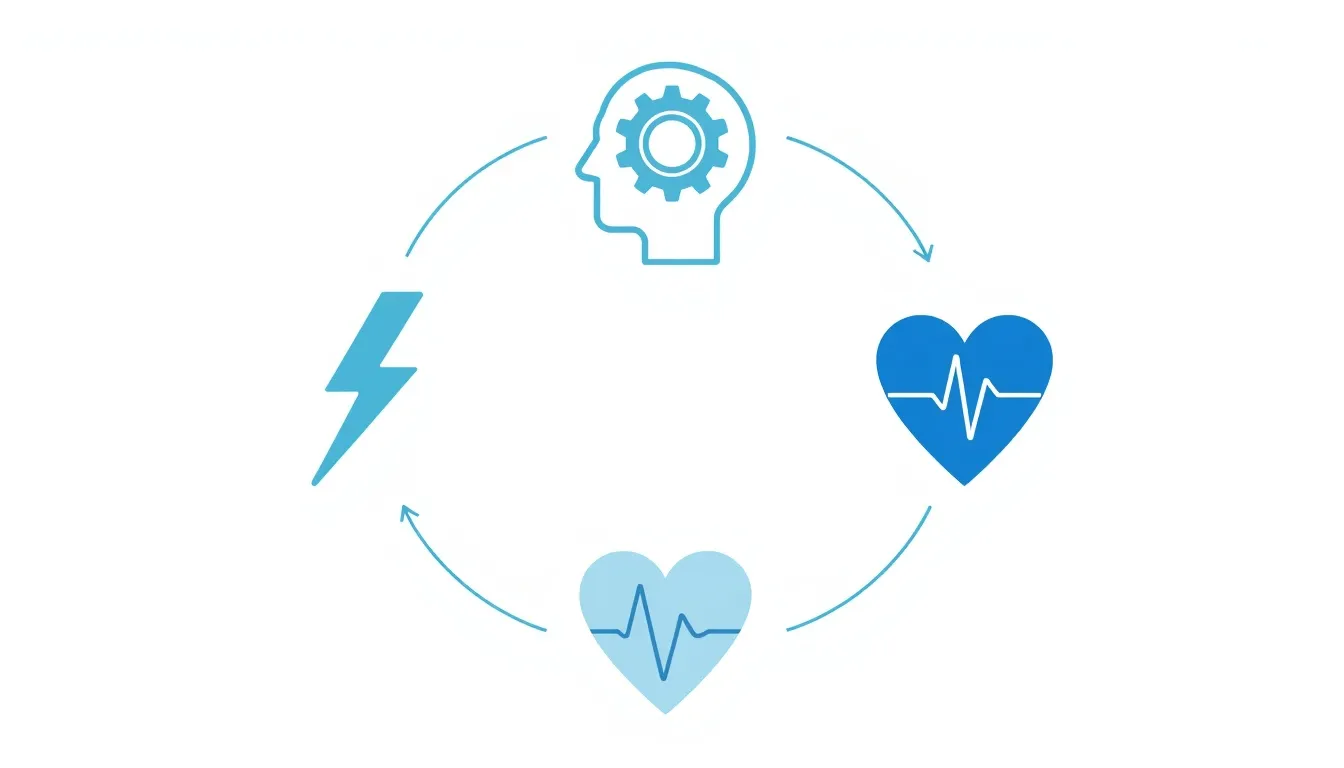
Perseverative cognition is not just mentally exhausting; it is a physiologically expensive process that takes a severe toll on the body. Because the human nervous system struggles to distinguish between an imagined threat and a physical one, mentally rehearsing a stressor keeps the body locked in a prolonged state of fight-or-flight arousal.
A comprehensive meta-analysis of sixty distinct studies confirmed that perseverative cognition is directly linked to elevated cortisol levels resulting from the chronic activation of the adrenal glands. Furthermore, patients demonstrate sustained increases in both systolic and diastolic blood pressure, alongside lower heart rate variability (HRV). This reduction in HRV is particularly concerning because it reflects suppressed activity in the vagus nerve, the primary neural pathway responsible for shifting the body back into a resting state. Over time, this unresolved physiological tension directly leads to severe somatic anxiety symptoms, disrupted sleep architecture, and significantly weakened immune function.

Perseverative Cognition in Autism and ADHD
While perseverative cognition is a transdiagnostic process occurring across many different mental health conditions, it presents uniquely in neurodivergent individuals.
In autistic profiles, cognitive perseveration frequently overlaps with restricted and repetitive behaviors. An autistic individual may repeatedly return to the same topic, memory, or question, but this is not always driven by anxiety. Often, the repetition serves as a regulatory, predictable, and self-soothing mechanism. The clinical goal of support in these cases is rarely to eliminate the repetition entirely, but rather to build cognitive flexibility so that the behavior does not impede daily task transitions.
In Attention-Deficit/Hyperactivity Disorder (ADHD), this cognitive pattern usually manifests as hyperfocus. Due to fundamental differences in executive functioning, a person with ADHD may find their attention entirely “stuck” on a specific distressing thought or task, finding themselves unable to consciously disengage. This profound difficulty in shifting attention often fuels severe adult ADHD emotional dysregulation and rapid decision fatigue.
Recent Advancements in Clinical Research
Psychiatric understanding of repetitive negative thinking is evolving rapidly, with recent academic milestones significantly reshaping modern clinical approaches. A 2025 ecological momentary assessment study tracked adults multiple times a day and discovered a bidirectional relationship between attention and overthinking. The research demonstrated that difficulty concentrating and repetitive negative thought actively feed each other in a continuous loop, proving that improving basic attentional control can reduce repetitive thinking just as effectively as traditional talk therapy.
Additionally, a 2025 model published in Dialogues in Clinical Neuroscience redefined perseverative thinking as a self-regulatory strategy that has misfired. The mind continuously searches for a resolution to an abstract problem, but the constant repetition actually updates the brain’s memory systems, causing the individual to view future neutral situations as threats requiring the exact same exhausting mental processing.
Evidence-Based Treatments to Quiet the Mind
Clinical psychology offers several highly effective, evidence-based frameworks to break the cycle of perseverative cognition without relying on simple thought suppression, which frequently backfires.
Standard cognitive therapy has been specifically adapted by researcher Edward Watkins into Rumination-Focused CBT (RF-CBT). Instead of merely analyzing why a thought is happening, specialized CBT for anxiety techniques train patients to notice the exact moment their brain shifts from useful problem-solving to abstract looping, allowing them to deliberately redirect their focus toward concrete, actionable steps. Another highly effective approach is Acceptance and Commitment Therapy (ACT), which utilizes a technique called cognitive defusion. Rather than fighting a distressing thought, patients learn to neutrally observe it as transient mental noise, directly neutralizing the brain’s false belief that thinking harder will eventually yield a satisfying answer.
Behavioral interventions also play a critical role, particularly the worry postponement technique. This strategy requires a person to briefly acknowledge a perseverative thought but consciously delay engaging with it until a pre-scheduled, fifteen-minute window later in the day. This effectively breaks the compulsive habit of immediately indulging managing intrusive thoughts. Finally, because the body remains in a state of high alert, these cognitive therapies must be paired with somatic nervous system regulation. Practices such as extended-exhale breathing, cold exposure, and aerobic exercise physically stimulate the vagus nerve, lowering cortisol and raising HRV to pull the body out of its stress response.
When to Seek Professional Support
Occasional overthinking after a stressful event is a normal human experience that typically resolves on its own. However, you should consult a licensed psychologist or psychiatrist if your repetitive thinking lasts for the majority of the day for two weeks or longer. Professional evaluation is particularly critical if this cognitive loop is accompanied by panic attacks, insomnia, persistent physical pain, or if it significantly disrupts your ability to function at work, school, or in personal relationships. Perseverative cognition is a well-documented physiological and neurological process, not a character flaw, and the brain can be successfully rewired for resilience with proper intervention.
Frequently Asked Questions (FAQ)
What is an example of perseverative cognition?
Replaying a difficult conversation for days, mentally rehearsing every possible outcome of an upcoming event, or being unable to stop thinking about a past mistake are all core examples. The thinking repeats continuously without resolving the issue or leading to constructive action.
What is the difference between perseverative cognition and rumination?
Rumination is a specific subset of perseverative cognition that focuses exclusively on past events and losses, making it strongly linked to clinical depression. Perseverative cognition is the broader umbrella term that also encompasses forward-looking worry and anxious mind-wandering.
How is perseverative cognition measured?
Clinicians and researchers most commonly measure this utilizing the Perseverative Thinking Questionnaire (PTQ-15). It is a validated, fifteen-item self-report scale designed to measure how intrusive and difficult-to-stop a patient’s thoughts have been over the past two weeks.
Is perseverative cognition the same as OCD?
No, they are distinct concepts. Obsessive-Compulsive Disorder (OCD) involves intrusive thoughts paired with specific physical or mental compulsions performed to reduce distress. While perseverative cognition occurs within OCD, it is also a primary driver of generalized anxiety, depression, and PTSD.
Can perseverative cognition damage physical health?
Yes, chronic repetitive thinking is scientifically linked to sustained increases in blood pressure, resting heart rate, and cortisol levels. By keeping the nervous system locked in a prolonged state of stress activation, it can significantly increase cardiovascular risk and weaken immune function over time.
Is cognitive perseveration more common in autism or ADHD?
It occurs frequently in both profiles but operates through entirely different neurological mechanisms. In autism, it is often tied to a need for routine, predictability, and intense special interests. In ADHD, it typically appears as hyperfocus, driven by an executive functioning difficulty in disengaging attention from a highly stimulating thought.
How long does an episode of perseverative cognition last?
A standard episode following a daily stressor typically fades within a few hours to a few days as the nervous system naturally settles. When the mental looping persists daily for two weeks or longer and resists self-help techniques, it is usually tied to an underlying condition like GAD and requires professional evaluation.
How do you stop perseverative thinking?
The most effective clinical strategies include rumination-focused CBT, mindfulness-based attention training (MBCT), cognitive defusion from ACT, and scheduled worry postponement windows. Somatic regulation, such as cardiovascular exercise and vagus nerve stimulation, is equally critical for releasing the physical tension associated with the thoughts.
Medical Disclaimer & E-E-A-T AttributionThis article is for educational purposes and does not replace personalized medical or psychological advice. If you are recovering from a brain injury, trauma, or a mental health condition, work with a licensed clinician to build a plan suited to your situation. Written by: Adil Farooq, Psychiatry Magazine Medically reviewed by: [Dr. Adil Farooq MS · PhD] · Updated: 2026 |