Key Takeaways Quick Reference
-
Mental illness is highly hereditary but not genetically guaranteed. Most disorders are polygenic, meaning they are caused by thousands of small genetic variants working together, not a single ‘bad’ gene.
-
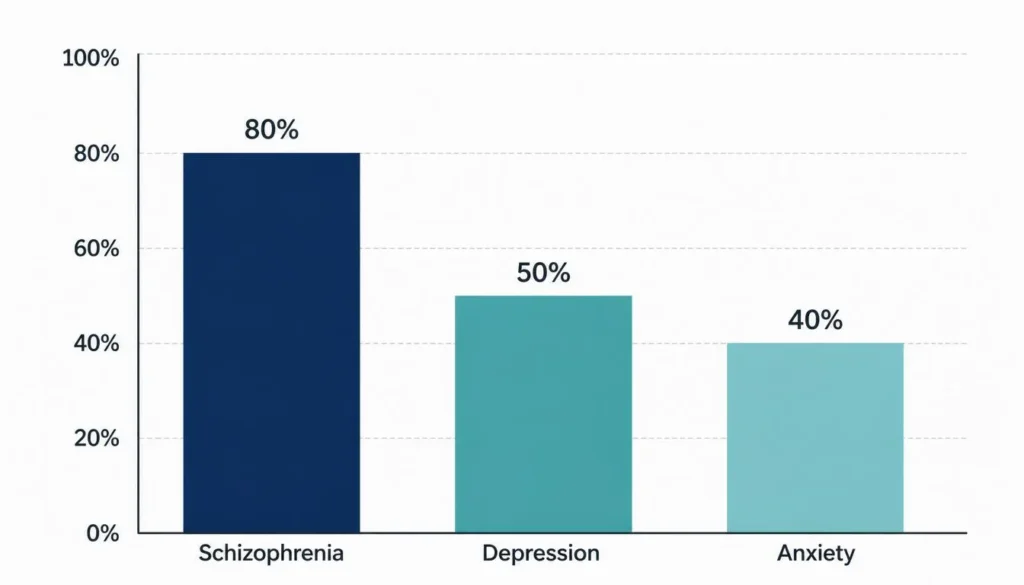
Heritability ranges widely: Schizophrenia (~80%), Bipolar Disorder (~70–80%), ADHD (~70–80%), ASD (~60–90%), Major Depression (~40–50%), and Anxiety (~30–40%).
-
Environment is equally critical: Through epigenetics, trauma, stress, and lifestyle choices can activate or suppress genetic vulnerabilities without changing your underlying DNA sequence.
-
Pharmacogenomics is transforming treatment: Genetic tests (like GeneSight) now allow psychiatrists to match the exact medication to your DNA, ending years of trial-and-error prescribing.
-
Your genes are not your destiny. Evidence-based interventions, including therapy and lifestyle changes, can override genetic risk factors in most cases.
“Will my children inherit my depression?”.
This question, spoken in therapy offices and whispered in family conversations around the world, represents one of the most urgent concerns in modern psychiatry “Is mental illness genetic”. The answer is nuanced and ultimately hopeful, but it requires understanding the complex science of psychiatric genetics.
Mental health disorders—including depression, schizophrenia, bipolar disorder, ADHD, and anxiety—are heavily influenced by genetics, but they are not simply “inherited” the way eye color or blood type is. They emerge from a complex interplay of hundreds of genetic variants, environmental triggers, and epigenetic mechanisms that science is only now beginning to fully decode.
The Myth of the “Mental Illness Gene”
When people think of genetic diseases, they often imagine conditions like Huntington’s disease or Cystic Fibrosis, where a single mutated gene guarantees the condition. Mental health does not work this way.
There is no single “schizophrenia gene” or “depression gene”. Instead, psychiatric disorders are polygenic. This means they are caused by the combined effect of hundreds, or even thousands, of tiny genetic variations across your entire genome. Individually, these variations do almost nothing. Together, they create a cumulative vulnerability.
In clinical research today, doctors use Polygenic Risk Scores (PRS). By scanning a patient’s DNA, doctors can calculate a single score that indicates their genetic liability for developing severe psychiatric conditions compared to the general population. While PRS is not yet used to diagnose patients definitively, it is a groundbreaking tool for early intervention and predicting which medications might work best.
Which Mental Illnesses Are Most Genetic?
To truly understand genetic risk, scientists look at heritability—a metric that estimates how much of a condition’s variation within a population is due to genetics versus environmental factors. These estimates largely come from large-scale twin studies, comparing identical twins (who share 100% of their DNA) with fraternal twins (who share roughly 50%).
Comprehensive Heritability Reference (2026 Evidence Base):
-
Schizophrenia: ~80% heritability (Key genes: COMT, DISC1, NRG1, MHC region).
-
Bipolar Disorder: ~70–80% heritability (Key genes: CACNA1C, ANK3).
-
Autism Spectrum Disorder (ASD): ~60–90% heritability (Key genes: CHD8, SHANK3).
-
ADHD: ~70–80% heritability (Key genes: DRD4, DAT1/SLC6A3).
-
Major Depressive Disorder: ~40–50% heritability (Key genes: 5-HTTLPR, BDNF, MTHFR).
-
Generalized Anxiety Disorder: ~30–40% heritability (Key genes: MTHFR, RBFOX1).
Schizophrenia and Bipolar Disorder share a significant amount of genetic overlap and exhibit the highest heritability rates in psychiatry. If one identical twin has schizophrenia, the other has a roughly 50% chance of developing it. This proves genetics are a massive factor, but also proves that environment still plays a crucial role—otherwise, the rate would be 100%.
While depression and anxiety absolutely run in families, their heritability is lower. This means your environment, life experiences, and trauma play a comparatively larger role in triggering these conditions than your DNA alone.
Epigenetics: How Trauma “Turns On” Genes
If genetics loads the gun, the environment pulls the trigger. This mechanism is called epigenetics.
Epigenetics is the study of how your behaviors and environment can cause changes that affect the way your genes work. Unlike genetic mutations, epigenetic changes are reversible and do not change your fundamental DNA sequence. Instead, through a process called DNA methylation, chronic stress can literally attach chemical tags to your DNA, turning specific mental health risk genes “on” or “off”.
-
Childhood Trauma: Severe early-life stress can alter the epigenetic regulation of the hypothalamic-pituitary-adrenal (HPA) axis—the system that controls your body’s reaction to stress. This can leave a person permanently hyper-vigilant.
-
Substance Abuse: Chronic alcohol or drug use can trigger epigenetic shifts that activate dormant genetic risks for mood disorders.
The MTHFR Gene Mutation
One specific genetic anomaly that severely impacts mental health is the MTHFR gene mutation, present in approximately 10–15% of the population.
The MTHFR gene produces an enzyme essential for processing folate into its active form, methylfolate. Methylfolate is what the brain uses to synthesize critical neurotransmitters like serotonin and dopamine. When this gene is mutated, patients suffer a functional folate deficiency in the brain. This leads to a significantly higher risk for severe anxiety and treatment-resistant depression because standard SSRIs are less effective without adequate methylfolate.
Pharmacogenomics: Matching Medication to Your DNA
The most practical, transformative application of genetics in modern mental health care is pharmacogenomics.
Historically, prescribing an antidepressant or an antipsychotic was a frustrating process of trial and error. A patient might suffer through months of side effects on one drug, only to find it doesn’t work. This happens because individuals metabolize medications at dramatically different rates depending on their Cytochrome P450 (CYP450) liver enzymes.
Patients fall into three metabolizer types: poor, normal, or ultra-rapid. Today, utilizing tests like GeneSight, psychiatrists can swab a patient’s cheek to analyze these exact enzymes. This genetic data tells the doctor exactly how quickly or slowly your body will metabolize specific psychiatric medications, allowing them to immediately prescribe the medication you are biologically wired to accept.

What to Do If Mental Illness Runs in Your Family
If you have a strong family history of psychiatric conditions, the data can feel overwhelming. However, understanding your genetic risk is empowering, not a life sentence. Here are actionable steps you can take:
-
Map Your Family History: Speak openly with relatives about their mental health diagnoses and which medications worked for them, as medication response is also hereditary.
-
Focus on Epigenetic Health: Because conditions like depression require an environmental trigger, focusing on stress reduction, strict sleep hygiene, and avoiding recreational drugs can keep genetic vulnerabilities dormant.
-
Seek Genetic Counseling: Speak with a specialized clinical consultant or a genetic counselor to understand your risk profile. If you are experiencing treatment resistance, ask your psychiatrist about pharmacogenomic testing.
-
Access Therapy Early: Therapy is neurobiologically active. Starting early therapeutic intervention is one of the strongest protective factors against the expression of inherited genetic vulnerabilities.
Frequently Asked Questions (FAQ)
Is mental illness 100% genetic?
No. Mental illness is not 100% genetic. Even conditions with the highest heritability rates, like schizophrenia, have identical twin concordance rates of only 40–50%. Genetics creates susceptibility; environment determines expression.
Is anxiety genetic or learned behavior?
Both, in roughly equal measure. Genetic studies suggest anxiety disorders are about 30% to 40% heritable. However, environmental factors, chronic stress, and learned coping mechanisms from parents significantly contribute to its development.
Does the MTHFR gene mutation cause depression?
It does not directly cause depression, but it can significantly increase vulnerability to treatment-resistant depression and anxiety by impairing the brain’s production of serotonin and dopamine.
Can you prevent a hereditary mental illness?
While you cannot alter your inherited DNA, you can heavily influence your epigenetic expression. Proactive therapy, robust stress management, healthy sleep hygiene, and avoiding substance abuse can prevent, delay, or significantly lessen the severity of genetic psychiatric conditions