Key Takeaways: What You Need to Know
- The Reality of Free Care: Completely free, unlimited marriage counseling with a licensed clinical specialist does not typically exist on private telehealth platforms.
- Top Legitimate Free Avenues: Employee Assistance Programs (EAPs), university graduate training clinics, non-profit community health centers, and faith-based counseling offer genuine free or near-free sessions.
- DIY At-Home Interventions: Couples can implement evidence-based psychological frameworks, such as the Gottman “State of the Union” meeting and active listening exercises, at zero cost.
- When to Upgrade: Deep-rooted issues such as chronic infidelity, severe trauma, or impending separation usually require transitioning from free community resources to dedicated, paid clinical therapy for lasting resolution.
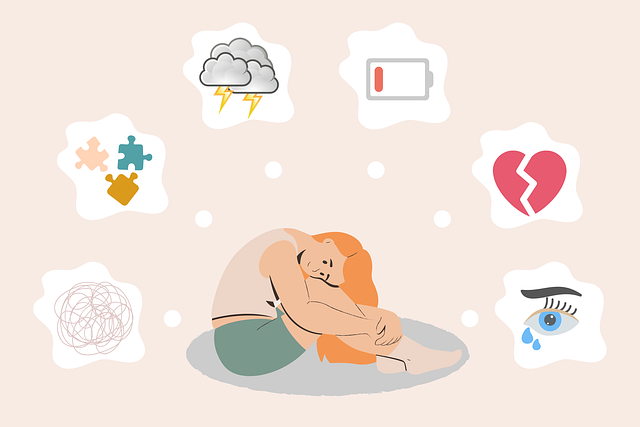
Financial pressure is statistically one of the primary catalysts for marital conflict. When a relationship reaches a point of severe strain, the added burden of paying hundreds of dollars for private therapy can feel impossible. For couples in this position, searching for free online marriage counseling is often the first, necessary step toward stabilizing their partnership.
However, the digital mental health landscape is complex. A quick search reveals thousands of websites promising “free counseling,” but many are lead-generation traps, brief credit-card trials, or forums staffed by untrained volunteers rather than licensed medical professionals.
This educational guide explores the reality of finding legitimate free resources online, details evidence-based DIY relationship exercises you can do at home, and explains the clinical limits of unpaid care.
Does Completely Free Online Marriage Counseling Exist?
To set realistic expectations for your relationship recovery, it is vital to distinguish between clinical therapy and peer support.
Licensed Marriage and Family Therapists (LMFTs), Licensed Clinical Social Workers (LCSWs), and doctoral-level clinical psychologists undergo thousands of hours of supervised training. Because of the high operational costs of maintaining clinical licenses and HIPAA-compliant telehealth platforms, finding a private clinician who offers unlimited, one-on-one free therapy is exceedingly rare.
When evaluating free couples counseling options online, services generally fall into four distinct categories:
- Institutional Free Care: Employer-sponsored benefits (EAPs) or government-funded programs that pay licensed clinicians on your behalf. (High Quality, Limited Sessions).
- Supervised Clinical Training: University graduate clinics where advanced therapy students treat couples under the direct supervision of licensed professors. (High Quality, Low/No Cost).
- Faith-Based & Non-Profit Services: Pastoral or community-led mediation. (Variable Quality, Free).
- Peer Support & Forum Groups: Online communities where couples share experiences. These offer emotional validation but do not constitute psychological treatment. (Non-Clinical, Free).
The Top 4 Legitimate Free (and Low-Cost) Avenues
If out-of-pocket therapy is currently impossible for your household budget, the following avenues provide legitimate, professional, or semi-professional support without the steep price tag.
1. Employee Assistance Programs (EAPs)
One of the most underutilized resources for free counseling is your (or your partner’s) workplace. An Employee Assistance Program is an employer-sponsored benefit that provides confidential, short-term counseling at zero cost to employees and their dependents.
Most mid-to-large companies cover 3 to 8 free sessions per incident per year. EAPs partner with licensed private-practice clinicians who conduct sessions via secure video calls. You do not need to disclose the nature of your marital distress to your manager; EAP usage is strictly protected by federal HIPAA privacy regulations.
2. University Graduate Training Clinics
Universities offering accredited Master’s or Doctoral degrees in Marriage and Family Therapy (MFT) or Clinical Psychology frequently operate community training clinics.
Advanced graduate students conduct therapy under the live supervision or video-review oversight of licensed faculty professors. Since 2020, most university clinics have expanded their services statewide via telehealth. Services are either completely free or billed on a nominal sliding scale based on income (often $5 to $20 per session), making this a highly accessible option for comprehensive care.
3. Federally Qualified Health Centers (FQHCs)
Community Mental Health Centers (CMHCs) and FQHCs receive federal funding to provide mental health services regardless of a patient’s ability to pay. These centers offer income-based sliding fee scales. If your household income falls below the federal poverty line, sessions are frequently provided for $0. The Substance Abuse and Mental Health Services Administration (SAMHSA) offers a free online treatment locator to find federally supported health centers in your state.
4. Faith-Based and Pastoral Counseling Networks
Many churches, synagogues, and mosques provide free marriage counseling to their congregants and local community members. Pastoral counselors excel at offering empathetic, values-centered mediation and communication support.
However, it is important to distinguish between spiritual guidance and clinical treatment. If you are examining the medical differences between a therapist vs. psychiatrist, remember that pastoral counselors generally do not hold clinical state licenses unless they explicitly possess dual LMFT credentials.
Free DIY Marriage Counseling: At-Home Exercises That Work
You do not always need to sit in front of a clinician to begin repairing your relationship. Clinical psychology research demonstrates that implementing structured, evidence-based communication frameworks at home can significantly reduce marital conflict at zero cost.
Exercise 1: The Gottman “State of the Union” Meeting
Developed by renowned relationship researchers Drs. John and Julie Gottman, this weekly 30-minute structured conversation prevents small resentments from escalating into major crises.
- Start with Appreciation (5 Minutes): Each partner shares specific things they appreciated about the other during the past week.
- Discuss What Went Well (10 Minutes): Highlight positive moments in the relationship.
- Process One Issue (15 Minutes): Pick one gentle topic of friction. Use “I-statements” (e.g., “I felt overwhelmed when…”) rather than accusatory “You-statements” (e.g., “You never help…”).
Exercise 2: The Speaker-Listener Technique
Derived from Prevention and Relationship Education Program (PREP) research, this exercise is designed to remove defensive reactions during heated discussions.
- The Speaker: Holds a designated object (like a notepad). They may only speak using “I-statements” describing their feelings, not their partner’s flaws.
- The Listener: Must summarize what they heard before responding. They cannot defend themselves, argue, or point out flaws in the speaker’s logic. They simply paraphrase the speaker’s emotional state until the speaker says, “Yes, that is exactly what I meant.” Only then do they switch roles.

The Hidden Limits of Free Care
While utilizing free relationship counseling is an excellent entry point, relying on unpaid or short-term models for deep, structural relationship issues can carry hidden clinical risks.
- Premature Termination: Because EAP and non-profit programs frequently cap session counts (e.g., stopping after 5 visits), therapy often ends abruptly just as the couple begins opening up about deep historical wounds.
- Lack of Specialized Modalities: Complex issues like betrayal trauma, severe personality clashes, or sexual dysfunction require certified specialists trained in advanced frameworks like Emotionally Focused Therapy (EFT) or the Gottman Method. Free generalist clinics rarely have clinicians certified in these high-level, expensive modalities.
- Wait Times: Free community mental health resources often have waitlists stretching from three to six months. In a marital crisis, waiting half a year for intervention can be detrimental to the survival of the relationship.
When Is It Time to Transition to Professional Therapy?
Free resources are designed primarily for prevention, educational skill-building, and short-term crisis stabilization. In many cases, a relationship requires the dedicated focus of a private clinician.
Couples often transition from a free community resource to a dedicated, paid clinical specialist when their relationship exhibits deep-rooted indicators, such as:
- Infidelity and Betrayal Trauma: Rebuilding trust after emotional or physical affairs requires a structured, multi-stage clinical roadmap that cannot be achieved in a handful of free EAP sessions.
- Chronic Escalation: If daily interactions are dominated by criticism, contempt, defensiveness, or stonewalling, a specialized clinician is needed to intervene before emotional safety collapses completely.
- High-Conflict Separations: If a marriage has deteriorated to the point where divorce is actively being considered, free peer mediation is insufficient. In such cases, specialized divorced couples counseling is necessary to navigate co-parenting dynamics, legal boundaries, and emotional separation safely.
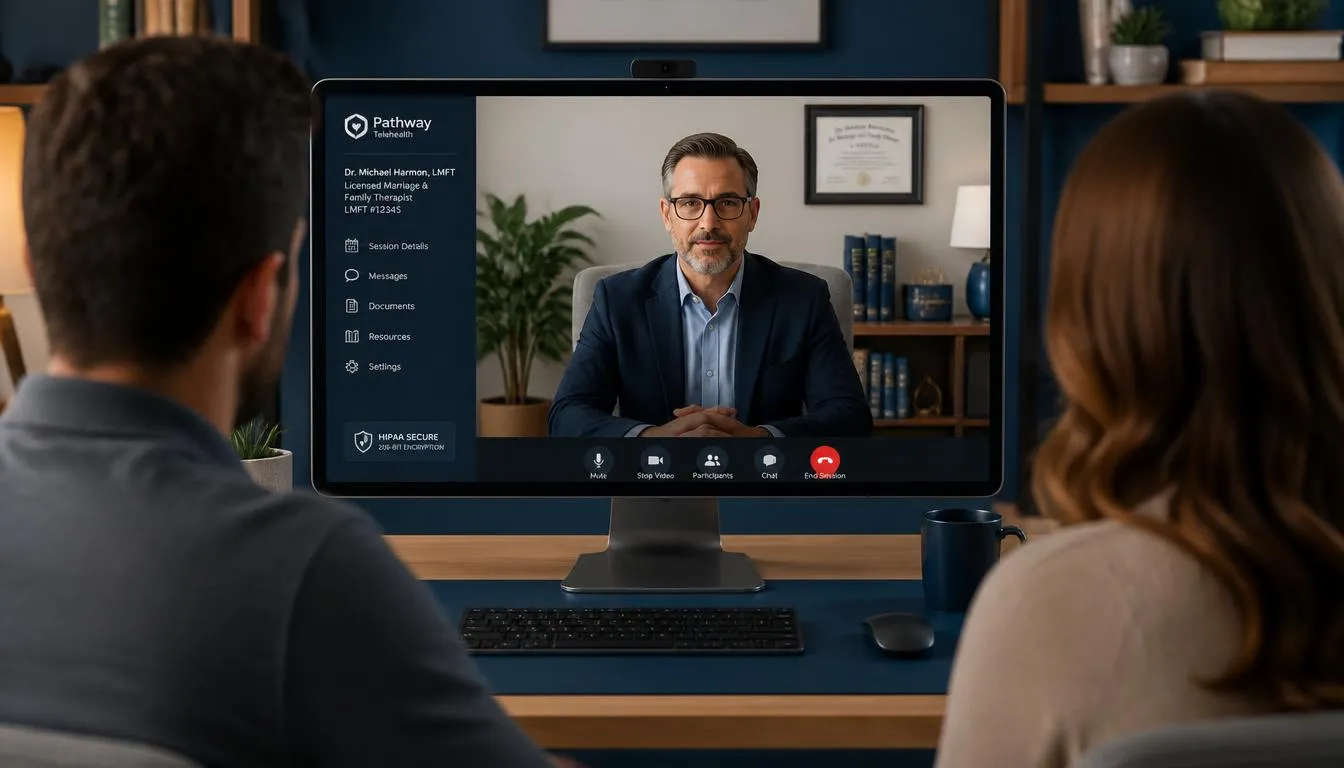
When couples decide to seek out private care, exploring a comprehensive online couples counseling guide can help them evaluate platform pricing, therapist credentials, and insurance reimbursement options. While out-of-pocket costs can be daunting, booking a specialized online couples relationship counselling session ensures you receive personalized, evidence-based care tailored specifically to your family’s long-term stability.
Frequently Asked Questions (FAQs)
Is a free 7-day online therapy trial worth it for couples?
Generally, no. A 7-day trial is barely enough time to complete intake paperwork and match with a provider. Real therapeutic progress requires consistency over weeks or months. Furthermore, many free trials automatically charge your credit card high monthly subscription fees if you forget to cancel before the week ends.
Does health insurance cover online marriage counseling?
Standard health insurance policies rarely cover couples therapy if the primary billing code is listed purely as a “relationship problem” (diagnostic code Z63.0). However, if one partner meets the diagnostic criteria for a mental health condition (such as Generalized Anxiety Disorder or Major Depression) and couples therapy is deemed medically necessary as part of their treatment plan, insurance may cover the sessions.
What is the difference between a marriage counselor and a pastoral counselor?
A licensed Marriage and Family Therapist (LMFT) holds a clinical Master’s or Doctoral degree, has completed thousands of hours of supervised clinical practice, and is legally regulated by a state medical board. A pastoral counselor is a religious leader offering moral and spiritual guidance, but is usually not licensed to diagnose or treat clinical disorders.
How do I ask my employer about EAP marriage counseling confidentially?
You do not need to speak directly to your manager. You can call your company’s HR benefits phone number or log directly into your third-party benefits portal. Ask specifically if the EAP covers outpatient telehealth couples counseling. Your usage of these benefits is protected by federal privacy laws.