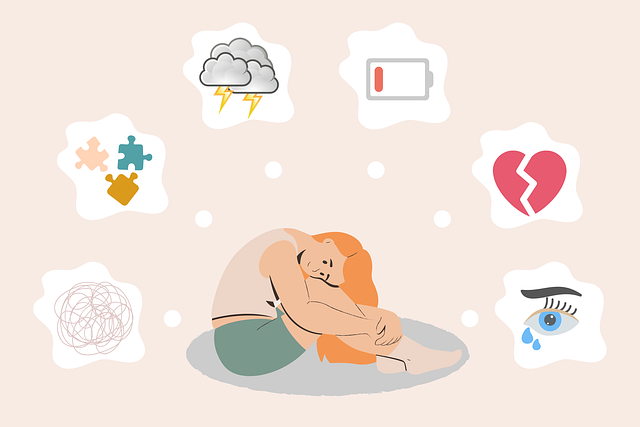
Trauma doesn’t only live in memory, it lives in the body. Long after a traumatic event has passed, survivors often carry it in a racing heart, a clenched jaw, disrupted sleep, or a nervous system that stays braced for danger. This insight is driving a meaningful shift in modern mental health care: pairing structured, evidence-based psychotherapy with holistic trauma therapy, body-centered and mind-body practices that help calm an overactivated nervous system and support deeper, more durable healing.
This guide explains what holistic trauma therapy is (and isn’t), the neuroscience behind why body-based practices work, and how modalities like somatic therapy, yoga, and acupuncture fit responsibly into an integrative care plan built around, not instead of, licensed clinical treatment.
| Quick Answer: Holistic trauma therapy pairs evidence-based treatments, such as EMDR and Trauma-Focused CBT, with body-centered, complementary practices including somatic therapy, trauma-sensitive yoga, acupuncture, breathwork, mindfulness, and expressive arts. These approaches target the autonomic nervous system directly, helping lower cortisol and improve heart rate variability (HRV). They are designed to support, not replace, professional trauma treatment. |
How Trauma Reshapes the Brain and Body
When a person experiences a traumatic event, the brain’s threat-detection system, centered in the amygdala, goes on high alert. At the same time, the hippocampus, which normally helps file memories with accurate time and context, can become less active, which is part of why traumatic memories often feel fragmented or perpetually present. The prefrontal cortex, responsible for reasoning and emotional regulation, can go comparatively quiet.
This threat response doesn’t switch off cleanly once danger has passed. The hypothalamic-pituitary-adrenal (HPA) axis can remain dysregulated, keeping cortisol, the body’s primary stress hormone, elevated well beyond the triggering event. Clinically, this shows up as hypervigilance, sleep disruption, intrusive memories, emotional numbing, or dissociation.

Trauma researchers increasingly describe this through the lens of the autonomic nervous system (ANS): a body oscillating between sympathetic activation (fight-or-flight) and dorsal vagal shutdown (freeze), with too little access to the calm, socially engaged “ventral vagal” state described in polyvagal theory. This is precisely the mechanism holistic and complementary therapies are designed to address.
What Is Holistic Trauma Therapy?
Holistic trauma therapy refers to a category of body-centered, mind-body, and lifestyle-based practices used to support trauma recovery alongside, never instead of, licensed clinical treatment. The term “holistic” reflects the underlying philosophy: trauma affects the whole person, nervous system, muscles, breath, sleep, and relationships, not just cognition, so recovery benefits from addressing more than thoughts and beliefs alone.
In a well-designed treatment plan, holistic care functions as one layer of integrative care: a coordinated model in which a licensed therapist or psychiatrist oversees evidence-based treatment, while complementary practices like somatic therapy, yoga, or acupuncture are layered in to support regulation, reduce physiological stress, and improve overall engagement in the healing process.
It’s worth being precise about language here. “Holistic” and “complementary” are not synonyms for “alternative” in the sense of replacing proven care. Responsible, trauma-informed treatment always positions these approaches as additive, not substitutive.
The Clinical Foundation: Why Evidence-Based Treatment Comes First
Before adding any complementary practice, it helps to understand the clinical foundation of trauma treatment. Eye Movement Desensitization and Reprocessing (EMDR) and Trauma-Focused Cognitive Behavioral Therapy (TF-CBT) are considered first-line, gold-standard treatments for PTSD, backed by decades of randomized controlled trials and endorsed by major clinical bodies, including the American Psychological Association and the World Health Organization.
These therapies work by directly helping the brain reprocess traumatic memories and correct the distorted beliefs trauma can leave behind, work that holistic practices are not designed to do on their own. Complementary approaches earn their place in a trauma recovery plan by supporting the nervous system so this deeper clinical work becomes more accessible and better tolerated, not by substituting for it.
Core Complementary and Holistic Modalities for Trauma Recovery
The modalities below represent the most clinically discussed complementary approaches used alongside trauma-focused psychotherapy. Each targets the nervous system through a different pathway, body, breath, movement, or creative expression.
Somatic Therapy: Releasing Trauma Held in the Body
Somatic therapy, including approaches like Somatic Experiencing, is built on the observation that trauma isn’t only stored as memory; it’s stored as unresolved physiological activation in the muscles, posture, and breath. Rather than focusing primarily on narrative, somatic therapists guide clients to notice body sensations directly, using techniques such as titration (working with small, manageable amounts of activation) and pendulation (moving attention between distress and a resourced, calmer state).
The goal is to help the nervous system complete a stress response that was interrupted at the time of the trauma, discharging stored survival energy instead of letting it remain locked in chronic tension, pain, or hyperarousal, a process explored in depth in this overview of body-focused therapy’s benefits for trauma and anxiety.
Trauma-Sensitive Yoga: Rebuilding a Felt Sense of Safety
Yoga, particularly trauma-sensitive or trauma-informed yoga, was developed specifically for trauma populations, using invitational, choice-based language instead of directive cues, and de-emphasizing physical correction or hands-on adjustment. Its core mechanism is improving interoception, the ability to accurately sense internal body signals like heart rate, muscle tension, and breath.
For trauma survivors, the body can feel like unpredictable or even unsafe territory. Gentle, consent-based movement helps rebuild trust in bodily sensation at a pace the nervous system can tolerate, gradually widening what trauma clinicians call the window of tolerance, the zone in which a person can experience stress without becoming overwhelmed or shutting down.
Acupuncture: Nervous System Regulation Through Traditional Chinese Medicine
Acupuncture, rooted in Traditional Chinese Medicine, involves inserting thin needles at specific points believed to influence the body’s energy pathways, or Qi. From a Western clinical research standpoint, several small studies, including work using the ear-based NADA protocol in veteran populations, have found associations between acupuncture and measurable reductions in cortisol, improved sleep, and modest reductions in PTSD symptom severity.
The evidence base for acupuncture in trauma care is still developing compared to somatic therapy or mindfulness, so it’s best positioned as a supportive, adjunct practice rather than a primary treatment, one many integrative clinics now offer alongside psychotherapy rather than in place of it.
Breathwork and Vagus Nerve Regulation
The vagus nerve is the primary highway of the parasympathetic nervous system, the body’s built-in braking system for stress. Its activity, often described as vagal tone, correlates closely with heart rate variability (HRV), a widely studied biomarker of nervous system resilience.
Simple breathwork practices, slow diaphragmatic breathing, extended exhales, and humming or chanting exercises, directly stimulate vagal activity, helping shift the body out of sympathetic (fight-or-flight) dominance and into a calmer, more regulated state. Because this mechanism is measurable and reproducible, breathwork is one of the most evidence-grounded entry points into holistic trauma care; a closer look at specific vagus nerve regulation techniques shows how accessible this practice can be, even in the middle of an acute stress response.
Mindfulness and Meditation-Based Approaches
Mindfulness-based interventions, including Mindfulness-Based Stress Reduction (MBSR), train present-moment, non-judgmental awareness, which can reduce the rumination and hypervigilance common after trauma. For trauma survivors specifically, mindfulness tends to work best when introduced gradually and paired with grounding techniques, since diving too quickly into open, unstructured awareness can occasionally intensify distressing sensations, another reason these practices work best under the guidance of a trauma-informed provider.
Expressive and Creative Therapies: Healing Without Words
Trauma often resists language, particularly when it occurred early in life or under extreme threat. Expressive and creative therapies, including art, music, and dance/movement therapy, offer a non-verbal pathway to process traumatic material that talk therapy alone may not fully reach. Creating something external and observable can also give survivors a sense of distance and control over difficult material, making it easier to approach safely. For a closer look at how these modalities work in practice, this guide to art and creative therapy breaks down specific techniques used in trauma-informed treatment settings.
Traditional vs. Holistic: A Side-by-Side Comparison
The table below summarizes how traditional clinical treatment and holistic complementary care differ, and where they intersect, within a well-designed trauma recovery plan.
| Dimension | Traditional Clinical Approaches | Holistic & Complementary Approaches |
| Primary Focus | Cognitive processing, memory reprocessing, and behavioral patterns | Nervous system regulation, bodily sensation, and breath |
| Examples | EMDR, TF-CBT, Prolonged Exposure, medication management | Somatic therapy, trauma-sensitive yoga, acupuncture, breathwork, art therapy |
| Delivery | Licensed therapist, structured protocol, largely verbal processing | Practitioner-guided or self-directed, often non-verbal and body-based |
| Evidence Base | Strong, supported by multiple randomized controlled trials | Emerging to moderate, growing research, mechanism-supported |
| Role in Recovery | Primary, first-line clinical treatment | Complementary, supportive adjunct |
| Best Used For | Directly processing traumatic memories and distorted beliefs | Calming the body and sustaining progress between sessions |
The Neuroscience Behind Integrative Trauma Care
The growing clinical interest in holistic trauma therapy isn’t rooted in replacing science with intuition, it’s rooted in an expanding evidence base connecting body-based practice to measurable nervous system change.
Heart rate variability (HRV), the variation in time between heartbeats, has become one of the most studied biomarkers in trauma research. Higher HRV generally reflects a nervous system with greater flexibility and capacity for self-regulation; chronically low HRV is associated with PTSD, anxiety, and poor stress recovery. Practices like breathwork, yoga, and somatic therapy have all been associated with improved HRV in controlled studies.
Similarly, dysregulation of the HPA axis and elevated baseline cortisol are well-documented features of chronic trauma exposure. Mind-body interventions that reliably lower cortisol are of particular clinical interest, since chronically elevated cortisol is linked not only to psychological symptoms but to cardiovascular and immune health risks over time.
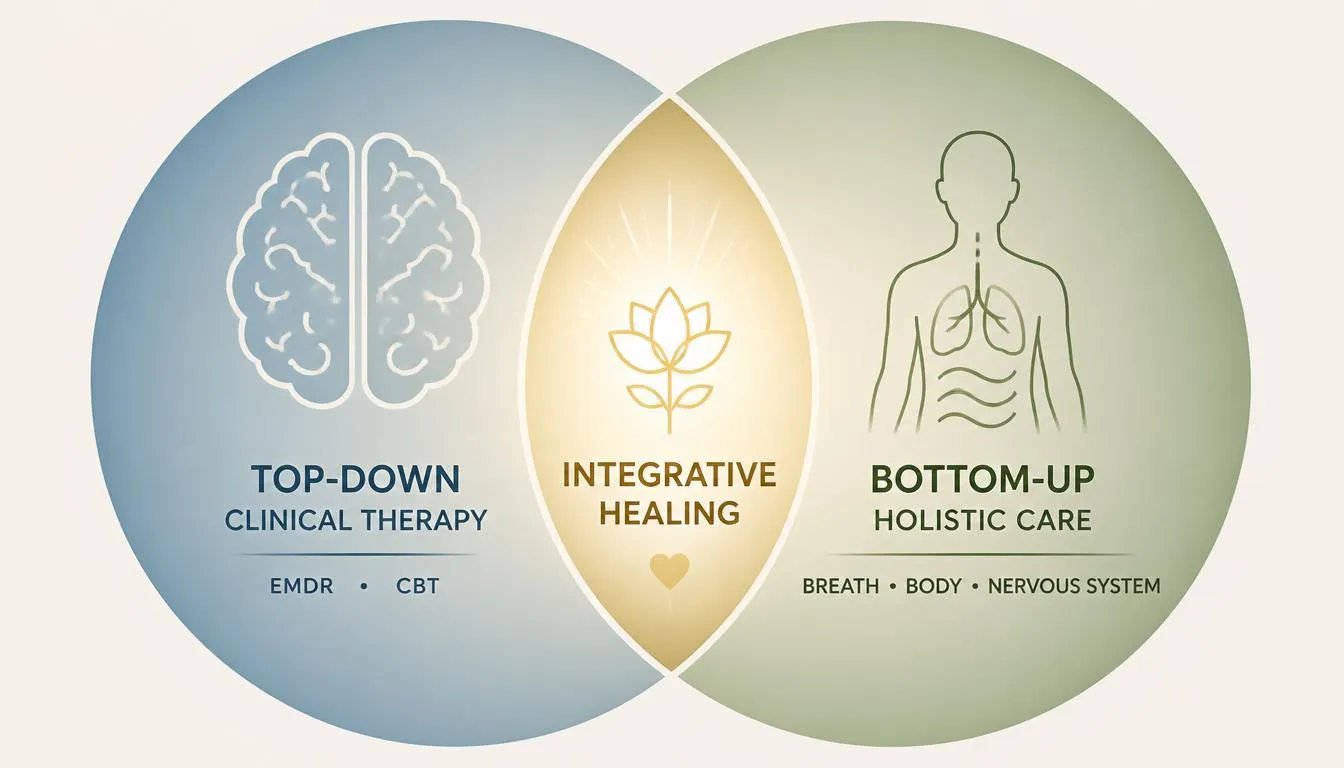
Perhaps most importantly, effective trauma treatment increasingly recognizes the need to combine top-down approaches (cognitive, verbal processing, the strength of EMDR and TF-CBT) with bottom-up approaches (somatic, sensory processing, the strength of holistic modalities). Neither is sufficient alone for every patient; together, they address trauma at both the level of narrative meaning and physiological survival response.
Building a Personalized Integrative Trauma Recovery Plan
Holistic trauma therapy works best as a structured, collaborative plan rather than a scattered set of wellness habits. A responsible integrative approach generally follows this sequence:
- Start with a licensed trauma specialist. A thorough assessment should guide whether EMDR, TF-CBT, medication, or another evidence-based treatment forms the foundation of your care.
- Prioritize safety and stabilization first. Before deep processing work or intensive somatic practice begins, clients need reliable grounding and coping skills.
- Introduce one complementary modality at a time. Layering in somatic therapy, yoga, or breathwork gradually makes it easier to track what’s actually helping.
- Track nervous system responses, not just mood. Sleep quality, resting heart rate, and physical tension are often earlier indicators of progress than mood alone.
- Reassess regularly with your care team. What helps during early stabilization may shift as processing deepens; integrative plans should evolve accordingly.
- Choose consistency over intensity. Brief, regular nervous-system-regulating practices generally outperform sporadic, high-intensity sessions for building lasting resilience.
Know the Limits: When Holistic Approaches Aren’t Enough
Holistic and complementary practices are genuinely valuable, but they are not equipped to safely manage every trauma symptom on their own. Seek immediate professional support, rather than relying on complementary practices alone, if you experience:
- Persistent flashbacks or dissociation that interfere with daily functioning
- Thoughts of self-harm or suicide
- Substance use as a primary coping strategy
- Panic symptoms that feel unmanageable or are worsening
- Safety concerns in your current living situation
If you are having thoughts of suicide or self-harm, contact the 988 Suicide & Crisis Lifeline (call or text 988 in the U.S.) immediately, or go to your nearest emergency room. Holistic practices can be part of long-term healing, but they are never a substitute for crisis-level care.
Finding Professional Support for Trauma and PTSD
If you’re navigating trauma or PTSD, the most important first step is connecting with a licensed clinician who can build an evidence-based foundation for your care, one that holistic practices can then support. Many survivors now start this process by seeking online therapy for trauma and PTSD, which offers a lower-barrier way to access trained trauma specialists, including EMDR- and TF-CBT-certified clinicians, without the wait times or logistical hurdles that once made trauma-focused care harder to reach.
Whether you’re exploring virtual mental health services for the first time or returning to care after a gap, working with a licensed professional is the foundation every holistic trauma therapy plan should be built around.
Frequently Asked Questions
What is holistic trauma therapy?
Holistic trauma therapy combines body-centered practices—like somatic therapy, yoga, acupuncture, and breathwork—with evidence-based psychotherapy such as EMDR or TF-CBT. It addresses how trauma affects the nervous system, not just thoughts and emotions, supporting fuller recovery when used alongside licensed clinical treatment rather than in place of it.
Can holistic therapy alone treat PTSD?
No. Holistic approaches are complementary, not standalone treatments for PTSD. Clinical guidelines recommend evidence-based therapies like EMDR, TF-CBT, or medication as the primary treatment, with holistic practices used to support nervous system regulation, reduce stress, and improve engagement in the overall recovery process.
What is somatic therapy, and how does it help trauma?
Somatic therapy focuses on bodily sensations rather than only thoughts, helping release tension and survival energy that trauma leaves stored in muscles and posture. Techniques like titration and pendulation gently guide clients between distress and calm, building nervous system resilience and reducing chronic hyperarousal over time.
Does yoga actually help with trauma recovery?
Research on trauma-sensitive yoga suggests it can ease PTSD symptom severity by improving interoceptive awareness—the ability to safely notice internal body sensations. Choice-based, gentle movement helps survivors reconnect with a body that may feel unsafe, complementing talk therapy rather than replacing structured clinical treatment.
Can acupuncture help with trauma-related anxiety?
Preliminary studies suggest acupuncture may lower cortisol levels and improve heart rate variability, both markers of nervous system regulation, which can ease trauma-related anxiety and sleep disruption. Evidence is still emerging, so acupuncture works best as an adjunct alongside, not a replacement for, trauma-focused psychotherapy.
How does the vagus nerve relate to trauma healing?
The vagus nerve is the primary pathway of the parasympathetic nervous system, helping shift the body out of fight-or-flight. Practices like diaphragmatic breathing and extended exhales stimulate vagal tone, improving heart rate variability and helping trauma survivors access a calmer, more physiologically regulated state.
Is holistic trauma therapy backed by scientific evidence?
Yes, with caveats. Somatic therapy, mindfulness, and trauma-sensitive yoga have moderate and growing evidence supporting nervous system regulation and symptom reduction. Acupuncture’s evidence base is smaller. None currently match the robust evidence behind EMDR or TF-CBT, which is why holistic care is positioned as complementary support.
How do I start an integrative trauma recovery plan?
Begin with a licensed trauma specialist who can assess your symptoms and recommend evidence-based treatment. From there, introduce one complementary modality at a time—such as somatic therapy or breathwork—track your nervous system’s response, and adjust the plan collaboratively with your care team as you stabilize and progress.
Medical Disclaimer & E-E-A-T AttributionThis article is for educational purposes and does not replace personalized medical or psychological advice. If you are recovering from a brain injury, trauma, or a mental health condition, work with a licensed clinician to build a plan suited to your situation. Written by: Adil Farooq, Psychiatry Magazine Medically reviewed by: [Dr. Adil Farooq MS · PhD] · Updated: 2026 |