| Quick Answer
Online therapy is licensed mental health treatment delivered by video, phone, or secure messaging instead of in an office. Research consistently shows it works as well as in-person care for anxiety, depression, and many trauma-related conditions when sessions are live and therapist-guided. Most plans cost $60–$250 per session, and a growing number of insurance plans now cover it at parity with in-office visits. |
| Key Takeaways
• Online therapy is clinically equivalent to in-person therapy for most common conditions when delivered through live video with a licensed provider, not a lesser, “backup” option. • Cost varies widely by model: subscription platforms average roughly $65–$100 per week, while insurance-billed private practice sessions typically run $100–$250 per session before coverage. • Coverage has expanded but remains uneven: federal parity law and dozens of state laws now require many insurers to cover telehealth mental health care similarly to in-person visits, though rules differ by state and plan type. • It isn’t the right fit for every situation, active crises, psychosis, or conditions requiring in-person medication management or hospitalization-level support need a different level of care. |
What Is Online Therapy?
Online therapy, also called teletherapy, virtual therapy, or telemental health, is professional mental health treatment provided remotely by a licensed therapist, counselor, psychologist, or clinical social worker. Instead of sitting across from a provider in an office, you connect through a secure video call, a phone session, or an encrypted messaging platform, and the clinical relationship, treatment planning, and confidentiality protections work the same way they would in person.
The category covers more ground than most people realize. It includes solo private-practice therapists who happen to offer sessions over video, large subscription-based platforms that match you with a provider algorithmically, employer-sponsored Employee Assistance Programs (EAPs), and hospital-affiliated telepsychiatry programs. What unites all of them is that a licensed clinician, not a chatbot, and not an unlicensed “coach”, is directing your care.
If you’re comparing your options, it helps to start from a single, trustworthy source rather than piecing together reviews from a dozen tabs. Our online therapy services hub breaks down accredited providers, specialties, and formats in one place so you can see the full landscape before committing to a platform.
Online therapy exploded in adoption during the COVID-19 pandemic, when in-person offices closed almost overnight and clinicians pivoted to video sessions within weeks. What began as an emergency workaround has since become a permanent, evidence-backed pillar of the mental health care system, not a stopgap, but a format many clients now actively prefer.
How Does Online Therapy Work?
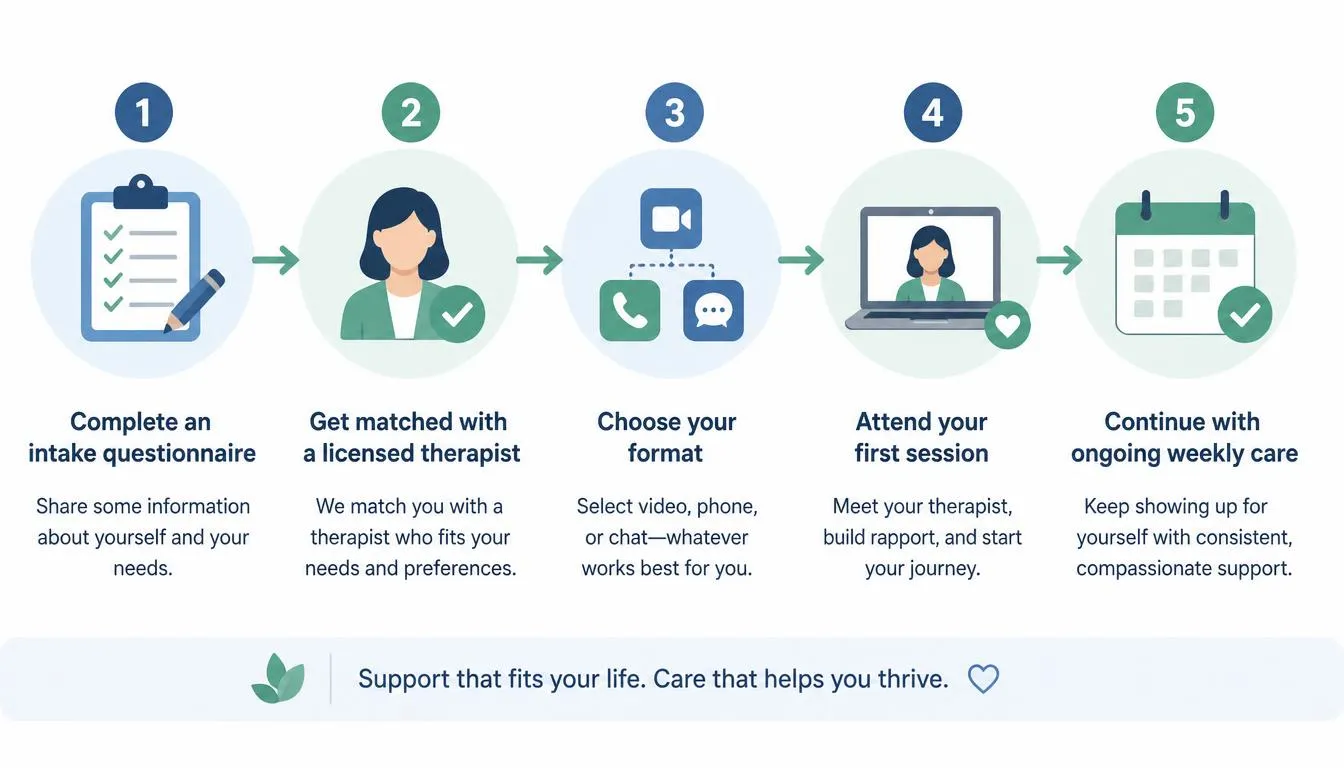
The mechanics are more straightforward than people expect, and most platforms follow a similar sequence from sign-up to your first session.
Step 1: Intake and assessment. You’ll complete a questionnaire covering your symptoms, history, goals, and any relevant medical or medication information. Reputable providers use this to screen for issues, like active suicidal crisis or psychosis, that require a higher level of care than outpatient telehealth can safely provide.
Step 2: Therapist matching. Based on your intake, you’re matched with a licensed clinician whose specialties align with your needs, anxiety, depression, trauma, relationship issues, grief, or a specific therapeutic modality. Some platforms let you browse and choose; others assign automatically and let you request a switch if the fit isn’t right.
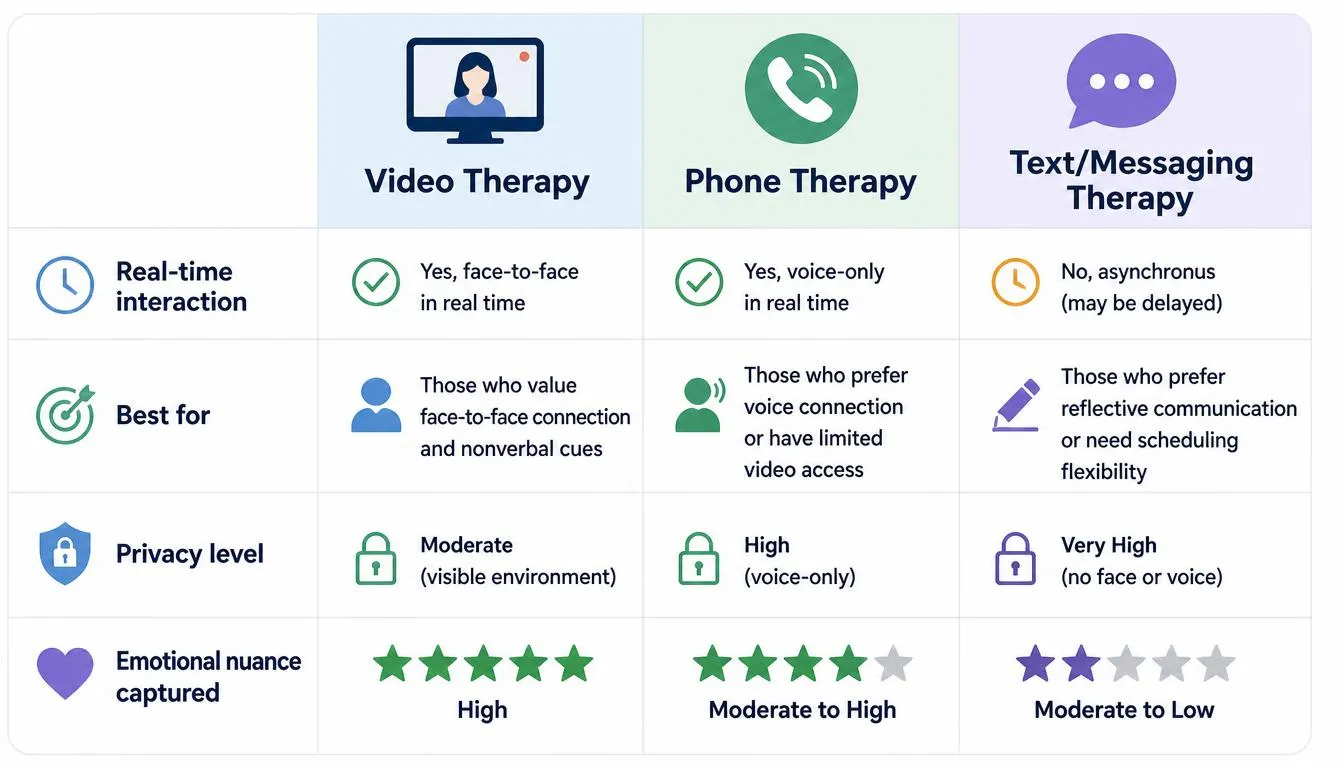
Step 3: Choosing your session format. Most platforms offer a mix of live video, live audio-only calls, and asynchronous text messaging you can send throughout the week. Many people combine formats, a weekly video session plus messaging in between for check-ins.
Step 4: Your first session. This typically runs 45–55 minutes and focuses on building rapport, clarifying your goals, and outlining a treatment plan. It’s normal for the first session to feel more like an information-gathering conversation than “deep” therapeutic work.
Step 5: Ongoing care. Sessions continue on a recurring cadence, usually weekly, with progress reviewed periodically and the treatment plan adjusted as needed, exactly as it would be in an office-based practice.
Is Online Therapy Actually Effective? Here’s What the Research Shows
This is the question that matters most, and the evidence base has grown substantially in the past few years. A 2024 systematic review and meta-analysis published in the Canadian Medical Association Journal, which analyzed randomized controlled trials comparing therapist-guided remote cognitive behavioral therapy (CBT) to in-person CBT, found essentially no meaningful difference in effectiveness between the two formats across a range of mental health conditions. That finding isn’t an outlier, it replicates a broader pattern in the literature.
A widely cited meta-analysis by Greenwood and colleagues, pooling 12 randomized controlled trials with more than 900 participants, similarly found no significant difference between online and in-person therapy in symptom reduction, treatment completion, or therapeutic alliance, the working relationship between client and therapist that’s one of the strongest predictors of whether therapy actually helps. A 2022 systematic review in a leading psychiatry journal reached a parallel conclusion for depressive symptom reduction specifically, and other reviews have found comparable outcomes for anxiety disorders and PTSD when treatment is delivered through live, synchronous video.
There’s an important nuance here for anyone evaluating a platform: the strongest evidence supports synchronous formats, live video or live phone sessions where you and your therapist are talking in real time. Asynchronous text-only therapy, where you exchange messages over days without live interaction, has a thinner and more mixed evidence base, particularly for anything beyond mild-to-moderate symptoms. If you’re weighing formats, that distinction is worth more than any marketing claim on a platform’s homepage.
The evidence also has limits worth naming honestly. Research on teletherapy for schizophrenia, bipolar disorder with psychotic features, and severe personality disorders remains limited, and these conditions typically require in-person assessment, medication management, and crisis-response infrastructure that a purely virtual model can’t fully replicate.
Who Is Online Therapy Best For?
Online therapy tends to work best for mild-to-moderate mental health concerns where the primary intervention is talk-based rather than requiring hands-on medical monitoring. It’s a particularly strong fit if you live in a rural area with few local providers, have mobility or transportation limitations, manage a demanding schedule that makes weekly commutes impractical, or simply feel more comfortable opening up from a familiar space than in a clinical office.
Condition-wise, the research base is deepest for anxiety and depression, the two most common reasons people seek therapy in the first place. If anxiety is your primary concern, it’s worth looking specifically at providers offering specialized online therapy for anxiety , since anxiety treatment often benefits from structured, skills-based approaches like CBT or exposure-based work that translate well to video. Online therapy also shows strong outcomes for relationship and life-transition stress, grief, mild trauma symptoms, and building general coping skills.
It’s a less reliable first choice, however, if you’re currently in acute crisis, experiencing psychosis or severe dissociation, or need coordinated medication management alongside talk therapy for a complex psychiatric condition. In those situations, an in-person or hybrid model, combining virtual therapy sessions with periodic in-person psychiatric care, is usually the safer, more effective path.
Types of Online Therapy and Treatment Modalities
Online therapy isn’t a single technique, it’s a delivery method that can carry almost any evidence-based therapeutic approach. Understanding the modality matters more than understanding the platform brand.
Cognitive Behavioral Therapy (CBT) is the most-studied approach in telehealth research and focuses on identifying and restructuring unhelpful thought patterns that drive anxiety and depression. It translates unusually well to video because it’s structured, skills-based, and often involves between-session homework that clients can complete independently.
Dialectical Behavior Therapy (DBT) blends CBT techniques with mindfulness and distress-tolerance skills, and is commonly used for emotional regulation difficulties, self-harm urges, and some personality disorder presentations. Group DBT skills training has adapted successfully to video formats in several published trials.
EMDR and trauma-focused therapy treat trauma and post-traumatic stress by helping the brain reprocess distressing memories. If PTSD, complex trauma, or a specific traumatic event is what’s bringing you to therapy, look for a provider offering trauma-informed online therapy for PTSD and complex trauma, since not every general therapist is trained in trauma-specific modalities like EMDR, even when they’re comfortable treating anxiety or depression broadly.
Depression-specific programs often combine CBT with behavioral activation, structured re-engagement with meaningful activities, and represent one of the most heavily researched applications of internet-delivered psychotherapy, with multiple meta-analyses finding outcomes comparable to face-to-face treatment for moderate depression.
Couples and relationship counseling, delivered via video, has grown rapidly as a category in its own right, since video actually preserves the real-time back-and-forth and visible body language that text-based formats lose.
How Much Does Online Therapy Cost, and Is It Covered by Insurance?
Pricing depends heavily on the model you choose. Subscription-based platforms, which bundle a set number of live sessions with unlimited messaging into a flat weekly or monthly fee, typically run in the range of $65 to $100 per week. Insurance-billed sessions through a private-practice therapist’s own telehealth setup usually follow standard fee-for-service pricing, often $100–$250 per session before any insurance reimbursement is applied. Sliding-scale options, community mental health centers, and employer-sponsored EAPs can bring costs down substantially or eliminate them for a limited number of sessions.
Insurance coverage has improved meaningfully but still varies by state and plan. At the federal level, the Mental Health Parity and Addiction Equity Act requires many group health plans to avoid imposing stricter limits on mental health benefits than they apply to medical or surgical benefits, and expanded protections under that law are extending to individual marketplace plans as of 2026. Separately, the majority of states, more than forty, plus the District of Columbia, now have laws requiring private insurers to cover telehealth services on similar terms to in-person care, though a smaller subset of states go further and mandate equal payment rates (true payment parity) rather than just coverage parity. In practice, that means your specific coverage can depend as much on which state you live in and what type of plan you have as on the therapy itself.
Before starting with any platform, it’s worth calling the number on the back of your insurance card and asking two direct questions: whether telehealth mental health visits are covered at parity with in-person visits, and whether the specific provider or platform you’re considering is in-network. Access gaps still persist along demographic lines, research tracking mental health care utilization has found meaningfully lower rates of care access among Black, Hispanic, and Asian adults compared to white adults, even where parity laws technically apply, so confirming coverage in writing before your first session is worth the extra ten minutes.
How to Choose the Best Online Therapy Platform
With dozens of platforms competing for attention, a short, non-negotiable checklist cuts through the marketing noise faster than reading star ratings.
Verify licensure directly. Every therapist you’re matched with should hold an active license in your state, not just a certification or coaching credential. Legitimate platforms make license numbers verifiable, typically through your state’s licensing board website.
Confirm HIPAA-compliant technology. Video and messaging tools should use encrypted, HIPAA-compliant infrastructure, not consumer apps like standard video-call software never designed for protected health information.
Check specialty match, not just general availability. A therapist who’s excellent for general anxiety may not have specific training in trauma work, couples counseling, or eating disorders. Ask directly about a provider’s experience with your specific concern before your first session.
Clarify the cancellation and therapist-switching policy. Fit matters enormously in therapy outcomes, and a good platform makes it painless to request a different therapist if the first match doesn’t click, without extra fees or awkward confrontation.
Understand exactly what’s included in the price. Some subscriptions cap you at one live session weekly with “unlimited” messaging that in practice gets slow, asynchronous replies. Read the specifics, not just the headline number, and compare that against options like couples-specific platforms if online relationship and couples counseling is what you actually need rather than individual sessions.
The Honest Pros and Cons of Online Therapy
No format is universally superior, and a genuinely useful guide says so plainly.
Advantages include dramatically better access for people in rural or underserved areas, no commute time, easier scheduling around work and caregiving responsibilities, a wider pool of therapists to choose from (including specialists who may not practice locally), and, for many clients, a lower barrier to opening up from a familiar, private space.
Trade-offs include a real dependence on stable internet and private physical space, a thinner evidence base for asynchronous text-only formats compared to live video, occasional friction with insurance billing depending on your state, and, for some people, a genuinely different, sometimes less immediate, sense of connection compared to sitting in a room with another person. Neither format is “less real” than the other; they’re simply different, and the right choice depends on your specific situation, condition, and preferences.
What to Expect in Your First Online Therapy Session
Set aside a private, quiet space with reliable internet, and test your camera and microphone beforehand so technical issues don’t eat into limited session time. Your therapist will typically start by reviewing confidentiality, emergency protocols (including what happens if you’re in crisis between sessions), and your intake information, before moving into open conversation about what brought you to therapy and what you hope to get out of it.
It’s completely normal to feel a little awkward on camera at first, most people report that feeling fades within two or three sessions. If it doesn’t, or if something about the fit feels consistently off after a genuine try, that’s useful information, not a failure on your part; switching therapists is a routine, expected part of finding the right match, in person or online.
When Online Therapy Isn’t Enough
Online therapy is not designed to replace emergency psychiatric care. If you or someone you know is experiencing thoughts of suicide, a mental health crisis, or an immediate safety concern, reach out to the 988 Suicide & Crisis Lifeline by calling or texting 988, or chatting at 988lifeline.org, 24 hours a day, free and confidential. If there is an immediate danger to life, call 911 or go to the nearest emergency room. Most online therapy platforms explicitly state that they are not equipped for real-time crisis intervention, a responsible provider will tell you this upfront rather than let you find out during an emergency.
People Also Ask
Is online therapy as good as in-person therapy?
For most common conditions, anxiety, depression, and many trauma-related concerns, multiple meta-analyses and randomized controlled trials have found no meaningful difference in outcomes between live video therapy and in-person therapy. The strongest evidence supports live, synchronous sessions specifically, rather than asynchronous text-only formats.
How much does online therapy cost without insurance?
Subscription-based online therapy platforms typically cost $65–$100 per week for a bundled package of sessions and messaging, while individual pay-per-session rates through a private telehealth practice usually range from $100–$250 per session. Sliding-scale and community-based options can bring this cost down significantly.
Does insurance cover online therapy?
In most states, yes, at least partially. Federal parity law requires many insurers not to impose stricter limits on mental health coverage than medical coverage, and over forty states now require insurers to cover telehealth similarly to in-person visits, though the specific reimbursement rate and in-network requirements vary by plan and state.
What’s the difference between online counseling and online therapy?
The terms are often used interchangeably in casual conversation, but “counseling” sometimes refers to shorter-term, issue-specific support, while “therapy” more often implies ongoing, in-depth treatment of a diagnosed condition. In practice, verify the specific license type (LPC, LCSW, LMFT, psychologist) rather than relying on the marketing term alone.
Can online therapists prescribe medication?
Licensed therapists, counselors, and psychologists generally cannot prescribe medication regardless of format, that requires a psychiatrist, psychiatric nurse practitioner, or physician. Many online therapy platforms now offer separate telepsychiatry services or referral pathways if medication becomes part of your treatment plan.
Is online therapy private and secure?
Legitimate platforms use encrypted, HIPAA-compliant video and messaging systems, and your sessions carry the same confidentiality protections as in-person therapy, with the same legal exceptions (such as imminent risk of harm to yourself or others). Avoid any provider that asks you to use unsecured, consumer-grade video apps for sessions.
How do I know if my online therapist is actually licensed?
Ask directly for their license type and number, then verify it independently through your state’s professional licensing board website, this takes a few minutes and is the single most reliable way to confirm you’re working with a qualified clinician rather than an unlicensed coach.
Conclusion: Is Online Therapy Right for You?
Online therapy has moved well past its pandemic-era reputation as an improvised substitute for “real” therapy. The clinical evidence built over the past several years is consistent: for anxiety, depression, and many trauma-related concerns, live video therapy with a licensed clinician performs on par with in-person care, and for a large number of people, its accessibility, flexibility, and privacy make it the more sustainable long-term choice. It isn’t the right tool for every situation, active crises and certain severe psychiatric conditions still call for in-person, higher-acuity care, but for the millions of people who delay or avoid therapy because of cost, distance, scheduling, or stigma, it has closed a real and long-standing gap in access to mental health treatment.
If you’re ready to take the next step, start by verifying licensure, confirming your insurance coverage in writing, and choosing a format, video, phone, or messaging, that matches both your comfort level and the severity of what you’re working through.
| Medical Disclaimer & E-E-A-T AttributionThis article is for educational purposes and does not replace personalized medical or psychological advice. If you are recovering from a brain injury, trauma, or a mental health condition, work with a licensed clinician to build a plan suited to your situation.
Written by: Adil Farooq, Psychiatry Magazine Medically reviewed by: [Dr. Adil Farooq MS · PhD] · Updated: 2026 |