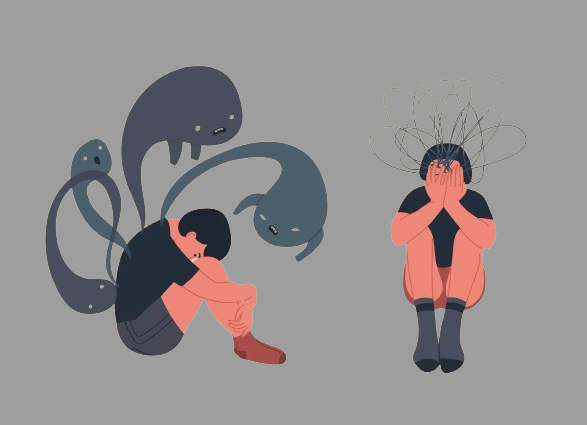
Depersonalisation disorder vs dissociation difference is the question that brings people to their phones at midnight — after days of feeling like a ghost in their own life, watching themselves from slightly the wrong angle, wondering if what is happening to them has a name. It does. And more importantly, it has two different names — one of which is a category, and one of which is a specific condition inside that category — and knowing the difference changes everything about what happens next.

The depersonalisation symptoms that most people describe — the glass wall between self and experience, the emotional flatness, the sense of watching yourself perform a life — appear in clinical literature under both terms. Both words circulate in therapy offices, mental health forums, and late-night search results, often used interchangeably by people who mean something specific and by clinicians who sometimes should know better. They are not the same thing. Treating one as the other produces no improvement and leaves the person no closer to the framework that would actually help.
Dissociative disorders explained accurately — for the first time, in a single place, with clinical precision and plain language — is what this article delivers. The diagnostic taxonomy, the neurological mechanisms, the lived-experience differences, the causes, and the treatments all diverge in ways that matter and that no accessible resource has yet assembled side by side.
By the time you finish reading, you will have the clinical definition of each condition, the neuroscience that separates them, a practical framework for distinguishing which one fits your experience, the causes behind each, and the specific treatment pathways that work. Let us begin at the foundation.
Dissociative Disorders Explained: The Clinical Taxonomy You Need First
The depersonalisation disorder vs dissociation difference cannot be understood without first establishing what dissociation actually is — because one of the most common sources of confusion is that people use the word “dissociation” to mean something specific when they are actually referring to something broad.
Pierre Janet, the French psychiatrist who first formally described dissociation in 1889, defined it as the psychological disaggregation of normally integrated mental functions — the splitting of consciousness from memory, perception, identity, or behaviour in ways that disrupt the ordinary continuity of experience. That definition has held for over a century because it is correct. Dissociation is not a single experience. It is a category of experiences that share this common mechanism: normal integration breaks down.
The DSM-5 places the dissociative disorders into four main categories. Depersonalisation/Derealisation Disorder is one. Dissociative Identity Disorder is another — involving distinct identity states and significant memory gaps between them. Dissociative Amnesia covers the loss of autobiographical memory extending beyond ordinary forgetting. Other Specified and Unspecified Dissociative Disorders cover presentations that do not fit neatly into any of the above.
The ICD-11 defines dissociative disorders similarly — as conditions characterised by disruption or discontinuity in the normal integration of consciousness, memory, identity, emotion, perception, behaviour, and sense of self. That list is long because the territory is large. Dissociation is not one thing. It is the name for a family of related experiences that all involve some form of fragmentation in how a person experiences themselves or their world.
The dissociation spectrum is the most practically useful way to understand this. At one end: normal, everyday dissociation — highway hypnosis, absorption in a book, autopilot during a familiar commute. These are universal, brief, and not distressing. At the other end: pathological dissociation — involuntary, distressing, impairing, and clinically significant. Depersonalisation disorder sits within this pathological end, but it is one specific location on the spectrum, not the whole of it.
The clearest possible orienting statement: dissociation is the umbrella. Depersonalisation disorder is one specific room inside it.
Van der Hart, Nijenhuis, and Steele’s structural dissociation of the personality theory adds a further clinical dimension. Their model describes how trauma fragments the personality into an apparently normal part — the ANP, which manages daily functioning — and an emotional part — the EP, which carries the unintegrated trauma. This structural division underlies many complex dissociative presentations and is the theoretical foundation of contemporary trauma-informed dissociation treatment.

Normal dissociation is not a disorder. It is a universal feature of human consciousness — the mind’s capacity to narrow or shift attention in ways that temporarily reduce awareness of some aspects of experience. Highway hypnosis is dissociation. The absorption of reading a novel so completely that the room disappears is dissociation. Daydreaming is mild dissociation.
Pathological dissociation is qualitatively different. It is involuntary, it is distressing, it is not context-bound, and it interferes with the continuity of memory, identity, and self-experience in ways that significantly impair functioning. Jennifer Freyd’s betrayal trauma theory offers one of the most compelling explanations for why pathological dissociation develops — it is an evolutionarily adaptive survival response, the mind’s capacity to separate from an experience that would otherwise be neurologically and psychologically unbearable.
The clinical line between normal and pathological dissociation is crossed when the experience cannot be voluntarily stopped, when it occurs in response to stress or trauma cues rather than chosen absorption, and when it disrupts the person’s capacity to maintain continuity of self, memory, or daily functioning. Many people living with pathological dissociation have never been assessed — because the experience is internal, invisible, and they have assumed it is universal.
What Is Depersonalisation Disorder? The Clinical Definition and Lived Experience
Depersonalisation symptoms are among the most difficult to communicate to someone who has not experienced them — not because they are rare but because the ordinary vocabulary of English does not have words precise enough to name them accurately. The DSM-5 definition of Depersonalisation/Derealisation Disorder is a starting point: persistent or recurrent experiences of feeling detached from one’s mental processes or body, like an outside observer of one’s own thoughts, feelings, sensations, and actions.
The derealisation component adds the external dimension. Where depersonalisation involves self-detachment — the self feels unreal or distant — derealisation involves world-detachment — the external environment feels unreal, dreamlike, foggy, or artificially constructed. Objects may appear flat or two-dimensional. Colours may seem muted. Distances may appear distorted. The world looks the same as it always did and feels like a film set.
Both components co-occur frequently enough that the DSM-5 groups them under a single diagnosis. But the most clinically important feature of the condition — the feature that most reliably differentiates it from psychosis and that many people with DPD do not know about — is preserved reality-testing. The person with depersonalisation disorder knows that their perception is distorted. They are not deluded. They are not losing touch with reality. They know reality is real even as it fails to feel real.
Daphne Simeon’s research — documented in “Feeling Unreal,” the most comprehensive phenomenological account of DPD in clinical literature — describes this preserved insight as one of the defining features of the condition and, paradoxically, one of its most distressing dimensions. The person is fully aware that something is profoundly wrong with their perception. They cannot dismiss it as imagination. They cannot talk themselves out of it. They watch themselves watching themselves and know that this is not how experience is supposed to feel.
The Cambridge Depersonalisation Scale, developed at the Institute of Psychiatry in London, is the gold-standard clinical assessment tool for DPD — measuring frequency, duration, and the specific qualities of depersonalisation and derealisation experiences. Its existence reflects the clinical seriousness with which this condition is now treated.
Prevalence data clarifies something important. Transient depersonalisation — brief episodes in response to stress, sleep deprivation, or intense anxiety — affects up to 74% of people at some point in their lives. Persistent, impairing DPD affects approximately 1–2% of the general population. It is one of the most underdiagnosed psychiatric conditions precisely because it is internal, invisible, and because many sufferers have been told — incorrectly — that it is “just anxiety.”
Depersonalisation Symptoms: The Full Clinical Picture From the Inside
The clinical picture of depersonalisation disorder is specific enough that most people who have it recognise themselves immediately in accurate descriptions — and have spent years not finding those descriptions in mainstream health content.
Feeling like a robot or automaton in your own body — performing actions mechanically, without the felt sense of agency that should accompany them — is one of the most consistent reports. Watching yourself from outside, as if through a camera positioned slightly behind and above you, is another. The specific quality of emotional numbing that DPD produces is not the same as depression’s flatness — it is the knowledge that you should feel something while simultaneously registering nothing, a gap between the expected emotional response and the absent actual one.
Memory feels strange in DPD — not absent, as in dissociative amnesia, but oddly impersonal. The person can recall events clearly. The events feel like they happened to someone else, like memories accessed from a file rather than relived from experience. The voice may sound unfamiliar, arriving from a slight distance. Hands and face may appear or feel strange, wrong, not quite owned.
Time distortion is common — hours pass without the felt registration of their passing, leaving the person unsure how a day moved from morning to evening without them seeming to inhabit any of it. And the derealisation component adds a perceptual strangeness to the external world that compounds the internal detachment — the world and the self are simultaneously unreal, each confirming the other’s wrongness.
Preserved insight — the understanding that this is a perception, not an actual truth about reality — is both the distinguishing clinical feature and, for many people, a source of additional suffering. You cannot be reassured out of it by telling yourself it is not real. You already know it is not real. The knowing does not make it stop.
Depersonalisation Disorder vs Dissociation Difference: The Clinical Comparison
Depersonalisation disorder vs dissociation difference, examined with clinical precision, is the difference between a specific condition and the category that contains it — plus several additional distinctions that matter significantly for treatment, prognosis, and accurate self-understanding.
The most fundamental distinction is categorical. Dissociation is the broad clinical framework covering all forms of disruption in the normal integration of consciousness, memory, identity, and self-experience. Depersonalisation disorder is one specific, formally named condition within that framework — defined by self-detachment and derealisation, with continuous identity and intact memory, as the primary and persistent feature.
Memory is a key differentiator. Broad dissociative pathology — particularly dissociative amnesia and the amnesia component of DID — frequently involves significant memory disruption. There are gaps the person cannot account for, things done that are not remembered, periods of time missing from biographical continuity. Depersonalisation disorder, by contrast, leaves memory intact. The person remembers what happened. They simply experienced it from a distance — as if watching rather than living — and the memory carries that quality of impersonal witnessing.
Identity is another. At the complex end of the dissociative spectrum, particularly in DID, there are distinct identity states — personality parts with different names, different memories, different ways of experiencing and responding to the world. People who know the person may report them behaving in distinctly different ways at different times. In depersonalisation disorder, identity is singular and continuous. The self is intact. It feels unreal. But it is one self, consistent across time and context, watching itself from a slight distance.
The trigger pattern differs significantly. Broad dissociative episodes are typically trauma-triggered — they appear as responses to overwhelming stimuli, trauma cues, or states of extreme threat. Depersonalisation disorder can be triggered by anxiety, cannabis, sensory overload, or extreme stress — but it can also appear without an obvious trigger, and it does not follow the same trauma-cue pattern that characterises dissociative responses in PTSD and C-PTSD.
Duration and persistence is perhaps the clearest practical differentiator. Dissociative episodes — in broader dissociative presentations — are typically time-limited. They end, and the person returns to a baseline state. Depersonalisation disorder is chronic and persistent. The baseline IS the detached state. There is no clean return to felt presence between episodes because the condition is not episodic in the same way — it is the continuous background of the person’s experience.
All depersonalisation disorder involves dissociation. Not all dissociation involves depersonalisation disorder. That asymmetric relationship is the clinical key.
Depersonalisation Disorder Causes: The Neuroscience Behind Feeling Unreal
Depersonalisation disorder causes are not mysterious — they are neurologically documented, specifically mapped in neuroimaging research, and clinically important because they point directly toward the treatments that address them.
Cortical Inhibition and Amygdala Hypoactivation
Sierra and Berrios’ landmark research proposed the cortical inhibition model of depersonalisation — one of the most influential theoretical frameworks in the field. In DPD, heightened prefrontal cortical activity inhibits the emotional processing function of the amygdala, the brain’s primary threat and emotional significance detector. The result is the specific emotional numbing of depersonalisation — the person processes experience cognitively and perceptually but without the emotional registration that should accompany it.
The amygdala hypoactivation documented in neuroimaging studies of DPD patients explains the gap between knowing and feeling that is the defining quality of the condition. The information arrives. The emotional significance does not.
Medial Prefrontal Cortex and Insula Dysregulation
Neuroimaging research identifies abnormal activity in the medial prefrontal cortex — the region responsible for self-referential processing, the brain’s mechanism for constructing a felt sense of self — and in the insula, which integrates interoceptive bodily signals into conscious self-experience. When the insula is dysregulated, the body fails to feel like one’s own. The bodily signals that should construct the felt experience of inhabiting a self are not integrating correctly. This is the neurological basis of the robot-in-own-body experience.
Anxiety as the Most Common Trigger
Depersonalisation disorder is strongly associated with anxiety disorders — particularly panic disorder and generalised anxiety — where chronic sympathetic hyperarousal produces the cortical dampening that triggers detachment as a protective response. Many people experience their first episode of depersonalisation during a panic attack and then cannot understand why the feeling persists long after the panic has resolved. The answer is that the cortical inhibition pattern, once established, does not automatically reverse when the acute trigger passes.
Cannabis and Substance Triggers
Cannabis is one of the most reliably documented triggers of both acute and chronic depersonalisation — particularly in individuals with a genetic predisposition to anxiety or dissociative responses. A single episode of cannabis-induced depersonalisation can persist for months or years in susceptible people, developing into a full DPD presentation that has no obvious ongoing cause once the substance use has stopped. This fact is almost entirely absent from mainstream health content, leaving many people with cannabis-induced DPD without any framework for understanding what happened to them.
Trauma and Childhood Adverse Experiences
Chronic childhood trauma — emotional neglect, abuse, inconsistent early attachment — is consistently associated with depersonalisation disorder in the research literature. The dissociative response that protected the child from overwhelming experience by creating distance between the self and what was happening to it can become a baseline operating mode in adulthood — no longer a response to acute threat but a chronic default state that activates regardless of current safety.
Dissociation vs Depersonalisation: How to Tell — A Self-Assessment Framework
Dissociation vs depersonalisation how to tell is a question that has a genuinely useful clinical answer — not a diagnostic one, but a framework precise enough to bring meaningful specificity to a clinical conversation that most people do not know how to start.
Is the Experience About Self-Detachment or Memory?
Self-detachment without memory gaps — feeling distant, unreal, or observed — with full recall of events points toward depersonalisation disorder. Memory gaps — periods you cannot account for, things you apparently did that you have no memory of, time that is simply missing — point toward broader dissociative pathology requiring comprehensive clinical assessment.
Do You Have One Continuous Sense of Identity?
A persistent sense of a single, continuous self — even if that self feels distant, unreal, or not quite inhabited — is consistent with depersonalisation disorder. Experiences of distinct identity states, being told you behaved as a completely different person, having different names or different ways of experiencing yourself at different times, point toward dissociative presentations at the more complex end of the spectrum.
Do You Know Reality Is Real Even When It Feels Unreal?
Preserved reality-testing is the hallmark of depersonalisation disorder and specifically distinguishes it from psychosis. If you know, intellectually and with certainty, that the unreality is a distortion of your perception rather than an accurate description of the world — if you know you are not actually outside yourself, even as it feels that way — that preserved insight is a clinically important feature pointing toward DPD rather than a psychotic presentation.
Is It Episodic or Constant?
Episodic dissociation — states that come and go, typically in response to stress, trauma cues, or identifiable triggers, with a clear return to a different baseline between episodes — is more typical of dissociative episodes within broader dissociative presentations. Constant, baseline detachment that does not fully lift — the persistent quality of DPD — points toward depersonalisation disorder as a chronic condition rather than an episodic response.
When Did It Start — And Did Something Trigger It?
Sudden onset after cannabis use is one of the clearest clinical presentations of depersonalisation disorder — particularly if the detachment persisted long after the substance was used. Onset following a panic attack, period of extreme stress, or sensory overload also points toward DPD. Onset connected to a specific trauma history, particularly repeated or developmental trauma, warrants full dissociative assessment rather than a DPD-specific pathway.
Is There Emotional Numbing Alongside the Detachment?
Depersonalisation disorder almost always includes significant emotional blunting — the specific experience of knowing you should feel something and registering nothing. This combination of detachment plus emotional numbing plus preserved insight is the clinical signature of DPD. Broader dissociative states may include emotional flooding and intense affect rather than the characteristic numbing of DPD.
Does It Affect Your Sense of Continuity Over Time?
Feeling that your past belongs to a different person — that memories are films you watched rather than experiences you lived — without memory gaps, without missing time, and without distinct identity states is more consistent with DPD than with broader dissociation. The continuity is intact. The felt ownership of that continuity is impaired.
If four or more of these patterns apply consistently, a clinical conversation is warranted — not with a general anxiety framework, but with a clinician who has specific experience with dissociative presentations and the assessment tools to differentiate them accurately.
Depersonalisation Disorder vs Dissociation: Treatment Pathways for Each
The depersonalisation disorder vs dissociation treatment difference is as clinically significant as the diagnostic difference — which is why accurate identification is not academic but practical, directly determining whether the intervention you receive matches the condition you have.
CBT-Depersonalisation — The Specialist Protocol
Standard CBT — the kind applied to generalised anxiety or depression — is insufficient for depersonalisation disorder. Specialist CBT-DPD, developed by teams including David Veale and the Maudsley Hospital group in London, directly targets the attentional strategies and avoidance behaviours that maintain the detached state. It addresses the hypervigilant monitoring of symptoms — the constant checking “am I still unreal?” — that is one of the primary maintaining factors of chronic DPD. This protocol is distinct from general anxiety-focused CBT and must be delivered by a clinician specifically trained in it.
Mindfulness-Based Re-Embodiment
Mindfulness applied to depersonalisation disorder requires a specific orientation. The standard mindfulness instruction to observe thoughts from a distance is precisely what DPD sufferers are already doing involuntarily — it can initially worsen the detachment if applied without modification. DPD-adapted mindfulness directs attention toward present-moment bodily sensation and grounding — rebuilding the insula-mediated connection to embodied experience that the condition has disrupted. The goal is re-inhabiting rather than observing.
Addressing Anxiety as the Primary Driver
In anxiety-driven DPD — the most common presentation — treating the underlying anxiety disorder produces significant reduction in depersonalisation. SSRI medication and anxiety-focused therapy, when the anxiety is the primary condition maintaining the cortical inhibition pattern, can substantially reduce the frequency and intensity of dissociative detachment. This is one of the most consistently evidence-supported treatment approaches for DPD.
Reducing or Eliminating Cannabis Use
For cannabis-triggered depersonalisation disorder, complete cessation is the most critical first intervention — before psychological treatment can gain meaningful traction. Many cases of cannabis-induced DPD improve significantly within weeks to months of full cessation, as the neurological trigger is removed and the cortical inhibition pattern loses its primary maintenance. This is a fact that most people with cannabis-induced DPD are never told.
Trauma-Focused Therapy for Dissociative Disorders
For broader dissociative presentations rooted in trauma — particularly C-PTSD-related dissociation — EMDR (Eye Movement Desensitisation and Reprocessing), trauma-informed CBT, and somatic experiencing address the trauma foundation directly. The structural dissociation model of Van der Hart and colleagues guides treatment toward integration of the ANP and EP parts of the personality — the apparently normal daily-functioning part and the emotional part carrying unintegrated trauma.
Phase-Based Treatment for Complex Dissociation
The International Society for the Study of Trauma and Dissociation (ISSTD) guidelines for complex dissociative disorders recommend phase-based treatment: safety and stabilisation first, trauma processing second, integration and reconnection third. Skipping stabilisation — moving directly to trauma processing with a person who is not yet stable enough to tolerate it — is clinically contraindicated and can significantly worsen the presentation. This sequencing is not caution for its own sake. It is clinical necessity.
Specialist Assessment as the Non-Negotiable First Step
Both depersonalisation disorder and broader dissociative conditions require specialist assessment — not a general anxiety screening, not a standard depression questionnaire. A clinician trained in dissociative presentations will use specific tools: the Dissociative Experiences Scale (DES) for broad dissociation screening and the Cambridge Depersonalisation Scale for DPD-specific assessment. Without these tools, applied by a clinician who understands what they measure, accurate differential diagnosis is not possible — and treatment without accurate diagnosis produces no result.
Living With Depersonalisation Disorder: What Recovery Actually Looks Like
The most important thing this article can tell someone with depersonalisation disorder is this: you are not going insane. That is not reassurance offered to make you feel better. It is a clinical fact.
Preserved reality-testing — the fact that you know your perception is distorted, that you know reality is real even when it fails to feel real — is the neurological evidence that this is not psychosis, not schizophrenia, not a break from reality. It is a disorder of the felt quality of experience, not of the accuracy of experience. The glass wall between you and your life is real. Your life, and your mind’s capacity to accurately perceive it, is also real. Both things are true simultaneously.
Recovery from depersonalisation disorder does not announce itself dramatically. It is retrospective — noticed days later, in the quiet realisation that a conversation left something behind, that a moment registered with an unexpected warmth, that the glass wall thinned briefly and something from outside got through. These are not small things. They are the early evidence of a system beginning to change.
One of the most clinically important and least discussed aspects of DPD recovery is the role of not fighting the experience. Hypervigilance to symptoms — the constant monitoring of whether you still feel unreal, the checking and rechecking, the catastrophic interpretation of each moment of detachment — is one of the primary mechanisms that maintains and deepens the condition. Reducing the panic response to the depersonalisation, rather than the depersonalisation itself, is often the first and most significant clinical movement.
Neuroplasticity is the mechanism of hope: the prefrontal-insula circuitry that produces depersonalisation disorder changed once, under the influence of anxiety, trauma, or substance use — and it can change again, under the influence of targeted intervention, reduced hypervigilance, and consistent therapeutic contact. The brain is not fixed. What it learned, it can unlearn.
The person who recovers from depersonalisation disorder does not become a different person. They become more present in the one they always were — gradually, nonlinearly, and beginning with moments so small they are almost missed.
Frequently Asked Questions About Depersonalisation Disorder vs Dissociation
Q: What is the depersonalisation disorder vs dissociation difference exactly?
A: Dissociation is the broad clinical category covering disruption of memory, identity, consciousness, and self-experience — it includes multiple distinct conditions. Depersonalisation disorder is one specific condition within that category, characterised by self-detachment and derealisation with preserved reality-testing, continuous identity, and intact memory. All depersonalisation disorder involves dissociation, but not all dissociation involves depersonalisation disorder.
Q: What are the main depersonalisation disorder symptoms?
A: Feeling like a robot or outside observer in your own body, emotional numbing despite knowing you should feel, the world appearing unreal or dreamlike, your voice sounding unfamiliar, memories feeling like they belong to someone else, and time passing without felt registration. Always with preserved reality-testing — you know it is a distortion of perception, not an accurate truth about reality.
Q: What causes depersonalisation disorder?
A: The most common causes are anxiety and panic disorder triggering cortical inhibition of amygdala processing, cannabis use in susceptible individuals, childhood trauma and neglect, and chronic stress or sensory overload. Neurologically, the condition involves medial prefrontal cortex overactivity, insula dysregulation, and amygdala hypoactivation — the emotional registration system is dampened while cognitive processing remains intact.
Q: Is dissociation the same as depersonalisation disorder?
A: No. Dissociation is the umbrella term for a family of related conditions involving fragmentation of normally integrated mental functions. Depersonalisation disorder is one specific diagnosis within the dissociative disorders category. Dissociation also includes dissociative amnesia, DID, and other presentations — DPD specifically involves self-detachment and derealisation with a continuous identity and fully intact memory.
Q: Can depersonalisation disorder be treated?
A: Yes — and effectively. Specialist CBT for depersonalisation, mindfulness-based re-embodiment targeting insula reconnection, anxiety treatment where anxiety is the primary driver, and cannabis cessation for substance-triggered cases are all evidence-based pathways. Most people with DPD see significant improvement with targeted treatment from a clinician trained in dissociative presentations.
Q: How do I know if I have depersonalisation disorder or another dissociative condition?
A: DPD involves continuous identity, fully intact memory, persistent self-detachment with emotional numbing, and preserved reality-testing. Memory gaps — periods of missing time — distinct identity states, or trauma-triggered episodic switching point toward other dissociative conditions requiring specialist differential assessment using tools including the Dissociative Experiences Scale and the Cambridge Depersonalisation Scale.
Q: Is depersonalisation disorder serious or dangerous?
A: Depersonalisation disorder is not dangerous and is not psychosis — the preserved reality-testing is the clinical evidence of this. It is significantly distressing and impairing without treatment, and it can persist for years if untreated. With targeted intervention from a clinician experienced in dissociative presentations, most people experience substantial recovery — beginning with small moments of felt presence and progressing toward a more consistently inhabited experience of their own life.
Conclusion
The depersonalisation disorder vs dissociation difference is not a semantic debate about two interchangeable words. It is a clinically meaningful distinction between a broad category of psychological fragmentation and one specific, neurologically documented condition within it — and that distinction is the entire story of whether the treatment you receive will address what you actually have.
Dissociation is the umbrella — covering amnesia, identity disruption, absorption, and detachment across a vast clinical range. Depersonalisation disorder is a specific neurological condition within that range — with documented brain mechanisms, specific triggers, and treatment protocols designed for its particular presentation. The cortical inhibition model, the insula dysregulation, the preserved reality-testing — these are not theoretical abstractions. They are the architecture of a condition that is treatable when accurately named.
You now have the clinical taxonomy, the neurological framework, the six differential markers, and the treatment pathways that no single accessible resource has assembled in one place before this article. What comes next is a clinical conversation — ideally with a psychologist or psychiatrist experienced in dissociative presentations — that you are now equipped to have with the specific vocabulary that produces accurate assessment.
You are not losing your mind. You are experiencing a condition in which the felt quality of your own experience has been disrupted at the neurological level. That is a profoundly different thing — and it is a thing that can be found, named, and addressed.