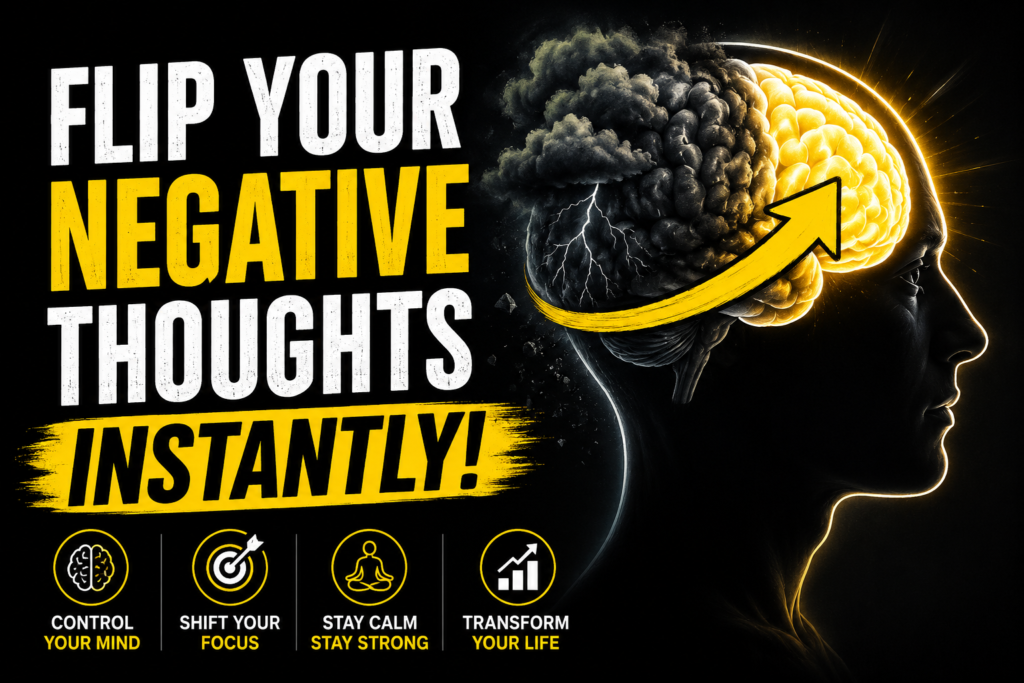
You know that feeling. A single dark thought creeps in, and suddenly your mind is spiraling. One worry leads to another. Before long, your entire mood has collapsed — and you are not even sure how it happened. If you have ever wondered how to stop negative thoughts immediately, you are not alone. In fact, millions of people fight this battle every single day. The good news is that your thoughts are not in charge — you are. This article gives you 12 powerful, science-backed techniques to take back control of your mind, starting right now.
What Are Negative Thoughts and Why Do They Happen?
Negative thoughts are mental responses that focus on danger, failure, loss, or pain. They are not a sign of weakness. However, they are also not an accurate reflection of reality. Your brain produces them automatically — often without your permission.
The human brain is wired to scan for threats. This is called the negativity bias — a survival mechanism inherited from our ancestors. Thousands of years ago, noticing danger quickly kept people alive. Today, however, that same wiring causes your brain to fixate on problems, criticism, and worst-case scenarios — even when you are perfectly safe.
Understanding this is important. Negative thoughts are not your fault. Nevertheless, you do have the power to change how you respond to them.
The Science Behind Negative Thinking
When a negative thought appears, your brain triggers a stress response. Your body releases cortisol and adrenaline — the same chemicals released during physical danger. As a result, your heart rate rises, your muscles tighten, and your thinking becomes narrow and fearful.
How the Brain Gets Stuck in Negative Loops
Repeated negative thinking actually strengthens the neural pathways associated with fear and worry. In other words, the more you think negatively, the easier it becomes to think negatively again. Neuroscientists call this “neurons that fire together, wire together.”
Moreover, chronic negative thinking keeps your nervous system in a constant low-level state of alert. Over time, this exhausts your body, weakens your immune system, and increases your risk of anxiety and depression. Therefore, learning how to stop negative thoughts immediately is not just about feeling better — it is about protecting your health.
The Role of the Amygdala
The amygdala is the brain’s alarm system. It reacts to perceived threats in milliseconds — long before your rational mind can respond. This is why negative thoughts can feel so automatic and overwhelming. However, the prefrontal cortex — the thinking, reasoning part of your brain — has the power to override the amygdala. Every technique in this article works by activating that rational part of your brain.
Common Negative Thought Patterns to Recognize
Before you can stop negative thoughts, you need to recognize them. Psychologists call unhelpful thinking styles cognitive distortions. These are mental habits that twist reality in a negative direction.
Cognitive Distortions Examples
Catastrophizing means assuming the worst possible outcome will happen. For example, you make one mistake at work and immediately think you will get fired. All-or-nothing thinking means seeing everything in extremes — either perfect or a complete failure. Mind reading means assuming you know what others think — usually that they think badly of you.
Additionally, overgeneralization involves taking one bad experience and deciding it will always happen. For instance, one failed relationship becomes “I will never find love.” Recognizing these patterns is the first step toward breaking them.
Why You Must Stop Intrusive Thoughts Immediately
Leaving negative thoughts unchecked causes real damage. Research consistently shows that prolonged negative thinking raises cortisol levels, disrupts sleep, and weakens emotional resilience. Furthermore, negative thought patterns are the primary driver of anxiety disorders and clinical depression.
On the other hand, people who actively manage their thoughts report higher energy, better relationships, and stronger mental health. Therefore, learning how to get rid of negative thoughts is one of the most valuable skills you can develop.
The longer a negative thought goes unaddressed, the stronger its grip becomes. Consequently, the best time to stop a negative thought is the moment it appears — not later, not tomorrow. Right now.
Technique 1: Use the Thought Stopping Technique
The thought stopping technique is one of the oldest and most effective tools in cognitive behavioral therapy. It works by interrupting the negative thought the moment it begins — before it has time to spiral.
When you notice a negative thought appearing, say the word “STOP” firmly in your mind. Some people find it helpful to visualize a bright red stop sign. Others actually say it out loud. The physical act of interruption breaks the automatic chain of negative thinking.
After you say stop, immediately redirect your attention to something neutral or positive. This technique works because it forces your brain to switch gears. With practice, the pause between trigger and spiral grows longer — giving you more and more control.
Technique 2: Try CBT Techniques for Negative Thoughts
Cognitive Behavioral Therapy, or CBT, is the most extensively researched psychological treatment for negative thinking. At its core, CBT teaches you to identify, challenge, and replace distorted thoughts with balanced ones.
How to Challenge a Negative Thought Using CBT
When a negative thought appears, ask yourself three questions. First — is this thought based on facts or feelings? Second — what evidence exists for and against this thought? Third — what would I say to a close friend who had this thought?
Most negative thoughts collapse under this kind of honest examination. For example, the thought “Nobody likes me” feels completely true in the moment. However, when you look for real evidence, you will almost always find it is an exaggeration. CBT techniques for negative thoughts help you see the difference between what your mind says and what is actually true.
Technique 3: Practice Mindfulness for Negative Thoughts
Mindfulness is the practice of observing your thoughts without attaching to them or judging them. It is one of the most powerful ways to overcome negative thinking — and it requires no equipment, no special training, and no cost.
When a negative thought appears, do not fight it. Instead, simply notice it. Say to yourself: “I am having the thought that I am not good enough.” This tiny shift in language creates distance between you and the thought. You are no longer inside the thought — you are watching it from the outside.
Moreover, mindfulness teaches your brain that thoughts are just mental events — not facts, not commands, and not permanent. They arise, and they pass. In fact, studies show that regular mindfulness practice physically reduces the size and activity of the amygdala over time.
Technique 4: Use Grounding Techniques for Anxiety and Negative Thoughts
Grounding techniques work by pulling your attention out of your mind and back into your physical senses. They are especially effective when negative thoughts trigger anxiety or panic.
The 5-4-3-2-1 Grounding Technique
This technique is simple, fast, and remarkably effective. Start by naming five things you can see right now. Then name four things you can physically feel — the floor under your feet, the air on your skin. Next, identify three things you can hear. Then two things you can smell. Finally, one thing you can taste.
This process forces your nervous system to shift from threat mode into the present moment. As a result, the negative thought loses its power almost immediately. Therefore, the 5-4-3-2-1 technique is one of the fastest ways to stop intrusive thoughts immediately.
Technique 5: Reframe the Thought
Cognitive reframing means deliberately changing the way you interpret a situation. It does not mean pretending everything is wonderful. However, it does mean choosing a more balanced and helpful perspective.
For example, instead of “I failed at this,” try “I learned something valuable from this experience.” Instead of “Everything is going wrong,” try “This is a difficult moment, and difficult moments pass.” Reframing is not toxic positivity — it is honest perspective-taking.
Furthermore, reframing activates the prefrontal cortex and quiets the amygdala. With practice, it becomes a natural reflex — your brain automatically reaches for balance instead of catastrophe.
Technique 6: Journal to Get Rid of Negative Thoughts
Writing down your thoughts is one of the most underrated techniques to stop negative thoughts. When negative thoughts stay inside your head, they feel enormous, permanent, and overwhelming. However, the moment you write them down, something shifts.
How to Journal for Negative Thinking
Write the negative thought exactly as it appears in your mind. Then write three pieces of evidence that contradict it. Finally, write a more balanced version of the thought. This process — called expressive journaling with reappraisal — has been shown in multiple studies to reduce anxiety and improve mood within minutes.
Additionally, journaling creates a record of your thought patterns over time. Consequently, you begin to notice triggers, recurring themes, and gradual improvements — all of which strengthen your confidence in managing your mind.
Technique 7: Move Your Body to Shift Your Mind
Physical movement is one of the most immediate and powerful ways to control negative thoughts. When you exercise, your brain releases endorphins, serotonin, and dopamine — chemicals that directly counteract the effects of cortisol and negative thinking.
You do not need a gym. A brisk ten-minute walk is enough to interrupt a negative thought spiral. In fact, research from Harvard Medical School suggests that thirty minutes of moderate exercise three times per week is as effective as antidepressant medication for mild to moderate depression.
Moreover, movement works as a pattern interruption. Your body changes state — and your mind follows. Therefore, the next time a wave of negative thinking hits, stand up and move before you do anything else.
Technique 8: Use Breathing Exercises to Calm the Mind
Controlled breathing is one of the fastest ways to shift your nervous system from a stressed state to a calm one. Negative thoughts trigger shallow, rapid breathing — which in turn feeds more anxiety and more negative thinking. Slow, deliberate breathing breaks this cycle.
The 4-7-8 Breathing Technique
Inhale through your nose for four counts. Hold your breath for seven counts. Exhale slowly through your mouth for eight counts. Repeat this cycle four times. This specific pattern activates the parasympathetic nervous system — your body’s natural calm response.
As a result, cortisol levels drop, heart rate slows, and the mental space between you and your thoughts widens. Breathing techniques are especially useful because you can use them anywhere — at your desk, in your car, or in bed at night.
Technique 9: Talk to Yourself Like a Trusted Friend
Negative self-talk is one of the most damaging forms of negative thinking — and it is also one of the most overlooked. Most people speak to themselves in ways they would never dream of speaking to someone they love.
When you notice negative self-talk, pause and ask yourself: “Would I say this to my best friend?” The answer is almost always no. Therefore, deliberately shift your inner language. Replace “I am so stupid” with “I made a mistake, and I can learn from it.” Replace “I cannot do this” with “This is hard, and I am capable of figuring it out.”
Furthermore, self-compassion is not self-indulgence. Research by psychologist Dr. Kristin Neff consistently shows that people who treat themselves with kindness during difficult moments are more resilient, more motivated, and more emotionally stable than those who are harshly self-critical.
Technique 10: Use Positive Affirmations the Right Way
Positive affirmations have a complicated reputation — and for good reason. Telling yourself “I am happy and successful” when you feel miserable does not work. In fact, it can make negative thoughts stronger by highlighting the gap between where you are and where you want to be.
However, process-based affirmations do work. Instead of stating an outcome, affirm your ability to take action. “I am learning how to manage my thoughts.” “I am getting better at this every day.” “I have handled difficult moments before, and I can do it again.” These statements feel believable — and believable affirmations genuinely shift mood and motivation.
Moreover, repeating truthful, process-based affirmations consistently begins to rewire your brain over time through the principle of neuroplasticity.
Technique 11: How to Rewire Your Brain from Negative Thinking
Neuroplasticity is the brain’s remarkable ability to form new neural pathways throughout your entire life. This means you can literally rewire your brain from negative thinking — no matter how long those patterns have been in place.
Every time you challenge a negative thought, choose a balanced perspective, or redirect your attention, you are building new neural pathways. Over time, those pathways become stronger and more automatic. Meanwhile, the old negative pathways weaken from disuse.
Daily Habits That Rewire the Brain
Practicing gratitude every morning — naming three specific things you are grateful for — has been shown to increase baseline happiness levels within three weeks. Additionally, spending time in nature, limiting social media, getting adequate sleep, and maintaining social connections all support healthy brain chemistry and reduce negative thinking over the long term.
Technique 12: Distraction and Pattern Interruption
Sometimes the most effective way to stop a negative thought is simply to interrupt the pattern completely. Call a friend. Put on music. Step outside. Cook something. Play with a pet. Pick up a book.
This is not avoidance — it is strategic redirection. You are not pretending the thought does not exist. Instead, you are refusing to give it your full attention and energy. In fact, engaging your brain in a mildly absorbing activity is one of the fastest ways to break a negative thought loop.
Furthermore, choosing uplifting activities — ones that involve creativity, connection, or physical engagement — gives your brain a genuine positive experience to focus on. As a result, the emotional intensity of the original negative thought fades naturally.
How to Stop Negative Self-Talk in the Long Term
Stopping negative self-talk is a long-term project — not a one-time fix. However, with consistent practice, the way you speak to yourself can change profoundly. Start by simply noticing. Pay attention to your inner voice throughout the day without judging it. Write down recurring negative phrases. Then deliberately challenge and replace them using the techniques above.
Additionally, be patient with yourself. Negative self-talk develops over years — sometimes decades. Changing it takes time and repetition. Nevertheless, every moment you choose a kinder, more accurate thought is a moment of genuine progress.
Long-Term Habits to Prevent Negative Thinking
Managing negative thoughts is not just about responding to them — it is also about building a life that makes them less likely to take hold in the first place.
Regular sleep is foundational. Sleep deprivation dramatically increases negative thinking, emotional reactivity, and anxiety. Therefore, prioritizing seven to nine hours of quality sleep each night is one of the most powerful things you can do for your mental health.
Additionally, reducing alcohol and caffeine, maintaining meaningful relationships, setting healthy boundaries, and engaging in purposeful work or creative activities all build mental resilience over time. Furthermore, regular mindfulness practice — even just ten minutes a day — creates a quieter, more spacious mind that negative thoughts find harder to dominate.
When Negative Thoughts Become a Serious Concern
Most negative thinking is a normal part of human experience. However, there are times when negative thoughts become so frequent, so intense, or so disruptive that professional support is the right next step.
If your negative thoughts involve persistent hopelessness, thoughts of harming yourself, or an inability to function in daily life, please speak to a doctor, therapist, or mental health professional as soon as possible. Reaching out for help is not weakness — it is one of the most courageous and self-aware things a person can do.
A qualified therapist — particularly one trained in CBT, ACT (Acceptance and Commitment Therapy), or mindfulness-based approaches — can provide personalized tools and support that go far beyond what any article can offer.
You have more power over your mind than you may realize right now. Learning how to stop negative thoughts immediately is a skill — and like every skill, it improves with practice, patience, and self-compassion. You will not get it right every time. However, every time you pause before spiraling, every time you challenge a distorted thought, and every time you choose kindness over criticism, you are rewiring your brain in a meaningful way. The mind that once pulled you under can become the very thing that holds you steady. That change is entirely within your reach.