By Adil Farooq | Specialization Consultant & Author Profile
When extreme anxiety or trauma is triggered, logic fails. You cannot simply “think” your way out of a panic attack because the analytical part of your brain the prefrontal cortex essentially shuts down under threat. To regain control, you must bypass the mind and communicate directly with the body.
Somatic grounding exercises are physical, body-based techniques designed to regulate the autonomic nervous system. By using intentional movement, breathwork, and tactile feedback, these exercises shift the body out of a sympathetic “fight-or-flight” state and deliver immediate biological signals of safety to the brain.
Rather than analyzing your thoughts, somatic therapy focuses on releasing the physical tension, trapped energy, and stored biological stress responses that fuel emotional dysregulation making it a foundational approach in trauma-informed care.

The Neurobiology of Somatic Grounding
To understand why these physical interventions are so powerful, we must look at Polyvagal Theory, developed by neuroscientist Dr. Stephen Porges. Your autonomic nervous system constantly scans your environment for signals of threat or safety a process Porges calls neuroception. When a threat is perceived, whether real or rooted in past trauma, your body floods with cortisol and adrenaline.
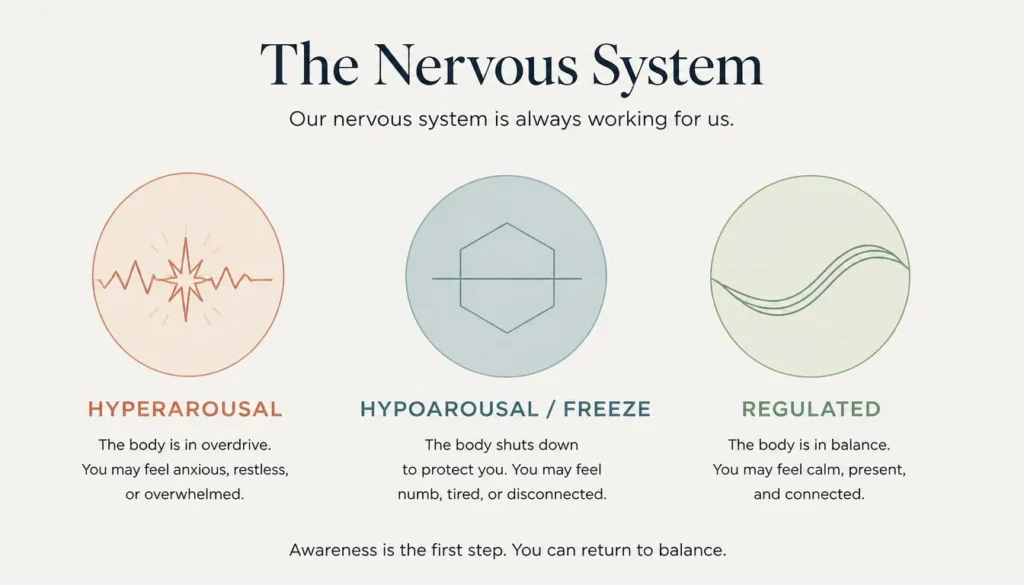
If this stress energy is not physically discharged, the body becomes trapped in one of two dysregulated states:
- Hyperarousal: panic, rage, hypervigilance, racing thoughts
- Hypoarousal: emotional shutdown, numbness, collapse the
freeze response described by Porges and Peter Levine
Somatic grounding exercises interrupt this survival cycle by directly stimulating the parasympathetic nervous system specifically the vagal brake which lowers heart rate, slows breathing, and expands your window of tolerance so you can process stressors without shutting down.
What Are Somatic Grounding Exercises?
The word somatic means “relating to the body.” Somatic grounding exercises are practices that use body awareness, movement, breath, and sensory input to regulate your stress response as opposed to cognitive techniques, which target thoughts.
Unlike talk therapy, somatic approaches work with:
- Physical sensations and bodily felt sense
- Intentional movement and proprioception
- Breathwork and respiratory rhythm
- Tactile and sensory input
- Muscle engagement and tension release
These exercises are foundational in Somatic Experiencing (developed by Dr. Peter Levine), EMDR therapy, and trauma-informed care frameworks. They are not relaxation tricks they are evidence-informed physiological interventions.
Core Somatic Interventions for Immediate Relief
Rather than trying a dozen random techniques, mastering a few scientifically backed modalities provides the most reliable relief during emotional flooding. Below are the most clinically supported somatic grounding exercises, organized by mechanism.
1. Deep Proprioceptive Engagement: The Wall Push
Proprioception is your body’s ability to sense its own location, movement, and actions in space. During dissociation or intense panic, you lose this physical anchor to present reality.
The Wall Push technique re-establishes this connection rapidly. Stand facing a solid wall, place both palms flat against the surface, and push forward with your full physical strength for 15 to 30 seconds. Focus entirely on the wall’s resistance and the contraction in your chest, shoulders, and arms.
This heavy proprioceptive input engages large muscle groups the fastest mechanism for metabolizing the adrenaline spike that accompanies a panic response. It is also a core technique used in occupational therapy for sensory processing regulation.
2. Vagal Toning: The Voo Breath
The vagus nerve is the primary highway of the parasympathetic nervous system, connecting your brain to your heart, lungs, and digestive organs. Activating it is the fastest biological pathway to signaling safety to a dysregulated brain.
Among the many vagus nerve regulation techniques, vocal resonance is uniquely fast-acting. The Voo Breath (developed in Somatic Experiencing) works as follows: take a full diaphragmatic inhalation, then release a low, sustained “Voooo” sound on the exhale until your lungs are empty. The deep vibration in your vocal cords directly stimulates the vagal pathways running through your neck and chest, triggering an immediate parasympathetic relaxation response.
3. Bilateral Stimulation: The Butterfly Hug
When the brain is overwhelmed, the left hemisphere (logic and language) and the right hemisphere (emotion and imagery) stop communicating effectively. Bilateral stimulation alternating input across the midline of the body forces these two hemispheres to re-engage.
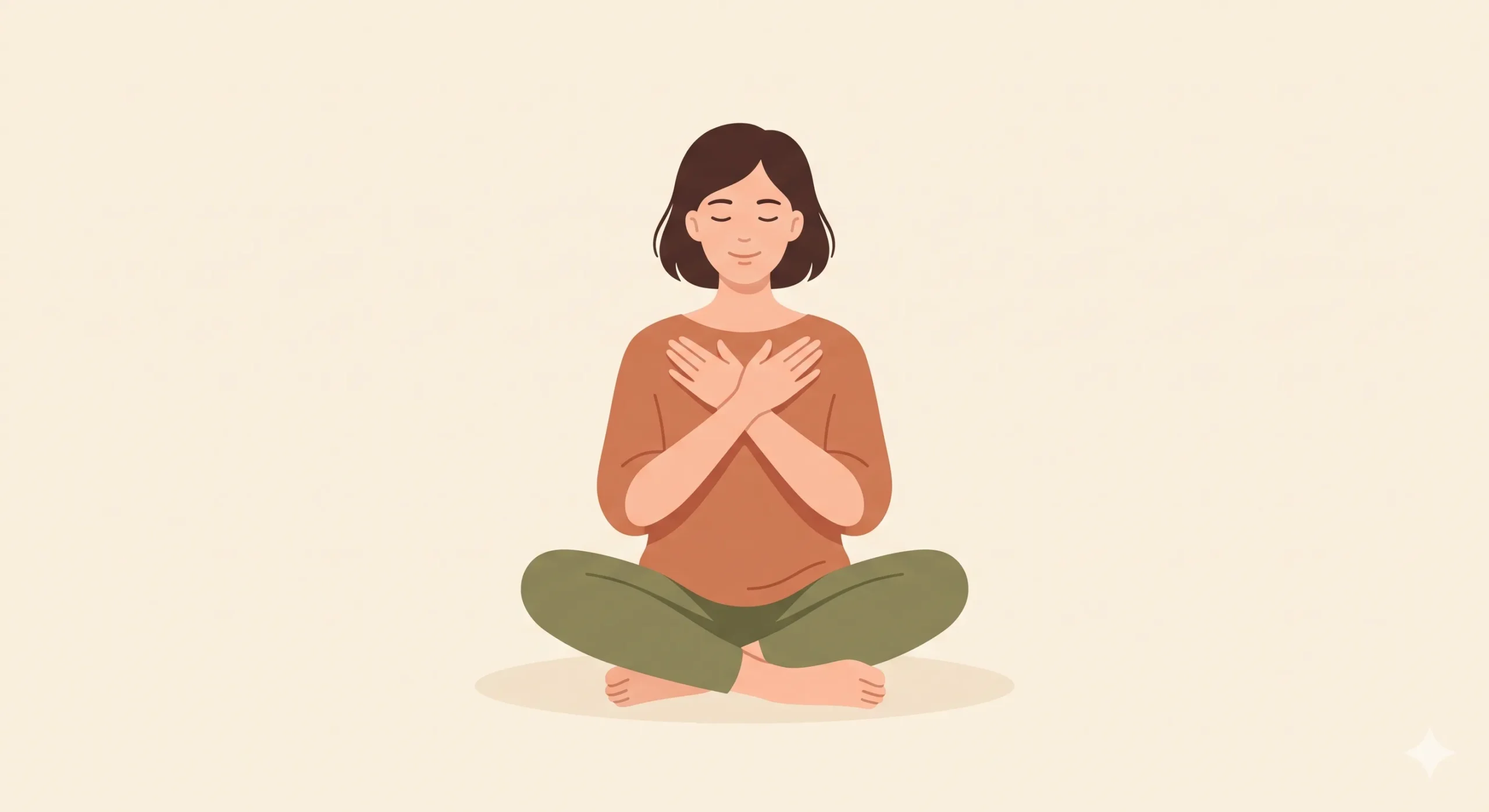
This is a foundational mechanism in EMDR therapy. The Butterfly Hug is a powerful self-administered version: cross your arms over your chest so your fingertips rest just below your collarbones. Close your eyes and slowly alternate tapping your left and right shoulders in a calm, rhythmic pattern while breathing slowly and deliberately. This rhythm mimics early maternal soothing patterns, making it particularly effective for those learning how grounding helps trauma processing.
4. Temperature Shift: The Mammalian Dive Reflex
Sometimes anxiety loops so aggressively that gentle breathing or tapping techniques cannot break the cycle. In these moments, a radical sensory shift is required to force the brain’s attention outward.
Activating the Mammalian Dive Reflex is a clinical somatic intervention for extreme distress. Submerge your face in a bowl of ice-cold water for 15 to 30 seconds, or hold a bag of frozen vegetables against the back of your neck. The intense cold immediately triggers a hard physiological reset: heart rate drops, blood flow redistributes to core organs, and the feedback loop of anxiety is interrupted at a biological level.
5. Barefoot Grounding and Textural Anchoring
Walking barefoot on natural surfaces soil, grass, or sand demands real-time sensory processing. By forcing the brain to analyze the exact temperature, pressure, moisture, and texture beneath your feet, you redirect conscious attention away from internal dissociation and anchor it to a tangible, physical present-moment reality.
6. Progressive Muscle Relaxation
Systematically tense each major muscle group calves, thighs, abdomen, chest, hands, shoulders for 5 seconds, then release slowly. Work from your feet upward. This technique teaches the nervous system the contrast between tension and relaxation, recalibrating its baseline state over time.
7. The 5-4-3-2-1 Sensory Grounding Method
This widely used orientation technique anchors awareness in present sensory reality:
- 5 things you can physically feel (not just see)
- 4 distinct sounds in your environment
- 3 textures you can touch right now
- 2 scents you can identify
- 1 slow, deliberate breath
Its strength lies in activating the orienting response the brain’s natural mechanism for shifting from threat-scanning to environmental awareness.
8. Gentle Rocking
Sit or stand and gently rock side to side or forward and back in a slow, rhythmic pattern. Rhythmic vestibular input motion that affects the inner ear’s balance system is one of the earliest self-soothing mechanisms humans develop. It directly down-regulates the sympathetic nervous system and is used clinically with children and adults who have experienced early relational trauma.
Somatic Grounding for Panic Attacks
During an active panic attack, the prefrontal cortex is offline and reasoning is unavailable. Effective somatic interventions at this stage must be immediate and physical:
- Push both feet firmly into the floor and feel the pressure
- Slow your exhale to be twice as long as your inhale
- Activate the Wall Push for 20 to 30 seconds
- Splash ice-cold water on your face if available
- Press your palms firmly together for 10 seconds, then release
Focus entirely on physical sensation. Panic decreases when the body receives consistent signals of physical support and safety.
Somatic Grounding for Dissociation
Dissociation is a state of disconnection from your body, thoughts, or surroundings, often triggered by overwhelm or trauma. If you experience dissociation or depersonalization, the following somatic techniques are particularly effective for re-anchoring awareness:
- Hold something textured a rough stone, a knotted cloth, a rubber ball
- Stamp your feet lightly and feel the floor beneath you
- Speak your own name aloud and describe your current physical location
- Look in a mirror and make slow eye contact with yourself
- Sit upright and press your back firmly against the back of a chair
These exercises re-engage the proprioceptive and interoceptive systems that dissociation temporarily disables.
What Are Trauma Release Exercises (TRE)?
Trauma Release Exercises were developed by Dr. David Berceli to help release deep muscular tension stored in the body after chronic stress or traumatic events. They involve controlled, therapeutic tremoring allowing the body’s natural shaking mechanism to discharge accumulated tension.
The 7 TRE exercises are:
- Wall sit (sustained isometric leg tension)
- Hip bridge hold
- Psoas and hip flexor stretch
- Inner thigh muscle activation
- Gentle leg tremoring in a supine position
- Pelvic tilt with breath
- Supported full-body shaking
Important: TRE should be approached gradually and, ideally, with guidance from a trained TRE practitioner particularly for individuals with a trauma history. The goal is titrated, safe release, not cathartic flooding.
Signs Your Nervous System Is Dysregulated
Chronic nervous system dysregulation manifests in recognizable patterns. Common signs include:
- Persistent irritability or emotional reactivity
- Emotional shutdown or numbness (freeze response)
- Hypervigilance scanning constantly for threats
- Panic attacks or surges of intense anxiety
- Dissociation or depersonalization episodes
- Chronic sleep disruption
- Digestive problems (the gut-brain axis is directly affected by vagal tone)
- Difficulty returning to calm after minor stressors
Somatic grounding exercises, practiced consistently, can meaningfully reduce all of these symptoms over time by increasing vagal tone and expanding the window of tolerance.
Can Somatic Exercises Release Stored Trauma?
Yes with important nuance. Trauma is not stored as a narrative memory in the hippocampus alone. It is encoded as patterns of activation and inhibition in the nervous system, body posture, muscle tension, and interoceptive sensations a concept central to the work of Dr. Bessel van der Kolk (author of The Body Keeps the Score).
Somatic practices may:
- Reduce chronic muscular tension patterns
- Improve autonomic nervous system regulation
- Increase interoceptive awareness (the ability to sense internal body states)
- Create felt-sense experiences of safety that begin to update threat-based nervous system patterns
However, deep trauma healing particularly complex or developmental trauma typically requires structured therapeutic support such as EMDR, Somatic Experiencing, or trauma-focused CBT. Somatic grounding exercises are an essential complement to, not a replacement for, clinical trauma treatment.
Safety note: Avoid forcing or chasing emotional release. If a technique consistently triggers overwhelm, stop and seek professional guidance.
Building a Resilient Nervous System: Daily Practice
Somatic healing is not just crisis management it is long-term nervous system conditioning. If you wait until you are in the middle of a severe panic attack to attempt these techniques, they will be much harder to execute. The nervous system learns through repetition during states of relative calm.
Research on neuroplasticity confirms that consistent daily practice builds stronger vagal tone meaning your body will naturally recover from stress faster and with less residual activation.
Morning (5–10 minutes)
- Voo breath: 3 to 5 repetitions on waking
- Butterfly Hug: 2 minutes with slow breathing
- Sunlight exposure: 5 minutes outdoors to regulate circadian and cortisol rhythms
Midday (2–5 minutes)
- Brief walk with barefoot grounding if accessible
- Shoulder rolls and slow neck movements to release accumulated tension
- Hydration and 3 slow diaphragmatic breaths
Evening (5–10 minutes)
- Progressive muscle relaxation from feet to shoulders
- Digital wind-down: screens off 30 minutes before bed
- Gentle humming or soft vocalizations to activate vagal tone before sleep
Consistency matters more than duration. Five minutes daily builds more robust nervous system resilience than 60 minutes once a week.
Somatic Grounding in Relationships: Co-Regulation
Nervous systems do not function in isolation. Polyvagal Theory identifies co-regulation the process by which two nervous systems mutually influence each other as a biological need, not a social preference. A calm, regulated nervous system genuinely helps regulate a distressed one.
Practical co-regulation strategies include:
- Sitting physically close to a safe, calm person
- Synchronized slow breathing with a partner
- Gentle, consensual physical contact (hand-holding, a hand on the back)
- Making slow, warm eye contact
- Speaking in a low, rhythmic, reassuring tone
For parents, caregivers, and therapists, understanding co-regulation is essential your own regulated state is the most powerful grounding tool you can offer another person.
How Often Should You Practice?
Daily micro-practices are more effective than occasional long sessions. Aim for:
- 5 to 10 minutes of dedicated somatic practice every day
- Brief 60-second resets during moments of stress (3 slow breaths, feet on floor, Wall Push)
- Consistency and regularity over intensity
Nervous system healing is gradual and cumulative. Most practitioners report meaningful improvements in baseline regulation within 4 to 6 weeks of consistent daily practice.
When Grounding Does Not Seem to Work
If somatic grounding techniques consistently feel ineffective, consider these adjustments:
- Shorten the exercise 30 seconds of focused Wall Push may outperform 10 minutes of ineffective breathing
- Add movement static techniques are harder to access during high activation
- Reduce environmental stimulation before attempting the exercise
- Work with a trauma-informed therapist to identify which modalities are the right fit for your nervous system’s pattern
Severe, persistent anxiety and trauma symptoms that interfere with daily functioning are recognized clinical conditions. If grounding exercises are not providing sufficient relief, please consult a licensed mental health professional. This article is informational and does not constitute medical or therapeutic advice.
Frequently Asked Questions
What is the most effective somatic grounding exercise for anxiety?
There is no single universal answer, as effectiveness depends on your nervous system’s dominant dysregulation pattern. However, the Wall Push (for hyperarousal and panic) and the Voo Breath (for ongoing anxiety) are consistently among the most fast-acting, evidence-informed techniques available without equipment.
What is the Rule of 5 in grounding techniques?
The Rule of 5 refers to the 5-4-3-2-1 sensory method: identifying 5 things you can feel, 4 sounds, 3 textures, 2 scents, and 1 breath. It works by engaging the orienting response the brain’s natural shift from internal rumination to external environmental awareness interrupting anxiety loops in the process.
Can somatic grounding exercises help with trauma?
Yes. Somatic grounding is a core component of evidence-based trauma therapies including Somatic Experiencing and EMDR. These exercises can reduce trauma-related nervous system activation, improve interoceptive awareness, and create felt-sense experiences of safety. Deep trauma healing typically benefits from professional therapeutic support as well.
How long does it take for somatic exercises to work?
Acute relief (in-the-moment calming) can occur within 60 to 90 seconds of activating the right technique. Long-term changes in baseline nervous system regulation increased vagal tone, expanded window of tolerance typically develop over 4 to 8 weeks of consistent daily practice.
What is the difference between somatic grounding and cognitive grounding?
Cognitive grounding techniques (such as thought reframing or journaling) target the content of thoughts. Somatic grounding targets the physiological state of the nervous system through the body movement, breath, touch, temperature, and proprioception. During acute anxiety or trauma activation, somatic techniques are typically more accessible because the cognitive brain is partially offline.
Are somatic grounding exercises safe for everyone?
Most somatic grounding exercises are safe for general use. Individuals with significant trauma histories should approach techniques that may evoke strong body sensations such as TRE gradually and ideally with professional guidance. If a technique consistently increases distress rather than reducing it, discontinue it and seek support.
What are examples of somatic grounding exercises I can do at work?
Discreet somatic techniques suitable for a workplace setting include: pressing your feet firmly into the floor under your desk, the Butterfly Hug self-tapping (arms crossed, hands under the desk), a silent Voo exhalation (slow breath out with lips slightly parted), gentle shoulder rolls, and pressing your palms together for 10 seconds beneath a table.
Final Thoughts on Somatic Grounding Exercises
Somatic grounding exercises are not relaxation gimmicks they are physiologically coherent interventions that speak the biological language of the nervous system. They work because they bypass the analytical mind and communicate directly with the body’s autonomic regulatory systems.
The practical implication is significant: you do not need to understand your anxiety to begin calming it. You do not need insight or willpower. You need a wall to push against, a sound to make, or a temperature to feel.
With consistent practice:
- Anxiety responses become shorter and less intense
- Recovery time after stressors decreases noticeably
- Sleep quality and emotional regulation improve
- The window of tolerance expands more of life becomes manageable
Your nervous system is not broken. It is responding exactly as it was designed to and it can learn new patterns of safety, one intentional body-based practice at a time.