You bring up something that hurt you. You choose the right moment, keep your voice calm, and stay respectful. But within minutes, the conversation has flipped completely — you’re apologizing, defending yourself, or explaining why you’re not “crazy” for bringing it up in the first place.

If this sounds familiar, you may have been on the receiving end of DARVO.
So what is DARVO, exactly? It’s a specific, three-step manipulation pattern that some people use when confronted about harmful behavior. Instead of addressing what happened, they deny it, attack the person who raised the concern, and then reverse roles — positioning themselves as the real victim.
Understanding what is DARVO, how it works, and why it’s so emotionally confusing is one of the most powerful things you can do to protect your own clarity in relationships.
This guide covers everything you need to know — the definition, real-life examples, the psychology behind it, how it affects you emotionally, and what you can do when it happens.
What Is DARVO? A Clear Definition
DARVO stands for Deny, Attack, Reverse Victim and Offender.
It’s a behavioral pattern, not a clinical diagnosis. The term is used by psychologists, therapists, and researchers to describe a recognizable sequence of responses that certain people use to avoid accountability when confronted about harmful behavior.
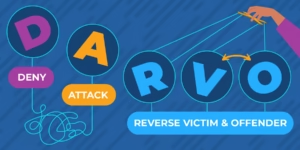
The pattern goes like this:
- The person denies the harmful behavior ever happened.
- They attack the credibility, character, or mental state of the person raising the concern.
- They reverse roles — claiming they are the real victim, while the person who was hurt is framed as the aggressor.
What makes DARVO particularly disorienting is the speed at which it works. A conversation that starts with you calmly raising a concern can end with you comforting the person who hurt you — and wondering if the whole thing was somehow your fault.
Once you understand the three-step structure, you’ll start to recognize it almost immediately.
Where Does the Term DARVO Come From?
The term DARVO was coined by Dr. Jennifer Freyd, a psychology researcher at the University of Oregon, in the late 1990s.
Her work focused on what she called “betrayal trauma” — the psychological experience of being harmed by someone you depend on or trust, like a partner, parent, or institution.
As part of that research, she began documenting how people who committed harmful acts tended to respond when confronted. A consistent pattern kept emerging: rather than taking responsibility, they would deny the behavior, attack the person confronting them, and then reframe the situation so they appeared to be the wronged party.
Dr. Freyd described this as a predictable institutional and interpersonal response to being held accountable — one that was designed, consciously or not, to silence the person raising the concern.
Her research initially focused on how institutions (schools, churches, corporations) use DARVO to protect themselves from accusations of wrongdoing. But the concept quickly expanded beyond institutional settings, because the same pattern showed up just as frequently in personal relationships.
Today, DARVO is widely used in therapeutic and educational contexts as a framework for helping people recognize and name a specific kind of manipulation that might otherwise leave them confused, doubting themselves, or silent.
Breaking Down the DARVO Acronym Step by Step
To fully answer the question of what is DARVO, it helps to examine each component individually.
D — Deny
The first move in DARVO is denial.
The person who caused harm refuses to acknowledge that the behavior happened — sometimes calmly, sometimes with dramatic force, but almost always with enough conviction to make the other person question their own memory.
Denial can take many forms:
- Flat denial: “That never happened.”
- Minimizing: “It wasn’t a big deal. You’re making this into something it’s not.”
- Reframing: “That’s not what I said. You’re taking it completely out of context.”
- Memory disputing: “I have no idea what you’re talking about.”
The goal of denial isn’t necessarily to convince the other person that their memory is wrong. It’s to introduce just enough uncertainty that the conversation becomes about whether something happened, rather than how to address it.
This is especially effective when the harmful behavior happened in private, with no witnesses — because now it’s one person’s word against another’s.
Example: You tell your partner, “Last night when you raised your voice and called me selfish in front of my family, I felt humiliated.” They respond: “I raised my voice? I wasn’t even loud. You always exaggerate everything.”
A — Attack
Once denial is in place, the next step is to attack.
This doesn’t always mean a full-blown argument or aggressive confrontation. Often, it’s subtler — a redirect toward the other person’s character, memory, emotional stability, or motives.
The attack step serves two purposes: it puts the person who raised the concern on the defensive (now they have to respond to criticism of themselves, not address the original issue), and it discredits them as a credible source.
Common attack patterns include:
- Attacking emotional stability: “You’re always so dramatic. You can never just have a normal conversation.”
- Attacking motives: “I know exactly what you’re doing. You’re just trying to start a fight.”
- Attacking character: “This is just like you — you always find something to complain about.”
- Bringing up unrelated past events: “Oh, so we’re doing this? Let’s talk about what YOU did last month.”
By the time the attack step lands, the conversation has often shifted entirely. The original concern is no longer on the table. Now, the person who raised it is explaining why they’re not “too sensitive,” not “crazy,” and not “attacking” the other person.
Example: “I don’t know why you always do this. You pick a fight right when things are going well. You have a real problem, you know that?”
R — Reverse Victim and Offender
The final and most disorienting step is the role reversal.
After denying and attacking, the person who caused harm now claims victim status. They present themselves as the one who has been wronged, hurt, or unfairly treated — by the very conversation you started.
The reversal can be subtle or dramatic:
- Subtle: Long silence, looking wounded, retreating — making you feel guilty for bringing something up.
- Moderate: “I can’t believe you’re treating me like this. After everything I do for you.”
- Dramatic: Tears, threats to end the relationship, or telling mutual friends that you “attacked” them.
The reversal works because it introduces a competing narrative. Now both people have a claim to being hurt. But the original concern — the thing that actually happened — has been completely buried.
Example: “I’m the one being attacked right now. You come at me with accusations, and then you wonder why I get upset? You’re the one hurting me.”
What Does DARVO Look Like in Real Life?
DARVO isn’t limited to one type of relationship. It shows up wherever someone wants to avoid accountability.
In a romantic relationship: A partner raises concerns about feeling emotionally neglected. The other partner says nothing like that ever happened, questions whether they’re “always trying to find problems,” and then says they feel “attacked and unappreciated” — and now needs comforting.
In a parent-adult child relationship: An adult child gently brings up a pattern from childhood that caused real pain. The parent denies anything happened, brings up how much they sacrificed, questions whether the child is being manipulated by a therapist, and then cries about being “accused” after all they’ve done.
In the workplace: An employee raises a concern about a manager making demeaning comments during a team meeting. The manager says it was “clearly a joke,” accuses the employee of being “too sensitive to work in a fast-paced environment,” and then reports to HR that the employee is creating a hostile dynamic.
In a friendship: A friend points out a hurtful comment made at a gathering. The other person says it was completely misinterpreted, questions whether the friend is “looking for reasons to be offended lately,” and then tells mutual friends they’ve been blindsided by a sudden attack on their character.
In every example, the structure is the same. Deny. Attack. Reverse. And the person who raised the concern ends up spending their energy defending themselves instead of discussing what actually happened.
Why Do People Use DARVO?
People don’t always use DARVO deliberately. Sometimes it’s a deeply ingrained reflex. But whether it’s conscious or not, it serves a function.

Protecting the self-image. For people whose identity is closely tied to being “a good person,” being confronted with harm they’ve caused can feel genuinely threatening to their sense of self. DARVO lets them deflect that threat without having to sit with the discomfort.
Avoiding real consequences. In cases where admitting to harmful behavior could mean losing a relationship, a job, or a reputation, denial and reversal become protective — keeping consequences at bay, at least temporarily.
It’s been learned and reinforced. Many people who use DARVO grew up in environments where this was modeled as the normal way to handle conflict. They watched adults deny, deflect, and reverse, and internalized it as the way conflict works.
It works. This might be the most important reason. DARVO is effective. It silences people, ends uncomfortable conversations, and leaves the person who was hurt second-guessing themselves enough to drop the issue. When a pattern is repeatedly rewarded, it becomes the default.
Signs You Are Experiencing DARVO
Because DARVO is designed to disorient, it can be hard to identify while it’s happening. These are signals worth watching for:
- You walk away from difficult conversations unsure of what was even said
- You regularly end up apologizing after bringing up something that bothered you
- You spend hours or days after a conflict replaying the conversation, questioning your own memory
- The other person’s response to your concerns consistently focuses on your flaws, not their behavior
- You feel like you can never raise anything without it “becoming a whole thing”
- You notice you’ve started self-censoring, anticipating how things will be turned back on you
- Mutual friends or family have heard a version of events where you were the problem
- Conversations about what the other person did somehow always end with you comforting them
None of these signs are definitive proof of DARVO on their own. But a cluster of them, especially over time, is worth paying attention to.
DARVO vs Gaslighting — Understanding the Difference
These two terms get confused because they often appear together. But they describe different things.
| DARVO | Gaslighting | |
|---|---|---|
| What it is | A three-step response to being confronted | A broader pattern of making someone doubt their reality |
| When it happens | Typically triggered by confrontation | Can happen at any time, in any conversation |
| Primary goal | Escape accountability | Undermine a person’s trust in their own perception |
| Overlap | Gaslighting is often part of the “deny” step | Can occur without DARVO’s full structure |
| How it feels | Sudden confusion, role reversal | Long-term disorientation, chronic self-doubt |
Gaslighting is often one of the tools used inside a DARVO response — especially in the denial step, where someone’s memory or interpretation of events is actively undermined.
But gaslighting can also happen independently, in everyday interactions, without the full three-step structure of DARVO.
The key distinction is that DARVO is specifically tied to moments of accountability — it’s a response to being confronted. Gaslighting is a broader, ongoing pattern of reality distortion.
DARVO and Narcissistic Abuse — Are They the Same Thing?
DARVO is strongly associated with narcissistic abuse, but the two aren’t interchangeable.
Narcissistic abuse refers to a broader pattern of manipulation tied to narcissistic personality traits — which can include love bombing, devaluation, stonewalling, smear campaigns, and more.
DARVO is one specific tactic that frequently appears within that pattern, especially during conflict or confrontation.
However, DARVO can also be used by people who don’t have narcissistic traits at all. Someone deeply shame-prone, someone with avoidant attachment, or someone who simply grew up in a household where blame was always deflected outward — any of these people might use DARVO in moments of confrontation without meeting any definition of narcissism.
So while DARVO is a common feature of narcissistic abuse, not everyone who uses DARVO is a narcissist, and not every form of narcissistic abuse involves DARVO specifically.
The Emotional Impact of Experiencing DARVO
The effects of repeated exposure to DARVO are real, and they accumulate over time.
Chronic self-doubt. After enough conversations where your memory and perception are challenged, it becomes difficult to trust your own version of events — even when you know what happened.
Anticipatory anxiety. You start dreading conversations before they happen, knowing from experience how they tend to end. Some people begin avoiding bringing up concerns entirely because the aftermath feels too exhausting.
Isolation. If the person using DARVO has spoken to others about the situation with a reversed narrative, you may find yourself socially isolated or feeling like you have to “prove” your experience to mutual friends.
Guilt and confusion. The reversal step is particularly damaging because it introduces real guilt — they looked so hurt. Maybe you were too harsh. Maybe the whole thing really was your fault. This confusion can make it very hard to assess any situation involving the other person clearly.
Loss of voice. Over time, many people in relationships with consistent DARVO dynamics stop raising concerns at all. This silence is what makes the pattern especially dangerous — it creates an environment where harmful behavior can continue unchecked.
How to Respond When DARVO Is Happening
You can’t force someone else to take accountability. But you can change how you respond in the moment, and that shift matters.
Stay anchored to the original point. When the conversation shifts to an attack on you or a claim of victimhood, gently bring it back: “I hear that you’re upset. I’d still like to talk about what happened yesterday.”
Name the pattern, if it feels safe to do so. This doesn’t mean accusing them of “doing DARVO.” It can simply be: “I notice that every time I bring something up, we end up talking about my behavior instead. Can we focus on the original concern?”
Don’t chase the attack. If someone attacks your character or memory during a confrontation, you don’t have to defend yourself. Defending yourself only takes you further from the original point. You can simply say, “I’m not interested in arguing about that right now. I want to talk about this specific thing.”
Document conversations when appropriate. In situations involving serious, repeated conflict — especially in workplace settings or relationships where safety is a concern — keeping a written record of what was said and when can help you trust your own memory, even when it’s being challenged.
Talk to someone outside the relationship. An outside perspective from a trusted friend, family member, or mental health professional can be invaluable. Isolation is one of the side effects of chronic DARVO — breaking it by talking openly to someone else is an important counter.
Give yourself permission to disengage. You’re allowed to say, “I’m not going to continue this conversation if it keeps coming back to accusations about me,” and leave the room. Staying in a DARVO cycle doesn’t produce resolution. It just produces exhaustion.
Can DARVO Change? Is It Possible for Someone to Stop Using It?
The honest answer is: it depends, and it’s usually not quick.
DARVO often functions as an automatic defensive response — meaning the person using it may not even fully realize they’re doing it. For change to happen, they need to first develop awareness of the pattern, then be willing to sit with the discomfort of accountability instead of deflecting it.
This is genuinely difficult work, and it typically requires professional support, usually in the form of individual therapy focused on accountability, shame, and communication.
Some people do change. But they have to want to, and that wanting has to come from within — not from the other person working harder to explain themselves or find the “right” way to raise concerns.
If you’re in a relationship where DARVO is a consistent pattern and the other person has shown no interest in examining their own behavior, that’s important information about what you can reasonably expect going forward.
When to Seek Professional Support
If DARVO is a recurring feature of a relationship — romantic, familial, or professional — therapy can help in two key ways.
First, a therapist can help you rebuild trust in your own perception after repeated experiences of being gaslit or having your concerns reversed. This is sometimes called “reality testing,” and it’s more important than it sounds.
Second, therapy can help you develop a clearer picture of the dynamic and decide how you want to respond — whether that means setting firmer limits, changing how you engage, or making decisions about whether to stay in the relationship.
This article is intended for informational purposes only and does not constitute clinical advice or diagnosis. If you believe you are experiencing manipulation or emotional harm, please speak with a licensed mental health professional.
FAQ
Is DARVO a diagnosable mental health disorder?
No. DARVO is a behavioral pattern, not a clinical diagnosis. It doesn’t appear in the DSM or ICD as a condition. It’s a framework used by psychologists and therapists to describe and explain a specific type of manipulative response to confrontation.
Who is most likely to use DARVO?
DARVO is commonly observed in people with high defensiveness, strong shame responses, or narcissistic traits. However, it can appear in anyone who has learned to avoid accountability — regardless of whether they have any diagnosable condition.
Can DARVO happen unintentionally?
Yes. Many people who use DARVO do so automatically, without being fully conscious of the pattern. It can be a deeply ingrained response, especially for people who grew up in environments where blame was consistently deflected or reversed.
Is DARVO the same as playing the victim?
They overlap significantly. The “reverse victim and offender” step of DARVO is essentially a sophisticated, structured version of playing the victim — but it happens specifically in response to being confronted, rather than just as a general manipulation tactic.
How do I prove DARVO is happening to me?
You don’t need to prove it to anyone to take your own experience seriously. That said, keeping detailed notes of conversations, including what was said and what shifted, can help you stay grounded in your own perception when it’s being actively challenged.
Can therapy help if I’ve experienced DARVO?
Yes, and it’s often very valuable. A therapist can help you rebuild trust in your own reality, process the emotional confusion that DARVO creates, and develop clearer strategies for how to handle relationships where this pattern is present.
Final Thoughts
What is DARVO, at its core? It’s a pattern that prioritizes the comfort of the person who caused harm over the reality of the person who experienced it.
Understanding the three steps — Deny, Attack, Reverse Victim and Offender — doesn’t just give you a vocabulary. It gives you a way to stay grounded when the conversation shifts beneath your feet.
You’re not too sensitive. Your memory isn’t faulty. And noticing this pattern isn’t an attack on anyone — it’s an act of clarity.