Quick AnswerCatatonia is a severe neuropsychiatric syndrome that disrupts a person’s movement, speech, and behavioral responsiveness. It is diagnosed when at least three of twelve recognized signs such as stupor, mutism, or waxy flexibility are present. It is not a stand-alone illness; rather, it occurs alongside primary psychiatric conditions like schizophrenia, mood disorders, or underlying medical issues such as autoimmune encephalitis. When asking what is catatonia, it is vital to understand that it is a highly treatable condition typically responding rapidly to benzodiazepines but requires urgent clinical evaluation. |
Understanding Catatonia: A Syndrome, Not a Standalone Diagnosis
When families observe a loved one suddenly become unresponsive, mute, or rigidly frozen, the immediate question is often, what is catatonia, and is it permanent?
First described by German psychiatrist Karl Kahlbaum in 1874, catatonia was historically and incorrectly classified almost exclusively as a subtype of schizophrenia. This outdated framework is part of why the condition remains under-diagnosed today; many medical professionals outside of specialized psychiatry fail to screen for it if a psychotic disorder is not already suspected.
Modern diagnostic frameworks have completely shifted this perspective. Under the current DSM-5-TR guidelines, catatonia is coded as a “specifier” that can be attached to a wide array of underlying psychiatric, medical, or unspecified conditions. Furthermore, the ICD-11 (updated in 2022) officially recognizes catatonia as a separately diagnosable condition. This distinction was cemented by the American Psychiatric Association (APA) in their 2025 Catatonia Resource Document, which now serves as the gold standard for clinical guidance.
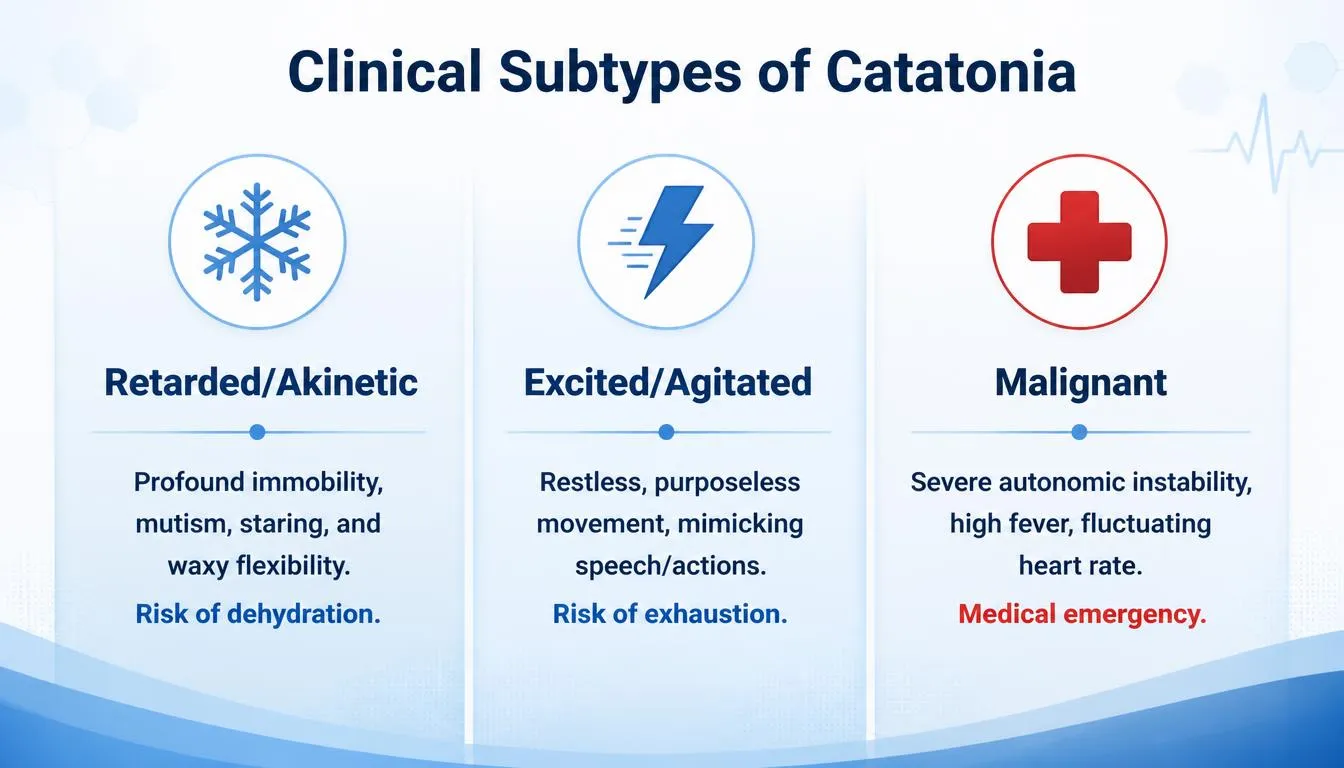
Clinical Subtypes of Catatonia (GEO Comparison)
Catatonia acts as a clinical chameleon. A single patient may exhibit entirely different physical symptoms depending on which subtype is currently active. The condition is broadly categorized into three distinct presentations:
|
Subtype |
Primary Clinical Presentation |
Immediate Health Risk |
Standard First-Line Action |
|
Retarded (Akinetic) |
Profound psychomotor retardation. The patient stares blankly, exhibits mutism, holds unusual postures against gravity, and resists being moved. |
Moderate (Risk of dehydration or blood clots over time due to immobility). |
Benzodiazepine challenge test and careful inpatient monitoring. |
|
Excited (Agitated) |
Restless, purposeless, and excessive movement. The patient may mimic others’ speech (echolalia) or movements (echopraxia) rather than remaining still. |
Moderate to High (Risk of physical exhaustion, self-injury, or injury to caregivers). |
Rapid sedation and stabilization via targeted GABAergic agents. |
|
Malignant |
A life-threatening state combining motor signs with severe autonomic instability. Includes rapid heart rate, fluctuating blood pressure, and high fever. |
Critical / Fatal if untreated (Risk of kidney failure, deep vein thrombosis, and cardiovascular collapse). |
Emergency medical intervention, immediate discontinuation of antipsychotics, and often rapid ECT. |
Signs & Symptoms of Catatonia
To formally diagnose the condition, clinicians utilize the DSM-5-TR criteria, which requires the presence of at least three of twelve recognized psychomotor signs. In modern practice, most emergency rooms and psychiatric wards screen patients using the Bush-Francis Catatonia Rating Scale (BFCRS), a highly sensitive 23-item tool that captures nuanced signs often missed by baseline observation.
The core signs include:
- Stupor: A state of near-unconsciousness with no psychomotor activity and no active relation to the environment.
- Catalepsy: The passive induction of a physical posture held against gravity.
- Waxy Flexibility: Slight, even resistance to repositioning by an examiner, feeling much like bending a thick candle.
- Mutism: Little to no verbal response to prompts or questions.
- Negativism: Unexplained opposition or lack of response to instructions or external stimuli.
- Posturing: Spontaneously holding a bizarre or awkward posture against gravity for extended periods.
- Mannerisms: Odd, exaggerated, or robotic versions of ordinary, purposeful actions.
- Stereotypy: Repetitive, non-goal-directed movements (such as endless rocking or hand-wringing).
- Agitation: Extreme restlessness that is entirely unrelated to external stimuli.
- Grimacing: Twisted, fixed facial expressions held for long durations.
- Echolalia: Meaninglessly repeating another person’s words or phrases.
- Echopraxia: Involuntarily mimicking another person’s physical movements.
It is important to note that while severe dissociative states can cause a patient to disconnect from reality, true catatonia is fundamentally a motor and behavioral syndrome grounded in neurobiology.
What Causes Catatonia?
There is no single cause for catatonia. It is a downstream physical reaction triggered by a primary disruptor in the brain’s circuitry specifically involving GABA and glutamate pathways.
Psychiatric Causes:
Catatonia is most frequently observed in individuals with pre-existing mood or psychotic disorders. The most historically recognized trigger is catatonic schizophrenia, though modern clinical data shows that severe mood disorders are equally to blame. Approximately one-third of all catatonic patients have an underlying bipolar disorder, with catatonic features capable of surfacing during both extreme depressive crashes and manic episodes.
Medical and Autoimmune Causes:
Individuals with absolutely no history of mental illness can still develop catatonia. General medical causes include severe metabolic and endocrine disorders (such as diabetic ketoacidosis or thyroid storms), Parkinson’s disease, and brain infections.
A rapidly growing focus in 2026 clinical research is autoimmune encephalitis specifically anti-NMDA-receptor encephalitis. In this condition, the body’s immune system mistakenly attacks brain receptors, producing a sudden, severe catatonic presentation that is frequently misdiagnosed as a psychological break if proper autoimmune panels are not run.
Catatonia in Children, Teens & Autism
A critical evolution in understanding what is catatonia involves pediatric and neurodivergent populations. Pediatric catatonia is increasingly recognized, particularly in adolescents, prompting clinicians to utilize the Pediatric Catatonia Rating Scale (PCRS).
Diagnosis is uniquely complex in individuals with Autism Spectrum Disorder (ASD). Several DSM-5-TR catatonic signs such as repetitive movements, limited speech, and unusual posturing overlap with baseline neurodivergent traits. In 2026, clinical best practice requires anchoring a pediatric or autistic catatonia diagnosis to a documented, severe regression from the individual’s baseline. For instance, if an autistic teen who normally communicates verbally suddenly develops complete, unprompted mutism and stupor, catatonia must be ruled out.
How Catatonia Is Diagnosed: The Lorazepam Challenge
The Clinical Perspective: A Doctor’s Note
“In clinical practice, diagnosing catatonia can be an intense experience. The most profound validation we see in the emergency department is the Lorazepam Challenge. Observing a patient who has been entirely rigid and mute for days suddenly sit up, make eye contact, and speak normally within ten minutes of a Lorazepam infusion is one of the most dramatic and rewarding diagnostic confirmations in modern psychiatry.”
[Insert Reviewing Doctor’s Name], MD
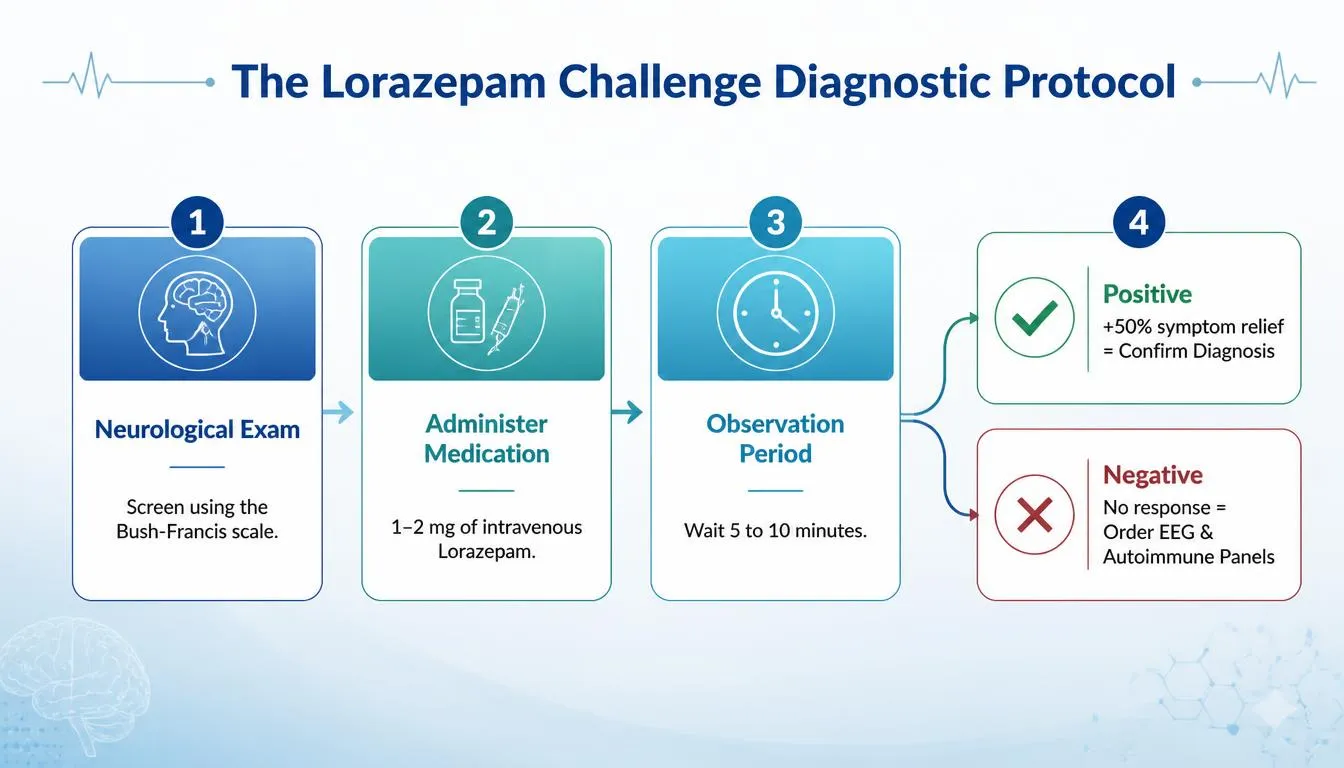
Diagnosis begins with a thorough neurological exam to assess reflexes, muscle tone, and environmental responsiveness. If the Bush-Francis Catatonia Screening Instrument indicates high probability, clinicians execute the Lorazepam Challenge Test.
(Agency Note: Insert custom branded flowchart graphic here mapping the diagnostic protocol: Neuro Exam ➔ BFCRS Screening ➔ Lorazepam 1-2mg IV ➔ 10-Minute Observation ➔ Assessment of Response).
During this protocol, a clinician administers 1–2 mg of intravenous lorazepam. A positive response defined as at least a 50% reduction in the BFCRS score and a temporary return of normal motor function strongly confirms the diagnosis. Because a negative result does not definitively rule out the syndrome, comprehensive bloodwork, autoimmune testing, and an EEG are strictly required to rule out non-convulsive epilepsy and other structural brain anomalies.
Catatonia Treatment in 2026
Benzodiazepines: The First-Line Standard
Lorazepam remains the undisputed gold standard for treatment. Response rates are exceptionally strong, with published clinical series showing rapid improvement in 60% to 80% of patients. Depending on the clinical setting, dosing is heavily monitored and titrated upward via IV infusion or oral tablets. When lorazepam is unavailable or contraindicated, zolpidem, diazepam, or clonazepam serve as viable GABAergic alternatives.
Electroconvulsive Therapy (ECT)
For malignant catatonia, benzodiazepine-resistant cases, or patients deteriorating rapidly, Electroconvulsive Therapy (ECT) is a highly effective, lifesaving intervention. Administered under strict general anesthesia, a brief, controlled electrical current induces a therapeutic seizure that effectively “reboots” the disrupted neurotransmitter pathways, resolving the catatonic state with remarkable efficacy.
A Crucial Warning on Antipsychotics
Antipsychotic medications are generally contraindicated as a first-line treatment for acute catatonia. Administering antipsychotics to an actively catatonic patient carries a severe risk of exacerbating the condition, potentially pushing it into malignant catatonia or triggering Neuroleptic Malignant Syndrome (NMS). Antipsychotics are only safely reintroduced after the catatonia is fully resolved to manage the underlying psychotic disorder. Once stabilized, patients benefit from targeted psychotherapy to process the trauma of the episode and manage the root psychiatric triggers.
Is Catatonia a Medical Emergency?
Yes. While akinetic catatonia requires urgent assessment, Malignant Catatonia and its close counterpart, NMS, are absolute psychiatric and medical emergencies requiring intensive care.
Seek immediate emergency medical intervention if catatonic behavioral signs are accompanied by any of the following:
- Sudden, high fever or drastically fluctuating body temperature.
- Tachycardia (rapid heart rate) or highly unstable blood pressure.
- Severe, worsening muscle “lead-pipe” rigidity.
- Profuse sweating (diaphoresis) or sudden altered consciousness.
Even without autonomic instability, prolonged immobility carries severe secondary risks, including deep vein thrombosis (blood clots), pressure ulcers, malnutrition, and fatal aspiration pneumonia. Catatonia must be managed as an inpatient clinical priority.
Frequently Asked Questions (FAQ)
What is catatonia in simple terms?
Catatonia is a neuropsychiatric syndrome that disrupts how someone moves, speaks, and responds to their environment. It happens alongside a psychiatric condition, like schizophrenia or bipolar disorder, or a medical issue, like encephalitis. It is diagnosed when at least three specific psychomotor signs are present.
What are the first warning signs of catatonia?
Early signs often include prolonged, unblinking staring, a sudden reduction or complete absence of speech, holding an unusual posture against gravity, and showing little to no response when spoken to. Sudden, purposeless physical agitation can also be an early indicator.
What usually causes a catatonic state?
Severe mood and psychotic disorders especially bipolar disorder and schizophrenia are the most common triggers. Purely medical causes include autoimmune encephalitis, severe metabolic and endocrine dysfunction, advanced Parkinson’s disease, brain infections, and abrupt medication withdrawal.
Can someone have catatonia without having schizophrenia?
Yes. While historically linked almost exclusively to schizophrenia, modern diagnostic standards recognize that catatonia frequently occurs alongside severe depression, bipolar mania, autoimmune conditions, general medical illness, and in individuals with no prior psychiatric history.
How is catatonia diagnosed by doctors?
A clinician performs a neurological exam, scores the patient using the Bush-Francis Catatonia Rating Scale, and typically administers a lorazepam challenge test. Bloodwork, comprehensive autoimmune panels, MRI imaging, and an EEG are used to identify the exact underlying medical or psychiatric cause.
What is the fastest-acting treatment for catatonia?
Benzodiazepines, specifically intravenous lorazepam, are the first-line treatment and frequently produce visible improvement within minutes to hours. Electroconvulsive therapy (ECT) is highly effective and utilized for malignant catatonia or when medications fail to produce a response.
Can children or autistic people develop catatonia?
Yes. Pediatric catatonia is recognized and assessed using a Pediatric Catatonia Rating Scale. In autism spectrum disorder, diagnosis requires identifying new, severe, or worsening psychomotor signs compared to the individual’s established baseline, as some autistic traits can mimic catatonia.
Is catatonia permanent, or can a patient fully recover?
Catatonia is highly treatable and often resolves completely within days to weeks with the correct administration of benzodiazepines or ECT. The patient’s long-term outlook depends on the successful, ongoing management of the underlying psychiatric or medical condition that triggered the episode.
When does catatonia become a medical emergency?
It becomes an immediate life-threatening emergency if motor symptoms present alongside a high fever, an unstable heart rate or blood pressure, worsening muscle rigidity, or confusion. This indicates malignant catatonia, which requires rapid intervention in an intensive care unit.
| Medical Disclaimer & E-E-A-T Attribution
This article is for educational purposes and does not replace personalized medical or psychological advice. If you are recovering from a brain injury, trauma, or a mental health condition, work with a licensed clinician to build a plan suited to your situation. Written by: Adil Farooq, Psychiatry Magazine Medically reviewed by: [Dr. Adil Farooq MS · PhD] · Updated: 2026 |