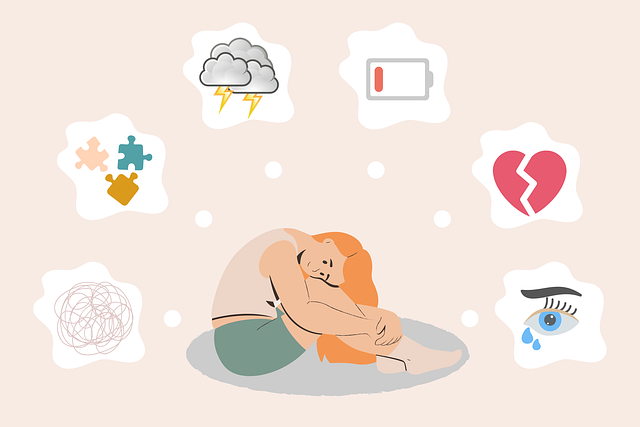
Short answer: Medicaid does not typically list “couples counseling” or “marriage counseling” as a standalone covered benefit. However, couples and conjoint therapy sessions are frequently reimbursed by Medicaid when at least one partner has a documented, billable mental health diagnosis and the session is clinically justified as treatment for that individual’s condition. Because Medicaid is a joint federal-state program, the specifics, covered CPT codes, session limits, prior authorization rules, and which providers can bill, vary by state and by managed care organization (MCO).
This guide breaks down exactly how Medicaid decides what qualifies, which diagnoses open the door to conjoint sessions, how billing actually works behind the scenes, and what to do if your state plan says no.
| Quick Answer for Fast Readers
● Medicaid rarely covers “marriage counseling” as its own category. ● It can cover couples sessions when billed as treatment for one partner’s diagnosed mental health condition (relational distress alone usually isn’t enough). ● Coverage, session caps, and provider rules differ by state and by Medicaid managed care organization (MCO). ● Licensed Marriage and Family Therapists (LMFTs), LCSWs, psychologists, and psychiatric providers may all be able to bill conjoint sessions, depending on your state’s provider enrollment rules. ● If Medicaid denies coverage, sliding-scale clinics, training clinics, and online platforms are realistic fallback options. |
The Short Answer: It Depends on the Diagnosis, Not the Relationship
Medicaid, like most commercial insurance, is built around the concept of medical necessity. A treatment is covered when it addresses a diagnosable condition experienced by an identified patient, not simply because two people are struggling to get along. This is the single most important concept to understand before you ever call your state Medicaid office or a provider’s billing department.
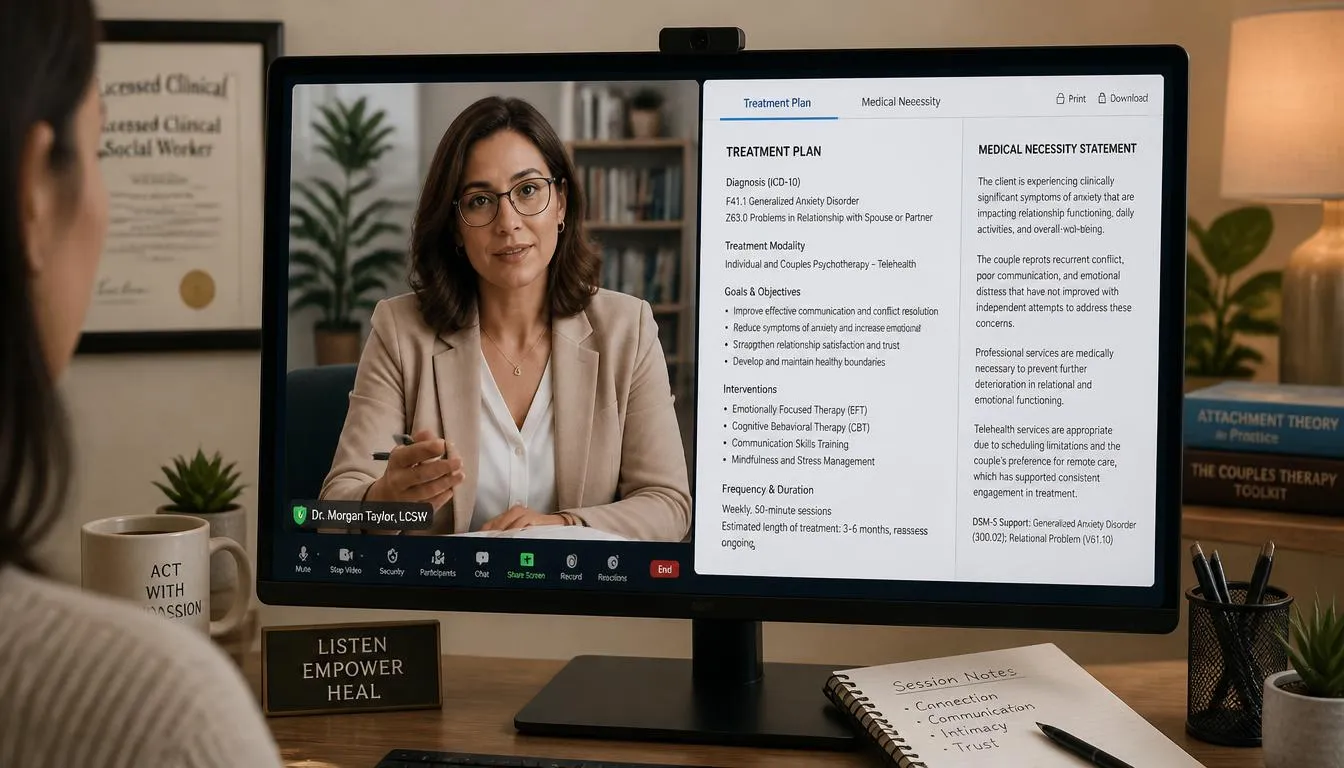
In practice, this means the label on the session matters enormously. “Marital conflict” or “relationship problems” on their own are typically classified using DSM “Z-codes” (such as Z63.0, problems in relationship with spouse or partner), and Z-codes are generally not reimbursable as a primary diagnosis under Medicaid. But when a partner is diagnosed with a covered clinical condition, depression, anxiety, PTSD, or an adjustment disorder, for example and the treating clinician determines that conjoint (couples) sessions are an appropriate, evidence-based part of that person’s treatment plan, Medicaid can often reimburse the session.
Why Medicaid Doesn’t Cover “Marriage Counseling” as a Standalone Benefit
Relational Distress vs. Individual Clinical Disorders
Every Medicaid state plan is required to cover medically necessary mental health services, but “medically necessary” is defined around individual clinical diagnoses, not relationship dynamics. This creates a meaningful distinction:
- Relational distress: Communication breakdowns, trust issues, or general dissatisfaction in the relationship, without a diagnosable individual disorder driving the referral.
- Individual clinical disorder: A diagnosis such as major depressive disorder, generalized anxiety disorder, PTSD, or an adjustment disorder, where relationship strain is a symptom or contributing stressor that the clinician is actively treating.
Medicaid programs are generally comfortable covering the second category and reluctant to cover the first. That’s why so many people searching for “couples counseling Medicaid” coverage get inconsistent answers, the outcome hinges on how the case is framed clinically, not on the fact that two adults are sitting in the room.
The Role of CPT Billing Codes
Behind every covered session is a CPT (Current Procedural Terminology) code that tells Medicaid what actually happened in the room. For couples and family work, the two most relevant codes are:
- CPT 90847 — Family psychotherapy with the identified patient present. This is the code most often used for couples counseling, since one partner is treated as the identified patient and the other partner participates as part of the treatment.
- CPT 90846 — Family psychotherapy without the patient present, typically used when a clinician meets with a partner or family member to support the identified patient’s treatment.
- CPT 90837 / 90834 — Standard individual psychotherapy codes (60 or 45 minutes), used when sessions are one-on-one rather than conjoint.
If a provider bills a session under a generic “marriage counseling” label instead of one of Medicaid’s recognized psychotherapy codes tied to a covered diagnosis, the claim is far more likely to be denied. Getting the billing code and the diagnosis code aligned correctly is often the real difference between a covered session and an out-of-pocket one.
How Medicaid Actually Pays for Conjoint Sessions: The “Identified Patient” Model
Under this model, one partner is designated as the identified patient, meaning the treatment record, diagnosis, and Medicaid claim are filed under that individual’s coverage. The other partner attends as a collateral participant whose presence supports the identified patient’s treatment goals. This is a completely standard and clinically accepted structure — it’s simply how the paperwork has to be organized for Medicaid (and most private insurers) to recognize the service as medically necessary.
Common Qualifying Diagnoses
Couples sessions are most likely to be approved when they are tied to diagnoses such as:
- Major depressive disorder or persistent depressive disorder
- Generalized anxiety disorder
- Post-traumatic stress disorder (PTSD), including relational trauma
- An adjustment disorder related to a major life stressor, such as a job loss, relocation, health crisis, or the relationship strain itself
- Substance use disorders, where family or couples sessions support recovery and relapse prevention
Notice that an adjustment disorder is one of the more common entry points to covered couples work, because it explicitly recognizes that a significant stressor, which can absolutely include relationship conflict, is causing clinically significant symptoms in one partner. A licensed clinician who identifies this pattern during an intake assessment can build a treatment plan that includes conjoint sessions as part of evidence-based care for that diagnosis.
Medical Necessity Documentation
For a couples session to hold up under a Medicaid audit or utilization review, the clinical record generally needs to show:
- A formal diagnosis for the identified patient, established through an intake evaluation
- A written treatment plan that specifically names conjoint or family sessions as part of the care plan
- Progress notes that tie each session back to the identified patient’s symptoms and treatment goals
- A licensed provider who is enrolled with Medicaid (or contracted with your MCO) and authorized to bill the relevant CPT code
State-by-State Medicaid Policy Variations You Need to Know
There is no single federal rule that spells out how couples counseling is handled under Medicaid. States have considerable flexibility in designing their behavioral health benefits, and most Medicaid beneficiaries today are enrolled through managed care organizations (MCOs) rather than traditional fee-for-service Medicaid. That adds another layer of variation, because each MCO negotiates its own network, prior authorization rules, and utilization management policies within the boundaries set by the state.
A few patterns worth knowing before you call your plan:
- States that route behavioral health through Certified Community Behavioral Health Clinics (CCBHCs) or community mental health centers often have more flexibility to authorize family and conjoint sessions as part of a broader treatment episode.
- Some MCOs require prior authorization for family psychotherapy codes (90846/90847), even if individual therapy doesn’t require it.
- A handful of states explicitly exclude “marital counseling” by name in their Medicaid provider manuals, which makes correct diagnosis and coding even more important.
- Session limits, when they exist, are usually expressed as an annual cap on outpatient psychotherapy visits overall, not a separate cap specifically for couples sessions.
Because these rules shift from year to year and state to state, the most reliable step is to call the member services number on your Medicaid or MCO card and ask directly: “Is CPT code 90847 covered under my plan, and does it require prior authorization?” That single question tends to cut through a lot of ambiguity.
Who Can Actually Provide Medicaid-Covered Couples Therapy?
Provider eligibility rules also vary by state, but the professionals most commonly authorized to bill Medicaid for conjoint or family psychotherapy sessions include:
- Licensed Marriage and Family Therapists (LMFTs)
- Licensed Clinical Social Workers (LCSWs) or LMSWs, depending on the state
- Licensed Professional Counselors (LPCs) or LMHCs
- Clinical psychologists (PhD or PsyD)
- Psychiatric nurse practitioners and psychiatrists, particularly when medication management is also part of care, see our full breakdown of the therapist vs psychiatrist distinction for how these roles differ and when you might need both.
Not every licensed clinician who accepts Medicaid is enrolled to bill family psychotherapy codes specifically, so it’s worth asking directly whether a prospective provider bills 90847 for couples work before you schedule an intake.
5 Steps to Get Couples Counseling Covered Through Medicaid
- Start with an individual diagnostic evaluation. One or both partners should complete an intake assessment with a licensed mental health provider to establish a formal diagnosis.
- Ask your clinician whether conjoint sessions fit the treatment plan. A qualifying diagnosis, depression, anxiety, PTSD, or an adjustment disorder tied to relationship stress, opens the door to couples sessions billed under CPT 90847.
- Confirm the provider is Medicaid-enrolled and bills family psychotherapy codes. Not every in-network therapist offers or bills for conjoint sessions, so confirm this before your first appointment.
- Check for prior authorization requirements with your MCO. Call member services and ask specifically about CPT codes 90846 and 90847.
- Request a written treatment plan that names couples sessions as part of care. This documentation protects coverage if the claim is ever reviewed or audited.
What If Medicaid Won’t Cover It? Affordable Alternatives for Couples
If your state Medicaid plan or MCO ultimately denies coverage for conjoint sessions, you still have realistic options for affordable care:
- Sliding-scale community mental health centers, which set fees based on household income
- University and graduate training clinics, where supervised clinicians-in-training offer therapy at reduced rates
- Employee Assistance Programs (EAPs), which often include a limited
 number of free counseling sessions regardless of insurance
 - Nonprofit and faith-based counseling centers, many of which use donation-based or sliding-scale pricing
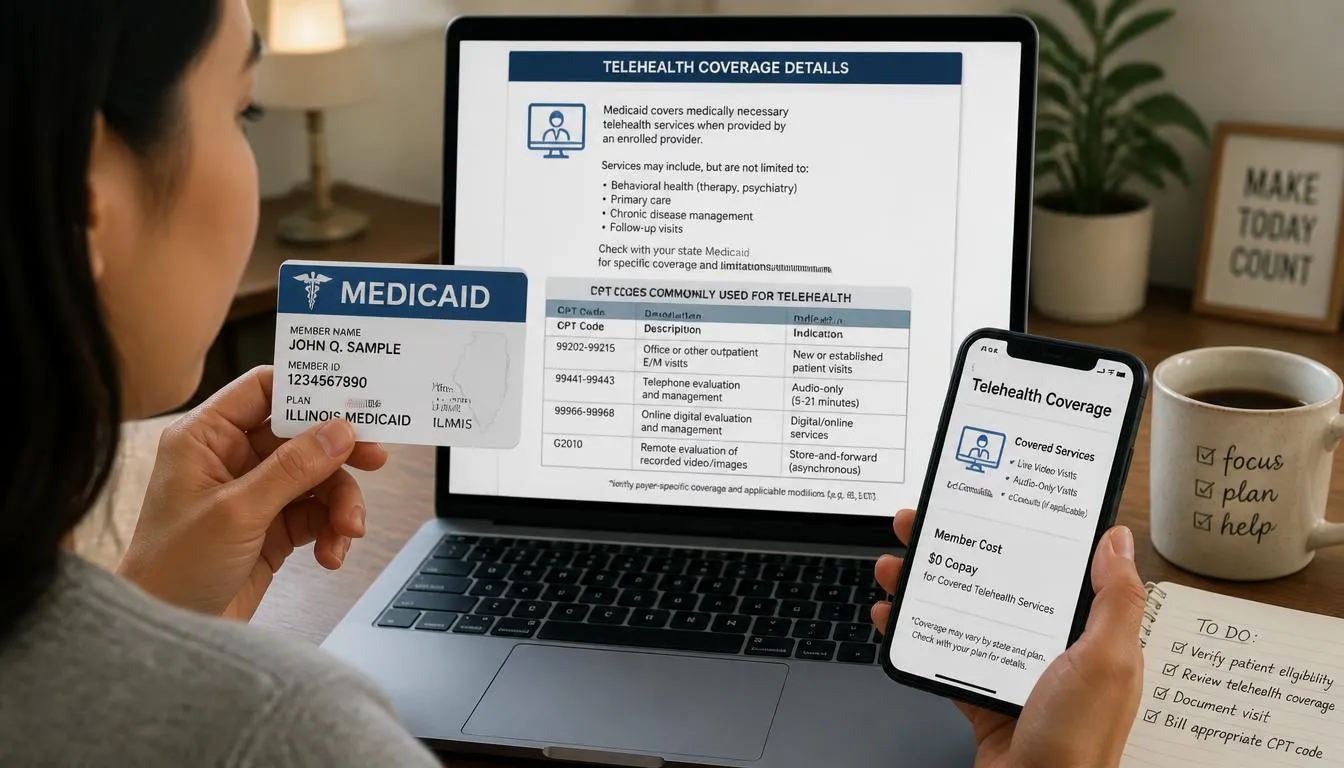
- Telehealth platforms offering online couples relationship counselling, which can be more affordable than in-person practice rates and may offer flexible payment plans even without insurance coverage
Combining approaches often works well in practice: one partner pursues individual, Medicaid-covered treatment for a diagnosed condition, while the couple separately accesses lower-cost conjoint sessions through a sliding-scale or online provider.
Individual Therapy vs. Couples Therapy Under Medicaid: The Clinical Distinction
Understanding how clinicians categorize therapy modalities can help you have a more productive conversation with your provider about what Medicaid is likely to cover. Couples-focused approaches such as the Gottman Method, Emotionally Focused Therapy (EFT), and Cognitive Behavioral Therapy (CBT) adapted for couples are all considered legitimate, evidence-based psychotherapy, the coverage question isn’t about the modality itself, but about whether it’s tied to a covered diagnosis and billed correctly.
If you’re trying to understand how couples-based approaches fit alongside individual modalities like CBT, DBT, or psychodynamic therapy, our types of psychotherapy explained guide walks through each major modality in plain language, including which conditions each approach tends to treat best.
Frequently Asked Questions
Does Medicaid cover marriage counseling for anxiety or depression?
Yes, this is one of the most common paths to coverage. If one partner has a diagnosed anxiety disorder or depression and the treating clinician determines that conjoint sessions support that person’s treatment plan, the sessions can typically be billed under CPT 90847 and covered like any other outpatient psychotherapy visit.
What CPT code is used for couples therapy billed to Medicaid?
Most conjoint couples sessions are billed using CPT 90847 (family psychotherapy with the identified patient present). CPT 90846 is used when the clinician meets with a partner or family member without the identified patient present. Both codes require a documented diagnosis and a treatment plan showing medical necessity.
Can we get couples counseling covered by Medicaid if we’re not married?
Yes. Coverage decisions are based on the identified patient’s diagnosis and treatment plan, not marital status. Unmarried partners, engaged couples, and long-term partners can generally access the same conjoint therapy billing structure as married couples.
Does every state Medicaid program treat couples therapy the same way?
No. Medicaid is state-administered, and each state, along with each managed care organization operating within it, sets its own rules for prior authorization, session limits, and provider eligibility for family psychotherapy codes. Always confirm details directly with your specific plan.
What’s the difference between couples therapy and family therapy for Medicaid billing purposes?
Both are typically billed under the same family psychotherapy CPT codes (90846/90847). The distinction is about who is in the room and how the identified patient’s treatment plan is written, couples therapy involves partners, while family therapy may involve children, parents, or other relatives, but the underlying medical-necessity and coding logic is the same.
How do I find a therapist who accepts Medicaid for couples sessions?
Start with your state’s Medicaid provider directory or your MCO’s online “find a provider” tool, and filter for behavioral health or family therapy. When you call a prospective provider, ask specifically whether they are enrolled to bill CPT 90847 for conjoint sessions, since not every Medicaid-enrolled therapist offers this service.
Will Medicaid cover online or telehealth couples counseling?
Many state Medicaid programs expanded telehealth coverage for behavioral health services, including family psychotherapy codes, and a number of these telehealth allowances have remained permanent. Coverage still depends on the same diagnosis and medical-necessity rules that apply to in-person sessions, so confirm telehealth eligibility with your specific plan before booking.
The Bottom Line
Couples counseling and Medicaid can work together, but only when the paperwork tells the right clinical story: a documented diagnosis for one partner, a treatment plan that names conjoint sessions as part of care, and a provider who bills the correct family psychotherapy CPT code. If your state plan or MCO denies coverage, sliding-scale clinics, training programs, and online platforms remain practical, lower-cost ways to keep working on your relationship while you explore your options. When in doubt, a single phone call to your Medicaid member services line, asking specifically about CPT code 90847 and prior authorization, is the fastest way to get a definitive answer for your situation.
Medical Disclaimer & E-E-A-T AttributionThis article is for educational purposes and does not replace personalized medical or psychological advice. If you are recovering from a brain injury, trauma, or a mental health condition, work with a licensed clinician to build a plan suited to your situation. Written by: Adil Farooq, Psychiatry Magazine Medically reviewed by: [Dr. Adil Farooq MS · PhD] · Updated: 2026 |