| QUICK ANSWER
A PTSD episode’s acute phase, the flashback, panic-like surge, or dissociative spike, typically lasts minutes to a few hours. A residual “trauma hangover” of exhaustion, numbness, and hypervigilance can then linger for hours to several days. Duration depends on trigger intensity, coping skills, safety, and trauma history. Acute Duration: Minutes to a few hours, the peak physiological spike, including flashbacks, panic-adjacent surges, and dissociation. The “Trauma Hangover” (Residual Phase): Hours to several days, emotional exhaustion, autonomic hyperarousal, brain fog, or emotional numbness. Key Variable Factors: Trigger intensity, regulatory capacity, safety of the environment, co-occurring substance use, and trauma type (single-incident vs. complex or developmental trauma). |
Defining a “PTSD Episode”
“PTSD episode” is not a formal diagnostic term found in the DSM-5-TR. The manual defines Post-Traumatic Stress Disorder (code 309.81) as a persistent clinical condition built on four symptom clusters: intrusion, avoidance, negative alterations in cognition and mood, and marked changes in arousal and reactivity. Clinically, what people describe as an “episode” or “PTSD attack” is an acute flare of these symptoms, a discrete window in which the nervous system’s threat-detection circuitry fires at high intensity, distinct from the lower-grade baseline vigilance that many people with chronic PTSD carry day to day.
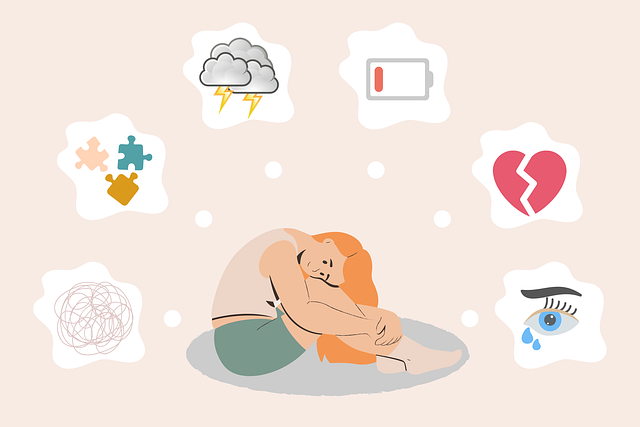
During an active episode, several processes can unfold at once or in rapid succession. A flashback is a sensory fragment of the trauma resurfacing so vividly that it can feel less like a memory and more like the event happening again in real time. Emotional flooding is a sudden, disproportionate surge of fear, grief, shame, or rage that arrives faster than it can be rationally processed. Dissociation shows up as depersonalization (feeling detached from one’s own body) or derealization (the surroundings feeling unreal, dreamlike, or distant). And panic-adjacent hyperarousal brings the physical signature most people associate with a PTSD attack: a racing heart, shallow or rapid breathing, sweating, and an overwhelming urge to flee, fight, or freeze in place.
What triggers emotional flashbacks can be strikingly specific or diffusely sensory, a raised voice, a particular scent, a date on the calendar, a crowded room, or a piece of media that echoes the original event. Because the amygdala encodes trauma memory with more emphasis on sensation than narrative sequence, a trigger doesn’t need to closely resemble the original trauma to activate the same alarm response.
The defining feature that separates an episode from baseline PTSD is time-boundedness. Chronic symptoms, hypervigilance, sleep disruption, a persistent low-level sense of dread, can hum in the background for months or years without a clear start or end point. An episode, by contrast, is the acute spike layered on top of that baseline: intense, disruptive, frightening in the moment, and, this is the detail most worth holding onto, self-limiting. The nervous system is built to return to baseline; it is not designed to sustain peak alarm indefinitely.
How Long Does a PTSD Episode Last? Timeline Breakdown
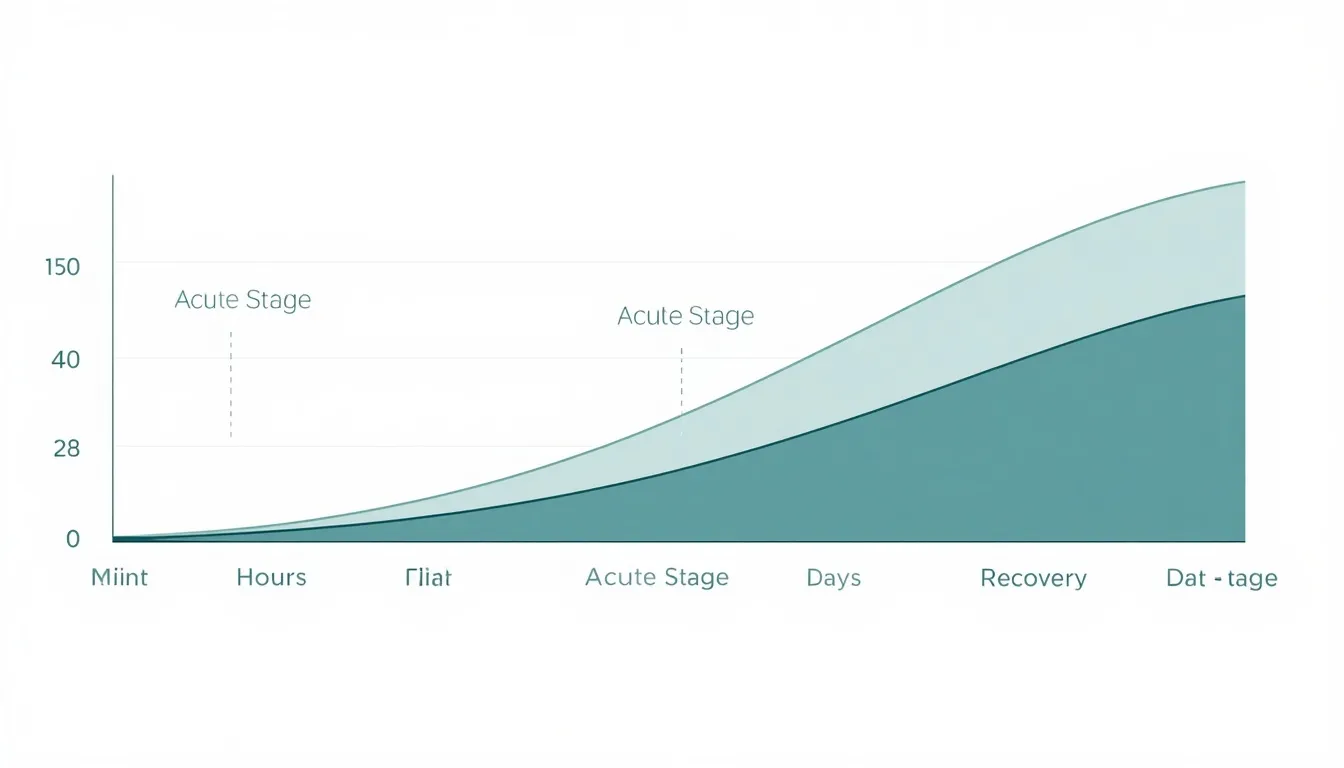
There is no single stopwatch answer, because a PTSD episode unfolds in two functionally distinct stages that operate on very different timelines: a short, intense acute stage, and a longer, quieter recovery stage.
The Acute Stage (Minutes to Hours)
The acute stage is the peak of autonomic arousal, the part most people mean when they ask how long a PTSD episode lasts. The sympathetic nervous system floods the body with adrenaline and cortisol within seconds of a trigger, producing the recognizable physical signature: elevated heart rate, rapid or shallow breathing, muscle tension, sweating, and a narrowed, hyperfocused attention on the perceived threat. For most people, this peak intensity holds for roughly five to twenty minutes before beginning to taper, similar in shape to the physiological curve of a panic attack.
What often extends a PTSD episode beyond that window is the intrusive-memory component layered on top of the physiological spike. Unlike a standalone panic attack, a flashback can keep re-triggering itself, a vivid sensory detail surfaces, the body reacts as though the threat is current, the reaction produces new sensations, and those sensations feed back into the flashback. This loop can stretch the acute stage to one or two hours, particularly when the person is unable to physically or psychologically exit the triggering environment. It’s worth noting this dynamic differs somewhat from acute stress disorder, a related but separate diagnosis describing trauma reactions in the first month after an event; understanding how episodic PTSD timelines compare to short-term acute stress reactions can clarify why an episode months or years after a trauma still follows a similar acute-then-recovery arc.
The De-escalation & Exhaustion Stage (“The Trauma Hangover”)
Once the acute physiological peak passes, the body does not simply switch back to baseline. Cortisol and adrenaline take time to clear from the bloodstream, and the nervous system needs time to downshift out of a defensive state. This produces what many clinicians and patients alike describe as a “trauma hangover”: physical fatigue that can feel disproportionate to the time elapsed, brain fog and difficulty concentrating, emotional numbness or, conversely, heightened emotional reactivity to minor stressors, and a lingering sense of hypervigilance even in objectively safe surroundings.
This residual phase typically lasts anywhere from a few hours to one to three days. Sleep is frequently disrupted during this window, either through difficulty falling asleep due to lingering arousal, or through nightmares that re-activate elements of the same trauma material. In more severe presentations, particularly where the trigger was intense, the trauma history is complex, or the person has limited recovery resources, this exhaustion phase can extend up to a week. Appetite changes, irritability, social withdrawal, and a reduced capacity to tolerate normal daily stressors are common during this stretch, even though the acute spike itself has long since passed.
Factors That Dictate Episode Duration
No two PTSD episodes unfold identically, and duration is shaped by a cluster of interacting variables rather than any single cause.
Trigger severity and proximity to the original trauma. A trigger that closely mirrors a core sensory element of the trauma, a specific sound, smell, or physical sensation, tends to produce a sharper, longer-lasting reaction than a more distantly associated cue. Repeated or prolonged trigger exposure (being unable to leave the triggering situation, for example) also extends both the acute and recovery stages.
Regulatory capacity and coping toolkit. Clinicians often describe this using the concept of the “window of tolerance”, the band of arousal within which a person can think clearly and stay present. Someone with a well-practiced set of grounding and somatic regulation skills tends to move through an episode faster than someone encountering intense dysregulation with no established coping strategy.
Safe versus hostile physical and social environment. A supportive, validating environment, a calm space, a trusted person who responds without judgment, shortens recovery. A chaotic, unsafe, or invalidating environment (including being dismissed, rushed, or re-exposed to trauma-adjacent stimuli) can prolong or even re-escalate an episode that was beginning to settle.
Co-occurring substance use. Alcohol and many recreational or misused substances interfere with the nervous system’s natural regulation process, either by blunting the parasympathetic rebound needed to de-escalate or by producing rebound anxiety and disrupted sleep that extend the exhaustion phase. Substance use as a coping mechanism, while understandable, is consistently associated with longer and more frequent episodes over time.
Trauma type, single-incident versus complex or developmental trauma. This is one of the most significant variables. Someone with PTSD from a single, time-limited event often experiences episodes with a relatively predictable arc. The picture changes when the trauma was repeated, prolonged, or occurred during childhood development, which is where the diagnosis of Complex PTSD becomes clinically relevant. Understanding how episode duration, intensity, and frequency differ between single-incident PTSD and complex PTSD helps explain why some people experience episodes that feel harder to interrupt, more entangled with emotional dysregulation, or accompanied by identity disturbance and relational difficulty rather than a clean acute-to-recovery arc.
Neurobiology of the Episode
Understanding what the brain and body are actually doing during a PTSD episode helps explain both why it feels so overwhelming and why it reliably resolves.
At the center of the acute reaction is the amygdala, the brain’s threat-detection hub. In PTSD, the amygdala becomes hypersensitized, firing in response to cues that resemble the original trauma even when there is no present danger, a phenomenon often described colloquially as an “amygdala hijack.” Under normal circumstances, the prefrontal cortex, responsible for reasoning, context, and top-down emotional regulation, would help evaluate the threat and calibrate the response. In PTSD, functional imaging research has repeatedly shown reduced prefrontal cortex activity during trauma-related triggers, which is part of why rational reassurance (“you’re safe now”) often fails to land in the moment; the brain region responsible for processing that reassurance is, temporarily, offline.
This amygdala-prefrontal imbalance also involves the hippocampus, which is responsible for placing memories in their correct time and context. When hippocampal function is disrupted during high-stress encoding, trauma memories can be stored in a fragmented, poorly time-stamped way, which is part of why a flashback can feel like the past intruding into the present rather than a memory being recalled.
Simultaneously, the sympathetic nervous system, the body’s accelerator, triggers the fight, flight, or freeze response, releasing adrenaline and cortisol and producing the physical symptoms of an episode. Recovery depends on the parasympathetic nervous system, particularly vagal tone, gradually reasserting control. Polyvagal theory offers a useful frame here: a ventral vagal state supports calm, social engagement and signals safety to the nervous system, while a dorsal vagal state is associated with shutdown, numbing, and dissociative freeze responses, which is why some PTSD episodes present not as visible panic but as a quiet, disconnected stillness. Because this entire cascade is a biological, time-limited process rather than a purely psychological one, an episode reliably de-escalates as cortisol clears and vagal tone re-engages, even without any specific intervention, though the right intervention can meaningfully shorten that curve.
Actionable Ways to Shorten an Active Episode
While a PTSD episode will eventually pass on its own, several evidence-informed, body-based strategies can measurably shorten both the acute spike and the exhaustion phase that follows it.
Sensory grounding (the 5-4-3-2-1 technique). Naming five things you can see, four you can touch, three you can hear, two you can smell, and one you can taste redirects attention from the internal flashback loop to concrete, present-moment sensory input. This works because it recruits the prefrontal cortex back into an active, observational role, interrupting the amygdala’s dominance over the moment.
The mammalian dive reflex. Briefly applying something cold, an ice pack, cold water, or a cold, wet cloth, to the face, particularly around the eyes and forehead, triggers a reflexive slowing of heart rate mediated by the vagus nerve. This is one of the fastest physiological ways to nudge the body out of a sympathetic-dominant state.
Bilateral stimulation. Alternating left-right physical stimulation, a self-administered “butterfly hug” (crossing the arms and alternately tapping each shoulder), or simply alternating taps on each knee, is a technique drawn from EMDR that appears to help the brain process and settle activated trauma material, even outside a formal therapy session.
Paced breathing. Extending the exhale longer than the inhale (for example, a four-count inhale and a six- to eight-count exhale) directly stimulates the parasympathetic nervous system and can measurably slow heart rate within a few breath cycles.
Orienting statements. Stating aloud or silently the current date, location, and a few true facts about the present (“It is 2026. I am safe. That event is over.”) helps the hippocampus and prefrontal cortex re-establish the time-stamped context that a flashback temporarily disrupts.

These techniques work best when practiced regularly, not only during a crisis, a nervous system that has rehearsed a grounding technique in a calm state can access it far more readily under acute stress. Learning how grounding techniques help trauma recovery in more depth, including which approach tends to fit different symptom profiles, is one of the most practical steps a person living with PTSD episodes can take toward shortening their duration over time.
When Episodic Distress Signals a Need for Clinical Intervention
Occasional, time-limited PTSD episodes that respond to grounding and self-regulation are a recognized part of the recovery process for many trauma survivors. Certain patterns, however, indicate that professional support is warranted rather than optional.
Red flags include: episodes that consistently last multiple days rather than hours; increasing frequency or intensity over time rather than gradual improvement; any thoughts of self-harm or suicide during or after an episode; reliance on alcohol or other substances to end an episode or fall asleep afterward; dissociative episodes involving memory gaps or a loss of time; and a level of functional impairment, missed work, withdrawal from relationships, inability to leave the house, that is worsening rather than stabilizing.
If any of these apply, a medical or mental health evaluation is the appropriate next step, not a last resort. Evidence-based treatments for PTSD include trauma-focused psychotherapies such as EMDR, Cognitive Processing Therapy, and Prolonged Exposure Therapy, alongside psychiatric medication management for symptoms like nightmares, hyperarousal, or co-occurring depression and anxiety. A psychiatrist can also assess whether episodes reflect uncomplicated PTSD, Complex PTSD, or a co-occurring condition such as panic disorder, which changes the treatment approach. Reaching out for specialized, trauma-informed psychiatric care is one of the most effective ways to reduce both the frequency and severity of future episodes, rather than managing each one in isolation as it arises.
Frequently Asked Questions
Can a PTSD episode last for days?
Most acute PTSD episodes peak within minutes to hours, but the residual “trauma hangover”, fatigue, numbness, hypervigilance, and disrupted sleep, can stretch across several days, especially after high-intensity triggers or with Complex PTSD. If distress persists beyond a week without any easing, or intensifies, it’s a signal to consult a trauma-informed clinician rather than wait for it to resolve alone.
What should you do when a PTSD episode won’t stop?
Anchor into the present using grounding tools like the 5-4-3-2-1 sensory method, slow your exhale longer than your inhale to engage the vagus nerve, and move to a safer, quieter environment if you’re able to. If severe symptoms persist beyond an hour, escalate to a crisis line, therapist, or emergency care, this reflects appropriate care-seeking, not failure to cope.
How do you calm someone during a PTSD episode?
Speak in a low, steady voice, avoid sudden touch or movement, and orient them to the present (“You’re safe, it’s [date], you’re at [location]”) rather than asking them to explain what happened. Offer simple grounding cues, naming objects in the room, breathing together, and stay present without rushing them; the acute spike usually resolves over minutes, not seconds.
Is a PTSD episode the same as a panic attack?
They share physiology, a racing heart, shortness of breath, and sympathetic nervous system activation, but a PTSD episode is typically anchored to a trauma-related trigger and often includes flashbacks or a felt sense of reliving the past, whereas panic attacks can occur without any identifiable trigger. The two can also co-occur, since PTSD raises the risk of panic disorder.
How often do PTSD episodes happen?
Frequency varies widely depending on trigger exposure, some people experience an episode weekly, others go months between them. Frequent, escalating, or increasingly hard-to-interrupt episodes often point to an unprocessed trauma load or insufficient nervous-system regulation skills, both of which trauma-focused therapy is designed to address.
Can PTSD episodes get worse over time if untreated?
Without treatment, episodes can become more frequent or more easily triggered as avoidance and hyperarousal patterns reinforce each other, and secondary issues like substance use, depression, or panic disorder can compound the picture. Early, evidence-based intervention, rather than waiting for episodes to resolve on their own, is associated with meaningfully better long-term outcomes.
Medical Disclaimer & E-E-A-T AttributionThis article is for educational purposes and does not replace personalized medical or psychological advice. If you are recovering from a brain injury, trauma, or a mental health condition, work with a licensed clinician to build a plan suited to your situation. Written by: Adil Farooq, Psychiatry Magazine Medically reviewed by: [Dr. Adil Farooq MS · PhD] · Updated: 2026 |