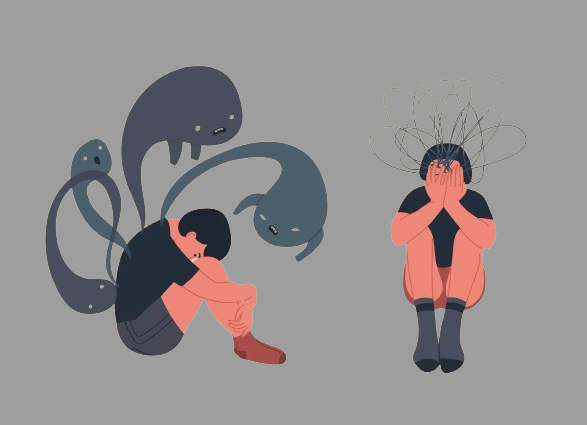
Things are going well. You got good news. Life feels steady for once. And then, almost immediately, a quiet dread creeps in — a low hum of anxiety that feels almost like waiting for something to go wrong.

If you’ve ever found yourself asking “why am I scared of being happy,” you’re not alone, and you’re not broken. This experience is far more common than most people realize, and it has real psychological roots that make complete sense once you understand them.
The fear of joy — the way happiness can feel unsafe, fragile, or even threatening — isn’t a character flaw. It’s a learned response. And just like any learned response, it can be understood, gently challenged, and over time, changed.
This article digs into what this fear actually is, what causes it, what it looks like in everyday life, and — most importantly — what you can start doing to loosen its grip.
What Does It Even Mean to Be Scared of Happiness?
Fear of happiness doesn’t usually look the way people expect.
It’s not that you actively dislike good things happening. You don’t walk around hoping for bad news. It’s subtler than that — and that subtlety is part of why it’s so hard to name.
It might look like:
- Feeling inexplicably anxious when things are going well
- Refusing to fully celebrate a win because something might still go wrong
- Downplaying good news so quickly it barely registers
- Feeling guilty for being happy when others around you are struggling
- Unconsciously stirring up conflict or problems in otherwise calm, peaceful moments
- A persistent sense that joy isn’t quite allowed — or that fully feeling it will cost you something
The common thread in all of these is that happiness feels like a risk. Like it’s asking you to let your guard down in a way that doesn’t feel safe.
And that perception — joy as danger — is always rooted in something real that happened. It didn’t come from nowhere.
Is There a Name for This? Cherophobia and Foreboding Joy
Yes — there are actually recognized terms for different versions of this experience.

Cherophobia is defined as an intense aversion to or fear of happiness. The word comes from the Greek “chero,” meaning “to rejoice.” Someone with cherophobia may actively avoid situations associated with joy or pleasure — not because they dislike good things, but because they carry a deep belief that happiness will inevitably lead to something painful.
Cherophobia, when significant, is considered a type of specific phobia. It can interfere with work, relationships, and quality of life.
Foreboding joy is a term coined by researcher and author Brené Brown, describing a milder but extremely common version of the same pattern. It refers to the experience of feeling a moment of joy and immediately feeling a wave of vulnerability, dread, or imagined catastrophe alongside it — as if acknowledging happiness means inviting something terrible to happen.
Brown’s research found this to be surprisingly universal. Many people she interviewed described practicing a kind of mental catastrophizing as a form of emotional preparation — bracing themselves in advance so that if something goes wrong, it hurts less.
The problem with this strategy is that it steals the moment. It means never fully experiencing joy because part of you is always watching for the drop.
Not everyone who fears happiness has cherophobia in its clinical form. Many people experience something closer to foreboding joy — a pattern that doesn’t meet clinical thresholds but still significantly diminishes how fully they can experience their own life.
Why Am I Scared of Being Happy? The Root Causes
If you’re asking “why am I scared of being happy,” the most useful place to start is not with your present circumstances but with your history. This fear doesn’t develop in a vacuum — it’s a response to experiences that taught you something about what happens when you feel good.
Past Trauma or Loss Following a Happy Moment
The human brain is designed to detect patterns, especially patterns involving potential pain. If something genuinely devastating happened close in time to a happy period — a sudden loss, a traumatic event, a relationship that collapsed — your brain may have quietly connected those two experiences.
Not logically. Not consciously. But in the part of your nervous system that’s constantly scanning for threats, an association can form: happiness was followed by pain. Happiness, therefore, signals danger.
This is sometimes called a conditioned fear response. It doesn’t need to make intellectual sense to feel completely real in the body.
Growing Up in an Unstable or Unpredictable Environment
If your childhood home was unpredictable — where calm periods might suddenly be interrupted by conflict, volatility, or chaos — your nervous system learned to stay vigilant even during apparently peaceful moments.
Good times weren’t safe to relax into, because experience had taught you that they could end without warning.
As an adult, that hypervigilance can persist. Even when your circumstances are genuinely stable, your nervous system may still be running the same old program — staying alert during calm moments because it once kept you safe to do so.
The Fear That Joy Will Be “Taken Away”
For some people, happiness feels fragile — like a thing that exists on borrowed time. Letting yourself fully feel it seems to somehow make it more vulnerable to disappearing.
There’s often a magical thinking quality to this: “If I admit how happy I am, it’ll be taken from me.” Or, “I’ll jinx it.”
Underneath this is usually a deep history of having good things disappear unexpectedly — people leaving, plans falling through, stability evaporating. When loss has been unpredictable and frequent, the mind develops a kind of preemptive grief.
If you never fully let yourself have something, losing it can’t hurt as much.
Guilt About Feeling Happy While Others Suffer
This version of fear of joy is especially common in highly empathetic people, caregivers, or people who grew up taking responsibility for others’ emotional states.
If someone you love is struggling — ill, grieving, in financial difficulty — allowing yourself to experience genuine happiness can feel like a betrayal. Like joy in the presence of another’s pain is somehow disrespectful or unfair.
This often comes from a distorted sense of responsibility for other people’s emotions, which may have been present since childhood. But it can also be a cultural or religious pattern — the belief that suffering is more virtuous than enjoyment, or that personal happiness is somehow selfish.
Fear That Contentment Leads to Complacency
Some people, particularly high achievers and people with perfectionist tendencies, unconsciously believe that feeling satisfied will make them stop trying.
The logic goes: “If I let myself feel happy with where I am, I’ll stop pushing. I’ll become lazy. I’ll lose the edge that’s gotten me here.”
So contentment gets suppressed — not because it doesn’t exist, but because it feels dangerous to a particular self-concept tied to constant striving and improvement.
This person might look high-functioning and successful from the outside, but internally they can never quite rest in their accomplishments. There’s always another threshold before it’s okay to feel genuinely good.
The Psychology Behind Fear of Joy — What’s Happening in the Brain
The fear of happiness, in most of its forms, is deeply connected to how the brain learns to manage perceived threats.

Your amygdala — the part of the brain most associated with threat detection and emotional memory — doesn’t distinguish very precisely between emotional threats and physical ones. And it doesn’t have a great sense of time. A threat it learned about twenty years ago can still register as current.
When joy has been followed by pain — or when safety has been consistently temporary — the brain can learn to treat positive emotional states as early warning signals rather than endpoints. Instead of joy saying “you’re safe right now,” it says “pay attention — something might be coming.”
This is a form of hypervigilance that develops in response to unpredictable or threatening environments. It’s adaptive in that context. It becomes a problem when the environment has changed but the brain’s threat map hasn’t updated yet.
Additionally, there’s a concept in psychology called negativity bias — the well-documented tendency of the human brain to weight negative experiences more heavily than positive ones. This was useful for survival, but in modern life it means that feelings of dread can attach themselves to joy quite easily, especially for people with histories of loss or trauma.
What This Fear Looks Like Day to Day
Fear of happiness often hides inside everyday behaviors that don’t immediately seem connected. A few common examples:
- Deflecting compliments reflexively. When someone says you did a great job or that you look well, you immediately dismiss it or change the subject.
- Minimizing achievements. A promotion, a completed project, a personal goal reached — these get quickly rationalized away: “I just got lucky,” “Anyone could have done it.”
- “Waiting for the other shoe to drop.” Good periods feel inherently temporary and suspicious. Instead of enjoying them, you spend them anticipating their end.
- Sabotaging relationships or situations during good periods. Starting arguments, making impulsive decisions, or pulling away from people right when things are going particularly well.
- Emotional blunting. Feeling genuinely numb or flat during moments that you know, intellectually, should feel good.
- Catastrophizing after good news. Receiving good news immediately triggers thoughts about all the ways it might still go wrong.
How Your Attachment History Shapes This Fear
Your earliest relationships — primarily with caregivers in childhood — were where you first formed beliefs about whether joy and connection were safe to feel.
If care was consistent and reliable, joy probably came to feel safe. When something good happened, it could be felt fully and shared.
If care was inconsistent, unpredictable, or came with conditions attached — “I’ll love you when you’re good” — joy became complicated. Happy moments might be followed by withdrawal or punishment. Connection might be available one moment and absent the next.
In this environment, emotional highs become things to be wary of. They precede drops. They signal vulnerability. Being too visibly happy might invite criticism, jealousy, or abandonment.
This is sometimes described as a feature of anxious attachment — a relational pattern that makes positive experiences feel unsafe because they heighten awareness of how much there is to lose.
You didn’t choose this. It was shaped by experiences you had before you had language for any of it.
Self-Sabotage and the Fear of Being Happy
One of the most painful manifestations of this fear is self-sabotage — and it’s worth addressing directly because it’s so common and so confusing.
Self-sabotage during happy periods often looks like completely irrational behavior from the outside: picking a fight with a partner when the relationship is going well, procrastinating on something important right when momentum is building, making a decision that you know even in the moment will cost you.
What’s actually happening in many of these cases is that the happiness itself became too anxiety-provoking to sustain. Unconsciously, creating a problem restores a sense of control — you’re no longer waiting for something to go wrong; you’ve made something go wrong, on your own terms, which somehow feels less terrifying than the uncertainty of happiness.
This is not a conscious calculation. It’s the nervous system trying to regulate itself using the only tools it learned.
How to Start Letting Yourself Feel Joy Again
This is not a process that happens all at once. It’s incremental. It requires patience, self-compassion, and — often — support. But it is possible.
Start with naming the fear in real time. When you notice yourself bracing, deflecting, or waiting for the drop, try naming it to yourself: “I’m feeling happy right now, and I also feel scared that it won’t last.” The act of naming creates a tiny bit of space between the feeling and the automatic response to it.
Practice staying in good moments a little longer. Instead of immediately deflecting or minimizing when something good happens, try staying with it for ten seconds longer than usual. Let yourself feel it without immediately pivoting to what comes next. This is a small but meaningful retraining of the nervous system.
Challenge the bracing thought with evidence. When you catch yourself thinking “this won’t last” or “something bad is about to happen,” gently ask: “Is there actual evidence for that right now, in this moment? Or is this an old pattern showing up?”
Start with smaller, lower-stakes joy. You don’t have to start with the biggest, most vulnerable joys. Start with small, manageable ones — a good meal, a song you love, a walk in good weather. Practice letting those feel good all the way through. Build the tolerance gradually.
Allow joy to coexist with other feelings. Joy doesn’t have to be pure or perfect to be real. You can be happy and grieving, happy and worried about someone else, happy and uncertain about the future. Allowing joy to exist alongside other emotions — rather than demanding it be pristine before you’ll let yourself feel it — takes some of the pressure off.
Talk about it. Saying out loud “I have a hard time letting myself feel happy” is, for many people, a genuinely profound experience. It names something that’s operated in the shadows for a long time. A trusted friend, a partner who is emotionally safe, or a therapist can all be good places for this conversation.
When to Talk to a Therapist
If this fear feels deeply ingrained, persistent, or connected to significant past trauma, therapy is likely to be the most meaningful path forward.
A therapist can help you:
- Understand the origin of the fear in your specific history
- Identify the automatic thought patterns that fuel it
- Work through any underlying trauma that has made joy feel unsafe
- Develop new, more flexible responses to moments of happiness and vulnerability
Approaches particularly useful for this kind of work include cognitive behavioral therapy (CBT) for addressing automatic negative thought patterns, EMDR for processing traumatic memories tied to the fear, and somatic or body-based therapy for addressing the physical hypervigilance that often underlies it.
This article is for informational purposes only. It is not intended as a diagnosis or a clinical treatment plan. If you believe you’re experiencing significant fear or avoidance of happiness connected to trauma or mental health concerns, please reach out to a licensed mental health professional.
Book A session
FAQ
Is fear of happiness a real psychological condition?
Yes, in its more intense form it’s referred to as cherophobia and is considered a type of specific phobia. A milder but still significant version — sometimes called foreboding joy — is extremely common and doesn’t necessarily meet clinical thresholds but still meaningfully affects quality of life.
Can past trauma really cause me to be scared of joy?
Absolutely. The brain forms associations between emotional states and outcomes — and if positive emotional states were followed by painful experiences repeatedly, joy can become a trigger for anxiety rather than a signal of safety.
Is cherophobia the same as depression?
No, though they can overlap. Depression involves persistent low mood, loss of interest in activities, and a range of other symptoms. Cherophobia is specifically about fearing or avoiding happiness itself. Someone with cherophobia might not be depressed — they might actively want to feel happy, but feel unsafe when they do.
Why do I feel guilty when things are going well for me?
This guilt often comes from one of two places: empathy for others who are suffering, or an old belief that you don’t fully deserve good things — which may have been shaped by early messages about your worth and place in the world.
Can therapy really help with something like this?
Yes, significantly. Fear of happiness often has deep roots in attachment history and trauma — both of which are areas where therapy produces real, meaningful change. You don’t have to just manage this pattern. It can shift.
Is self-sabotage always connected to fear of happiness?
Not always, but very often. When self-sabotage happens specifically during good periods — when things are going well and then suddenly fall apart due to something you did — the fear of happiness is frequently one of the underlying drivers.
Final Thoughts
Asking “why am I scared of being happy” is one of the most honest and perceptive questions a person can ask about themselves.
It means you’ve noticed something. That you’re paying attention to the gap between what you want to feel and what you actually allow yourself to feel — and that you sense there’s a reason for it.
You’re not too damaged for happiness. You’re not ungrateful, broken, or destined to feel this way forever.
The fear makes sense, given your history. But it doesn’t have to run the rest of your story.