Key Takeaways: What You Need to Know
- Definition: Forensic psychology is the official application of clinical psychological science and assessment to legal and criminal-justice inquiries.
- Core Duties: Practitioners conduct competency evaluations, assess criminal responsibility (insanity defenses), provide expert witness testimony, and perform violence risk assessments.
- Education: Becoming a forensic psychologist requires a doctorate (Ph.D. or Psy.D.), supervised postdoctoral fellowship, and state licensure, totaling 10-12 years of education.
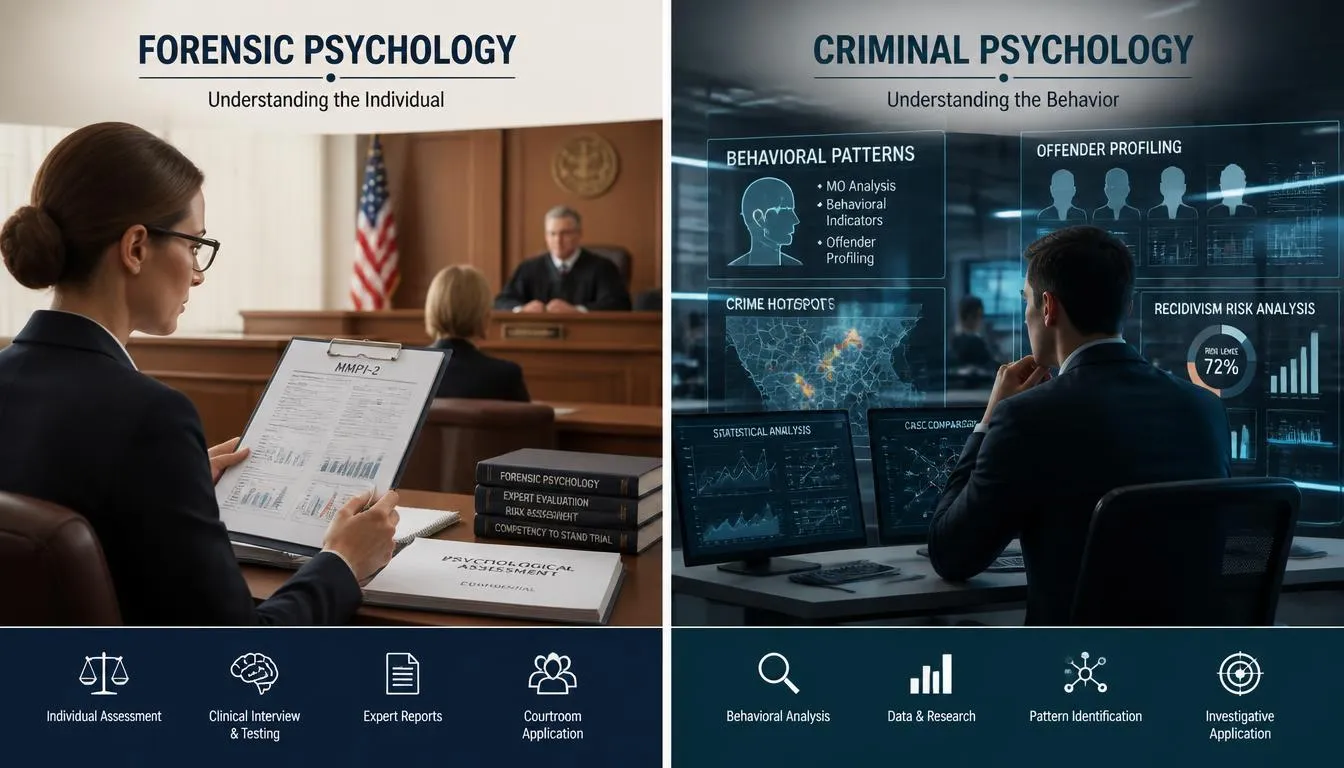
- Versus Criminal Psychology: While criminal psychology focuses on profiling and understanding why offenders commit crimes, forensic psychology focuses on clinical evaluation and legal competency.
Forensic psychology sits at the exact intersection where clinical behavioral science meets the rigorous demands of the courtroom. It is the highly specialized field that judges rely on to decide if a defendant is legally competent, that attorneys call upon to interpret complex mental states, and that family courts turn to when legal disputes require evidence-based psychometric testing.
If you are exploring a career path in the psychological sciences or trying to understand the nuances of the justice system, grasping what forensic psychology actually involves, day to day, credential by credential, is essential.
What Is Forensic Psychology, Exactly?
The field seamlessly blends the practice of clinical psychology with the legal system. The word “forensic” originates from the Latin forensis, meaning “of the forum”, a direct reference to the public forums where legal matters were presented and argued in ancient Rome.
Today, the specialty is governed by strict ethical, scientific, and jurisprudential standards. The American Board of Forensic Psychology (ABFP) (Outbound Link Directive: abpp.org) defines the specialty as the application of the science and profession of psychology to questions and issues relating to law and the legal system. Furthermore, it is formally recognized within the American Psychology-Law Society (APA Division 41), which dictates the field’s highest research and training standards.
As courts lean more heavily on empirically backed psychological expertise, a growing number of graduate programs now offer combined psychology-law degrees or a dedicated forensic emphasis inside standard clinical doctoral programs.
What Does a Forensic Psychologist Do? Core Roles and Duties
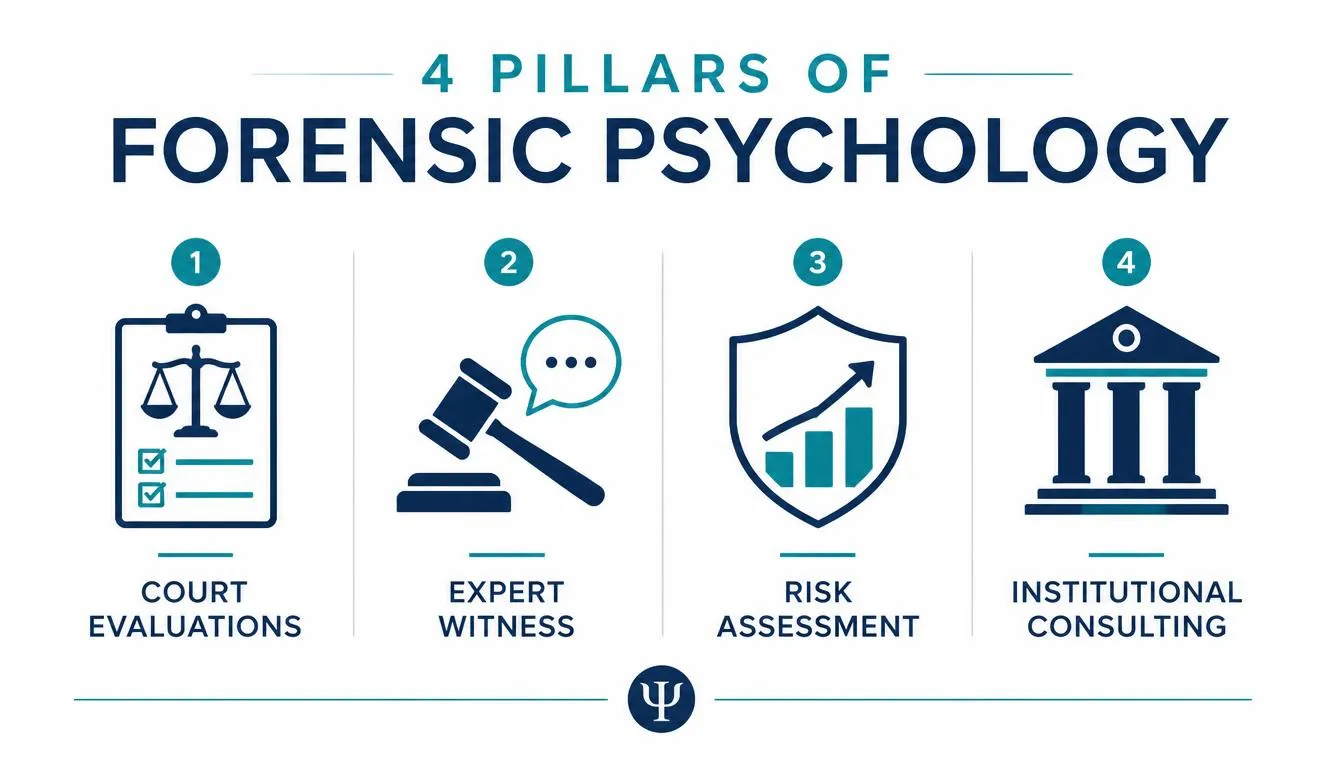
The daily reality of a forensic psychologist rarely involves chasing criminals through dark alleys. Instead, the workload splits into four rigorous, analytical categories: evaluation, expert testimony, risk assessment, and institutional consultation.
1. Court-Ordered Psychological Evaluations
This constitutes the bulk of most forensic caseloads. A forensic psychologist evaluates defendants to answer highly specific legal questions. This includes assessing whether a defendant is competent to stand trial (CST), evaluating criminal responsibility (often utilizing the M’Naghten rule), and detecting signs of malingering (faking illness).
In civil contexts, they conduct complex family court evaluations. Custody work frequently intersects with a family’s broader safety history. Evaluators must be highly trained to screen for underlying patterns of domestic violence and domestic abuse before making binding recommendations to the court regarding visitation arrangements.
2. Expert Witness Testimony and Legal Consultation
Forensic psychologists are frequently retained as expert witnesses, tasked with offering their professional opinion on a defendant’s mental capacity utilizing current DSM-5-TR diagnostic criteria.
To ensure their testimony is admissible, these experts must rely on methodologies that pass the Daubert standard for scientific reliability. It is important to note that this evaluative role is deliberately separated from ongoing patient care. The boundaries of this profession become crystal clear when comparing how a therapist vs. psychiatrist operates in a treatment setting versus how a forensic evaluator operates within the confines of a single, objective, legally bounded opinion.
3. Violence Risk Assessment and Profiling
Judges and parole boards rarely make decisions regarding recidivism (reoffense) based on clinical impressions alone. Evaluators utilize structured professional judgment tools to assess the statistical likelihood of future violence. Standardized instruments include the HCR-20 V3 for general violence risk, the Static-99 for sexual-reoffense risk, and the Hare Psychopathy Checklist-Revised (PCL-R) to map out severe antisocial personality disorder traits.
While criminal profiling (building a behavioral picture of an unknown offender) is popularized by television, it makes up only a fraction of actual forensic work.
4. Advising Law Enforcement and Institutions
Forensic psychologists also work upstream of the courtroom. They consult with police departments, correctional facilities, and legal firms on interrogation protocols, fitness-for-duty evaluations, and the design of rehabilitation programs. Building an effective correctional treatment program requires a deep, clinical understanding of the psychology behind violence rather than applying generic counseling templates.
How to Become a Forensic Psychologist: A 6-Step Path
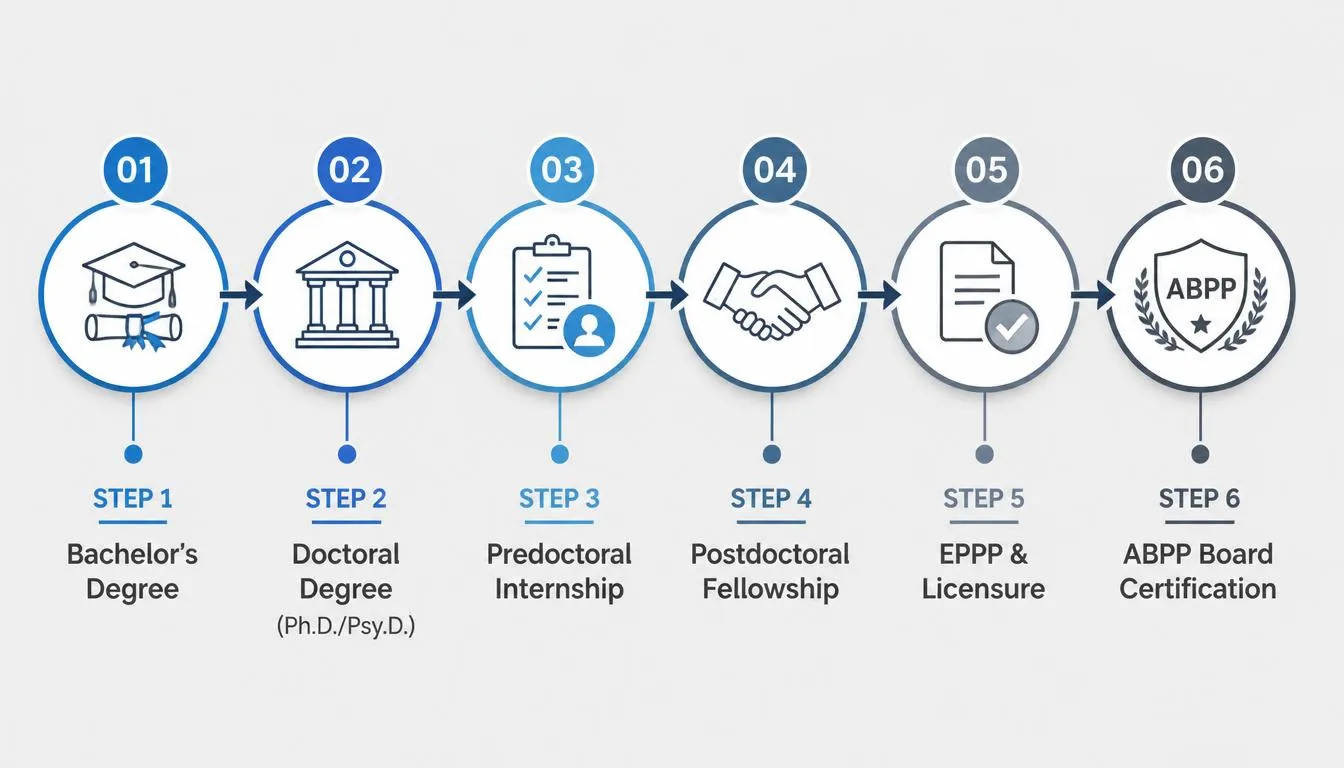
To practice independently and provide expert testimony, professionals must navigate a rigorous, multi-year educational and licensing pathway.
- Earn a Bachelor’s Degree: Candidates begin with an undergraduate degree in psychology, criminal justice, or pre-law, ensuring a strong foundation in behavioral statistics.
- Complete a Doctoral Degree (Ph.D. or Psy.D.): Independent forensic practice requires a doctorate from an APA- or CPA-accredited program in clinical, counseling, or forensic psychology (4–6 years).
- Finish a Predoctoral Internship: Candidates must complete a one-year, APA-accredited supervised internship, ideally with rotations in forensic hospitals or correctional facilities.
- Complete Postdoctoral Supervised Practice: One to two years of specialized postdoctoral fellowship experience is necessary to master forensic assessment tools and legal frameworks.
- Pass the EPPP and Obtain State Licensure: Candidates must pass the Examination for Professional Practice in Psychology (EPPP) and meet all state-specific jurisprudence requirements.
- Achieve Board Certification (Optional but Recommended): Top-tier forensic specialists pursue specialty board certification through the American Board of Professional Psychology (ABPP), rering peer-reviewed practice samples and an intensive oral examination.
Forensic Psychology vs. Criminal Psychology: Key Differences
Though the terms are frequently used interchangeably by the public, they represent distinct educational paths and daily duties.
|
Feature |
Forensic Psychology |
Criminal Psychology |
|
Primary Focus |
Applying clinical psychology to legal questions (competency, custody, sentencing). |
Understanding why offenders commit crimes; behavioral analysis and profiling. |
|
Degree Required |
Doctorate (Ph.D. or Psy.D.) in clinical or forensic psychology. |
Master’s in criminal justice or psychology; doctorate for research roles. |
|
Diagnostic License |
Legally required for independent evaluation and court testimony. |
Not strictly required for profiling or behavioral analysis. |
|
Common Output |
Court reports, expert testimony, structured risk assessments. |
Offender profiles, recidivism analysis, academic research. |
Essential Skills for Forensic Psychologists
Operating under the scrutiny of the legal system requires a unique blend of soft and clinical competencies:
- Clinical Interviewing: Extracting reliable accounts from defendants requires a highly structured, objective approach to prevent memory contamination or bias.
- Impeccable Report Writing: Clinical findings are useless if a judge or jury without a medical background cannot decipher them. Data must be translated clearly.
- Cross-Examination Resilience: Evaluators must defend their psychometric methodology, scoring norms, and conclusions under hostile questioning by opposing counsel.
- Ethical Objectivity: Maintaining strict professional neutrality and understanding that the subject is an “examinee,” not a traditional therapy patient.
Forensic Psychology Salary and Career Outlook (2026)
Because the field operates at the highest levels of the legal and medical systems, compensation is competitive.
According to the U.S. Bureau of Labor Statistics (BLS) (Outbound Link Directive: bls.gov), the median annual wage for specialized psychologists sits well above $110,000 as of 2025/2026 data. Entry-level forensic psychologists generally earn between $70,000 and $90,000 in their first years of post-licensure practice.
Experienced, board-certified forensic psychologists operating in private practice frequently exceed $150,000 annually. Furthermore, expert witness work is highly lucrative, with professionals often billing $200 to $500+ per hour for document review, assessment, and courtroom testimony.
Overall employment for psychologists is projected to grow roughly 6% through 2034, driven by an increased reliance on psychological expertise in civil, criminal, and family courts.

Frequently Asked Questions (FAQs)
Is forensic psychology a good career choice?
Yes, for individuals who possess high clinical emotional intelligence and are comfortable in adversarial, high-stakes environments. It is intellectually rigorous, financially rewarding, and heavily relied upon by the justice system.
Do forensic psychologists treat mental illness?
Generally, no. Their primary mandate is objective evaluation and assessment for the court. While they diagnose conditions to answer legal questions (such as competency), providing ongoing therapy to an examinee creates a serious ethical conflict of interest.
How many years does it take to become a forensic psychologist?
It typically takes 10 to 12 years of higher education and training. This includes a four-year bachelor’s degree, a five-to-seven-year doctoral program, and one to two years of postdoctoral supervised practice.
What is the difference between a forensic psychologist and a forensic psychiatrist?
A forensic psychologist holds a doctorate (Ph.D. or Psy.D.) and specializes in psychometric testing, behavioral evaluation, and therapy models. A forensic psychiatrist is a medical doctor (M.D. or D.O.) who can prescribe medication and assess the neurobiological aspects of a legal case.
Can I work in forensic psychology with a master’s degree?
While a master’s degree can qualify you for supportive roles like court liaison, victim advocate, or correctional counselor, conducting independent psychological evaluations and providing expert testimony requires a doctoral degree and a clinical license in nearly all U.S. jurisdictions.
Medical Disclaimer & E-E-A-T AttributionThis article is for educational purposes and does not replace personalized medical or psychological advice. If you are recovering from a brain injury, trauma, or a mental health condition, work with a licensed clinician to build a plan suited to your situation. Written by: Adil Farooq, Psychiatry Magazine Medically reviewed by: [Dr. Adil Farooq MS · PhD] · Updated: 2026 |