In today’s fast-paced world, anxiety and intrusive thoughts can quietly take over a person’s daily life. Many people experience moments of intense fear, doubt, or the need to repeat certain behaviors to feel “safe” or in control. For individuals with Obsessive-Compulsive Disorder (OCD) or related anxiety disorders, these patterns can become overwhelming.
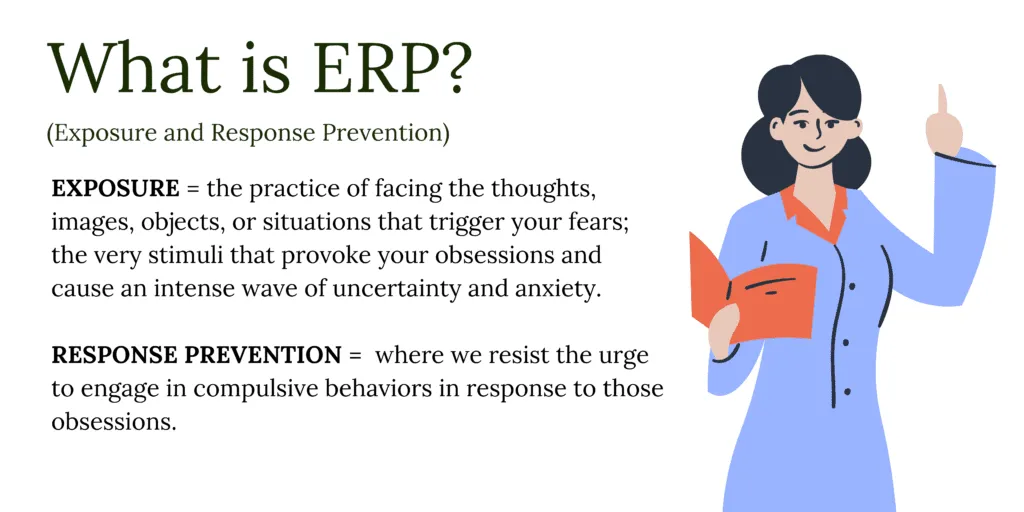
One of the most powerful and scientifically proven treatments for OCD and anxiety is ERP therapy, short for Exposure and Response Prevention. This approach helps people face their fears gradually and break free from compulsive behaviors that control their lives.
In this article, we’ll explore what ERP therapy is, how it works, how it differs from CBT, whether it can be done on your own, and how techniques like the 15-minute rule can change how you respond to anxiety. By the end, you’ll understand why ERP therapy is considered the gold standard treatment for OCD and how it can empower you to take back control of your mind and life.
What is ERP in Therapy?
Exposure and Response Prevention (ERP) is a specialized form of Cognitive Behavioral Therapy (CBT) designed to treat OCD, phobias, and anxiety disorders. The idea is simple but powerful: face what you fear and resist the urge to perform your usual compulsive response.
ERP works by exposing you to the source of your anxiety — either through real-life situations or mental imagery — and helping you resist engaging in the behaviors that normally relieve that anxiety (such as checking, washing, or seeking reassurance).
For example:
- A person afraid of germs might touch a doorknob and resist washing their hands immediately.
- Someone who fears harming others might hold a kitchen knife without seeking reassurance that they won’t lose control.
At first, anxiety spikes — but over time, your brain learns that nothing catastrophic happens when you don’t perform the compulsion. Gradually, your fear response weakens, and you gain confidence in your ability to tolerate uncertainty.
ERP therapy was originally developed in the 1960s by psychologist Victor Meyer and has since become a cornerstone of OCD treatment. It’s backed by decades of research and is now considered the most effective non-medication treatment for OCD and related disorders.
How ERP Therapy Works: Step-by-Step Process
ERP therapy is structured but highly individualized. A trained therapist guides you through a systematic process that helps you confront fears in manageable steps.
1. Assessment and Hierarchy Building
The first step is identifying your obsessions (distressing thoughts or fears) and compulsions (repetitive behaviors or mental rituals done to reduce anxiety).
Your therapist helps you create a fear hierarchy — a list of triggers ranked from least to most distressing.
For example:
- Touching a “dirty” surface might rank 30/100.
- Using a public restroom might rank 70/100.
- Shaking hands without washing afterward might rank 100/100.
2. Exposure Phase
Once the hierarchy is built, you begin gradual exposure starting with lower-level fears. You intentionally face the feared situation or thought.
For instance, you might touch a doorknob or imagine a feared scenario. The key is staying with the anxiety rather than avoiding it.
3. Response Prevention
Here’s where ERP gets its name — you prevent the usual response (compulsion). Instead of washing your hands or seeking reassurance, you resist the urge.
This step retrains your brain to recognize that anxiety naturally decreases on its own, without needing compulsions.
4. Repetition and Mastery
Repeated practice helps the brain learn a new association: the feared stimulus no longer equals danger. Over time, anxiety fades, and the compulsion loses its power.
Therapists often assign homework between sessions — brief daily exposures that build on progress.
5. Maintenance and Relapse Prevention
ERP doesn’t erase anxiety forever — it teaches you resilience and tolerance. You’ll learn how to apply ERP principles anytime intrusive thoughts or urges resurface.
What is the Difference Between ERP and CBT?
Although ERP is technically a branch of CBT, there are key differences in focus and approach.
| Aspect | ERP Therapy | CBT (Cognitive Behavioral Therapy) |
|---|---|---|
| Main Focus | Exposure to fears and prevention of compulsive responses | Identifying and changing negative thought patterns |
| Approach | Behavioral — teaches through experience | Cognitive — teaches through reasoning and reframing thoughts |
| Best For | OCD, specific phobias, health anxiety | Depression, generalized anxiety, panic disorder |
| Goal | Reduce fear and compulsive behaviors | Change distorted thinking and emotional reactions |
In short, CBT teaches you to think differently, while ERP trains your brain to react differently. Most OCD therapists combine the two, addressing both thought patterns and behavioral responses for a complete recovery plan.
Can You Do ERP Therapy on Your Own?
This is one of the most common questions people ask — and the answer is both yes and no.
When Self-Guided ERP Can Help
If you understand your triggers and have mild OCD symptoms, you can begin small, structured ERP exercises at home. Examples include:
- Touching “contaminated” objects and delaying handwashing.
- Writing down intrusive thoughts and resisting the urge to neutralize them.
- Practicing mindfulness and tolerating uncertainty.
Several self-help books and ERP apps (like NOCD or OCD Challenge) provide guided frameworks that can be very effective for mild symptoms.
When You Should Seek Professional Help
However, ERP can be emotionally challenging and requires precise structure. Without guidance, some people attempt exposures that are too intense or perform them incorrectly, reinforcing fear instead of reducing it.
You should always work with a licensed ERP therapist if:
- Your compulsions severely affect daily life.
- You experience panic, depression, or suicidal thoughts.
- You’re unsure how to design exposure tasks safely.
A trained therapist ensures exposures are gradual, safe, and effective, while teaching coping strategies and providing emotional support.
What is the 15-Minute Rule for OCD?
The 15-minute rule is a popular ERP technique that helps delay compulsions and retrain the brain.
When the urge to perform a compulsion arises (like checking or washing), you delay the behavior for 15 minutes. During this time, you sit with your anxiety and notice what happens.
Most people find that anxiety peaks and then naturally declines within that window — even if they don’t perform the compulsion.
Here’s how it works:
- When a trigger occurs, acknowledge the urge — don’t fight it.
- Set a timer for 15 minutes.
- During that time, focus on your breathing, notice your thoughts, and remind yourself: “This feeling will pass.”
- After 15 minutes, reassess. Usually, the urge has lessened or disappeared.
This technique teaches emotional endurance — the idea that anxiety doesn’t have to control you. Over time, you may extend the delay to 30 minutes or more, until the urge fades completely.
Benefits and Effectiveness of ERP Therapy
ERP therapy is one of the most extensively researched treatments for OCD and anxiety. Studies consistently show 60–80% of patients experience major symptom reduction after completing ERP programs.
Key Benefits
- Breaks the OCD cycle: By preventing compulsions, you teach your brain that anxiety subsides naturally.
- Improves daily functioning: People regain time, energy, and confidence.
- Builds resilience: ERP teaches tolerance for uncertainty — a skill useful in all areas of life.
- Reduces relapse risk: Long-term practice keeps symptoms manageable even under stress.
What Research Shows
According to the International OCD Foundation (IOCDF) and numerous clinical studies, ERP remains the most effective behavioral therapy for OCD, outperforming medication alone.
Combining ERP with SSRIs (selective serotonin reuptake inhibitors) often produces even better results, especially for severe cases.
Challenges and Common Misconceptions About ERP
Like any treatment, ERP therapy comes with challenges and misconceptions. Understanding them helps set realistic expectations.
“ERP is too scary”
ERP involves facing fears — but under controlled and supportive conditions. Therapists never force exposure beyond your comfort level. The process is gradual and designed to empower, not traumatize.
“ERP makes anxiety worse”
In the beginning, yes — anxiety spikes. But it quickly decreases as your brain learns there’s nothing dangerous about the feared situation. Over time, anxiety becomes weaker, not stronger.
“I can’t handle ERP”
People often underestimate their ability to tolerate discomfort. Therapists tailor exposures to your unique tolerance, starting small and celebrating every victory.
“ERP is only for OCD”
While ERP was developed for OCD, it’s highly effective for phobias, panic disorder, health anxiety, social anxiety, and even PTSD in some cases.
ERP Therapy for Specific Conditions
1. OCD (Obsessive-Compulsive Disorder)
ERP directly targets the cycle of obsessions and compulsions. Through exposure and non-response, individuals learn that anxiety diminishes naturally — breaking the OCD loop.
2. Generalized Anxiety Disorder (GAD)
ERP helps those with chronic worry practice tolerating uncertainty. Exposures might involve imagining feared outcomes without reassurance-seeking.
3. Panic Disorder
Therapists use interoceptive exposure — intentionally triggering mild physical sensations (like a racing heart) to prove they’re not dangerous.
4. Phobias
ERP exposes individuals to feared stimuli (like spiders or flying) in safe, gradual ways until the fear response weakens.
5. Health Anxiety (Hypochondria)
ERP involves resisting the urge to Google symptoms or seek medical reassurance, helping break the cycle of fear and checking.
How to Find an ERP Therapist
Finding the right therapist can make all the difference. Here’s how to start:
- Look for certified OCD specialists. Check the International OCD Foundation (IOCDF) directory or professional psychology networks.
- Ask about ERP training. Not all therapists who use CBT are trained in ERP. Ask specifically about their experience with exposure therapy.
- Consider online ERP therapy. Platforms like NOCD and Talkspace connect clients with licensed ERP specialists virtually.
- Ensure comfort and trust. ERP works best when you feel supported and understood by your therapist.
Conclusion
ERP therapy is more than just a treatment — it’s a pathway to freedom from the grips of OCD and anxiety. By facing your fears and learning to sit with discomfort, you retrain your brain to understand that uncertainty is not dangerous.
Unlike avoidance or compulsions, which feed anxiety, ERP helps you reclaim your time, energy, and confidence. Whether guided by a professional or practiced gradually at home, ERP teaches you that courage isn’t the absence of fear — it’s choosing to move forward despite it.
With consistent practice, patience, and support, recovery is not just possible — it’s achievable. ERP therapy stands as one of the most authentic, evidence-based, and empowering methods to help you overcome anxiety and live life fully again.