Quick AnswerIntrusive thoughts are unwanted, involuntary thoughts, images, or urges that clash with a person’s values and cause significant distress. Research shows roughly 94% of people experience them. They only become a clinical concern when they recur constantly, trigger compulsions, or interfere with daily life. Relief from intrusive thoughts comes from acceptance-based therapies like CBT and ERP, rather than suppression. |
What Are Intrusive Thoughts?
Intrusive thoughts are unwanted, involuntary mental images, thoughts, or urges that appear suddenly and feel completely disconnected from who you actually are. Clinicians describe this quality as “ego-dystonic” meaning the thought directly conflicts with your core values, moral compass, or genuine desires. Because they are ego-dystonic, they feel foreign, shocking, and invasive rather than like a genuine wish.
A sudden image of shouting in a quiet meeting, a flash of your car veering off the road, or a disturbing memory resurfacing during a peaceful moment are all the same underlying mechanism at work: a brain generating content your conscious mind never asked for and does not endorse.
The intense distress an intrusive thought produces comes almost entirely from how much meaning you attach to it, not from the thought itself. Someone with no history of anxiety might notice the image of swerving into oncoming traffic and dismiss it within seconds. Someone prone to intrusive thoughts might notice the same image and spend the next twenty minutes agonizing over what it means about their character. Same thought, different outcome and that gap is exactly where treatment works.
Why Intrusive Thoughts Happen: The Neuroscience
Every human brain generates strange, random, and sometimes disturbing content. This is a normal byproduct of the default mode network, the set of brain regions active during rest and mind-wandering. Most of this background noise is filtered out before it ever registers consciously. What turns a passing idea into a “sticky” intrusive thought is a second step: the anterior cingulate cortex, a region involved in error-detection and threat appraisal, mistakenly flags the thought as significant and worth a second look.
For most people, that flag fades quickly. But under high stress, sleep deprivation, hormonal changes, or an underlying condition like OCD, the brain’s threat-detection circuitry becomes hyper-vigilant. The warning flag stays raised.
This is often compounded by “thought-action fusion” a cognitive distortion in which having a thought about something feels morally equivalent to actually doing it, or makes it feel more likely to happen. Thought-action fusion is why a meaningless, passing image can feel like a confession rather than a harmless neurological glitch.
The “White Bear” Effect and Suppression
Trying to forcefully suppress intrusive thoughts actively backfires. Psychologist Daniel Wegner’s classic “white bear” experiments showed that actively trying not to think about something actually increases how often it returns (a pattern known in psychology as ironic process theory). Every attempt to push a thought away requires the brain to run a background check to confirm the thought is absent. The thought “sticks” precisely because of the immense mental effort spent trying to unstick it.
Common Types of Intrusive Thoughts
Intrusive thoughts cluster into recognizable thematic categories. Knowing which one your experience falls into is often the fastest route to understanding the anxiety driving it.
- Harm-Related and Aggressive Thoughts: These involve a terrifying fear of losing control and hurting someone a parent gripped by a sudden image of dropping their baby, or an unexpected urge to swerve a car into traffic. When persistent and paired with checking rituals, it is clinically referred to as Harm OCD.
- Fear-Based and Catastrophic Thoughts: These center on absolute worst-case scenarios, such as sudden job loss, terminal illness, or public humiliation. They frequently overlap with generalized anxiety disorders.
- Sexual Intrusive Thoughts: Unwanted sexual images or urges that directly conflict with a person’s actual attractions or values. This includes Sexual Orientation OCD (SO-OCD), where someone repeatedly questions their orientation based on intrusive content rather than genuine feeling.
- Religious or Moral Intrusive Thoughts: Blasphemous images, the fear of having committed an unforgivable act, or intense doubt about one’s own morality are the hallmarks of scrupulosity, a religious or moral form of OCD where faith itself becomes the trigger for obsessive doubt.
- Relationship-Focused Thoughts (ROCD): This involves repetitive doubt about a partner or the relationship itself (“Do I really love them?” or “Are they the one?”) that has little to do with the relationship’s actual quality and everything to do with an exhausting doubt-and-check cycle.
- Postpartum and Perinatal Intrusive Thoughts: Between 70% and 100% of new mothers report at least one unwanted thought about their baby’s safety. These thoughts feel disturbing precisely because they clash violently with the intense protective instinct new parents feel. Because they frequently overlap with severe mood symptoms, they are heavily linked to postpartum depression, and both conditions benefit from coordinated clinical treatment.
Are Intrusive Thoughts Normal?
Yes. The clinical research on this is unusually consistent. A massive multinational study spanning 13 countries and six continents found that roughly 94% of people reported having at least one unwanted intrusive thought within the previous three months. By contrast, separate clinical estimates place true Obsessive-Compulsive Disorder at only 1–3% of the global population.
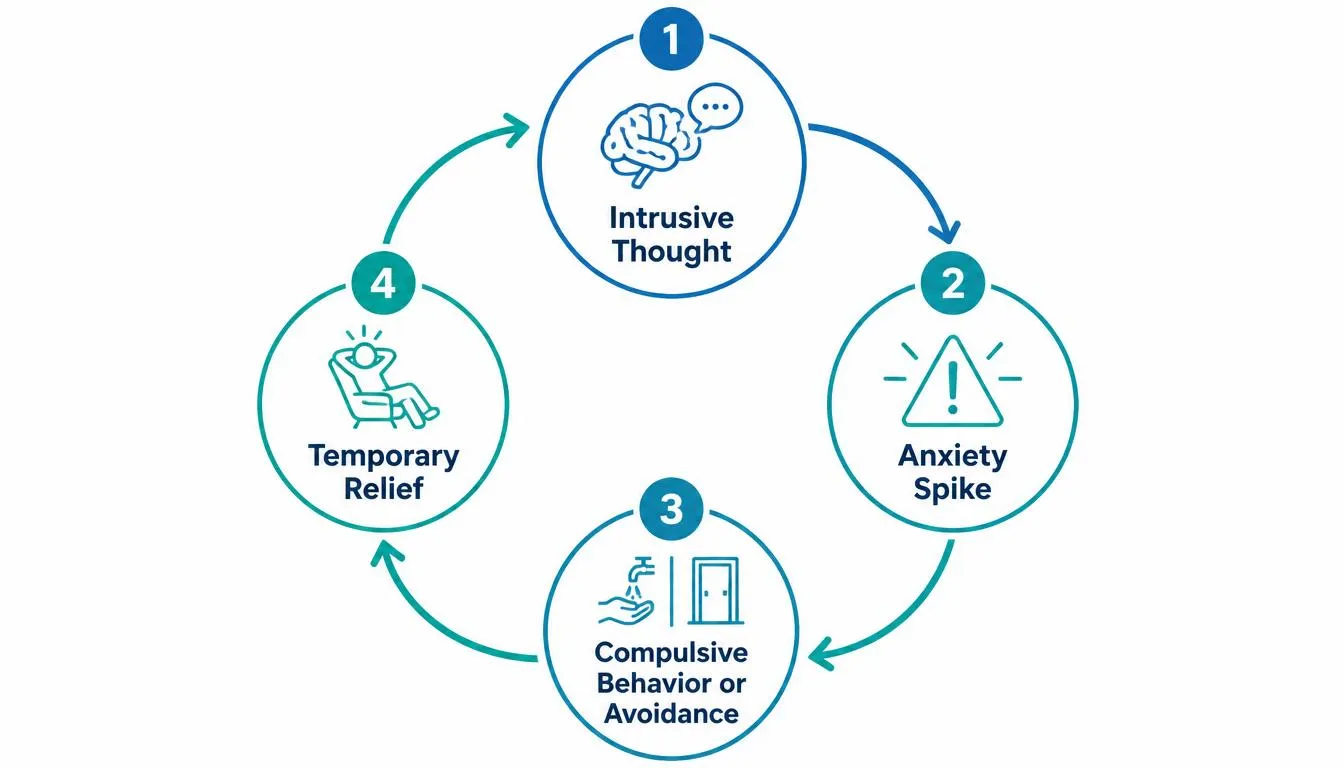
Having the thought is close to universal; developing a debilitating disorder around it is not. The difference lies entirely in interpretation. Someone without an anxiety condition notices a strange thought, dismisses it as weird, and moves on. Someone with OCD treats the thought as meaningful, dangerous, or self-revealing, which launches a cycle of checking and reassurance-seeking.
Intrusive Thoughts vs. Rumination vs. Worry
These three terms are often used interchangeably, but they represent distinct psychological entities. Understanding the difference is crucial for effectively managing intrusive thoughts.
| Feature | Intrusive Thoughts | Rumination | Worry |
| Onset & Nature | Sudden, involuntary, ego-dystonic image or urge. | Repetitive, dwelling mental loop about past/present events. | Future-oriented chain of “what-if” catastrophic scenarios. |
| Cognitive Trigger | Default Mode Network “brain glitch” or threat false-alarm. | Search for certainty, meaning, or self-blame. | Anticipation of potential external danger or failure. |
| Primary Emotion | Immediate shock, sudden spike of horror, or guilt. | Prolonged sadness, exhaustion, or frustration. | Chronic anxiety, muscle tension, and restlessness. |
An intrusive thought is frequently the spark, and rumination is the fire it starts. Effective treatment must address both the initial thought and the mental habit of chewing on it afterward.
In-the-Moment Protocol: Coping With an Intrusive Thought
If you are currently experiencing a spike in anxiety due to an unwanted thought, follow these four immediate steps:
- Label It Instantly: Say silently to yourself, “That is an intrusive thought. It is not a fact, a prediction, or a desire.”
- Refuse the Debate: Do not analyze, argue with, or seek reassurance about the thought. Treat it like background noise, a passing train, or a pop-up ad on a computer.
- Anchor Your Body: Engage your physical senses to pull your brain out of its cognitive loop. Feel your feet firmly on the floor, or list three physical objects you can see around you.
- Continue Your Task: Return to whatever you were doing prior to the thought. Allow the anxiety spike to decay naturally without performing a compulsion or avoidance behavior.

How to Manage Intrusive Thoughts Long-Term
The single most consistent finding across cognitive-behavioral research is that fighting an intrusive thought gives it more power. Effective management starts from the opposite instinct: reducing the thought’s significance.
- Acceptance and Cognitive Defusion: This means noticing the thought, naming it, and letting it pass without argument. This is the core mechanism behind Acceptance and Commitment Therapy (ACT), which trains people to hold a thought lightly instead of fusing their identity with it.
- Reducing Compulsions: Checking, mental review, confessing, or repeatedly searching for reassurance online all provide short-term relief but long-term reinforcement. Each compulsion teaches the brain the thought was dangerous enough to require a response.
- Mindfulness Practice: Building observational skills allows you to watch a thought arise and pass without automatically believing it.
- Journaling: Writing down when intrusive thoughts spike often reveals a hidden trigger sleep loss, a specific life stressor, or a hormonal shift that isn’t obvious in the heat of the moment.
Intrusive Thoughts in Mental Health Conditions
Intrusive thoughts show up across several diagnoses, and the specific disorder they are attached to shapes what treatment looks like.
- Obsessive-Compulsive Disorder (OCD): Intrusive thoughts (obsessions) are paired with compulsions. A subtype sometimes called “Pure O” involves primarily mental compulsions, silent reviewing, checking feelings, or self-reassurance making it one of the more frequently missed presentations of OCD.
- PTSD: Thoughts take the form of vivid, highly sensory flashbacks triggered by trauma reminders. They are memory-based rather than hypothetical.
- Generalized Anxiety: Thoughts tend to be catastrophic predictions about the future rather than taboo images, blending into chronic worry.
- Depression: Thoughts often take a severely self-critical form, replaying past failures and imagining rejection, which deepens a sense of hopelessness.
Need Immediate Support?
If intrusive thoughts are accompanied by an active, genuine urge or intent to harm yourself or others, please reach out for immediate help. Call or text 988 (US/Canada), contact 111 (UK), or reach your local emergency services. Intrusive thoughts are highly treatable, and professional support is available 24/7.
Treatment Options
- CBT (Cognitive Behavioral Therapy): Helps identify the distorted appraisals that turn a passing thought into a severe spiral.
- Exposure and Response Prevention (ERP): The gold-standard treatment specifically for OCD-related intrusive thoughts. It works by gradually exposing someone to a thought’s trigger while deliberately withholding the compulsion, permanently breaking the learned link between the thought and the anxiety response.
- Medication: SSRIs can lower the overall intensity and frequency of intrusive thoughts, particularly in OCD, and are most effective when combined with targeted behavioral therapies.
Intrusive Thoughts in the Digital Age
Constant connectivity adds a modern layer to an old phenomenon. Doomscrolling, health-symptom searching, and using AI chatbots for reassurance can all dramatically extend an intrusive thought’s lifespan. If you notice yourself repeatedly asking a search engine to confirm a fear is unfounded, that pattern is functioning as a compulsion, not a solution. Interrupting the search is often the fastest way to break the cycle.
Myths About Intrusive Thoughts
- Myth: Having the thought means you secretly want to act on it.
Truth: The distress an intrusive thought causes is evidence against intent. People distressed by a thought are actively rejecting it; genuine desires do not produce this level of horror. - Myth: Only people with a diagnosed mental illness get intrusive thoughts.
Truth: Population research puts lifetime prevalence at roughly 94%. What varies isn’t who gets the thought, but how much the thought is believed and analyzed. - Myth: The goal of treatment is to eliminate intrusive thoughts completely.
Truth: No treatment removes the brain’s capacity to generate strange thoughts. The goal is changing your relationship to the thought so it passes in seconds instead of hijacking your day.
Frequently Asked Questions (FAQ)
What are intrusive thoughts a symptom of?
Intrusive thoughts themselves are a normal cognitive event. They only become a clinical symptom when they are highly frequent, distressing, and tied to conditions like OCD, PTSD, generalized anxiety disorder, depression, or postpartum OCD.
How do you stop intrusive thoughts?
You don’t stop them by fighting them. The evidence-based approach is to instantly label the thought, decline to engage with it through compulsions or reassurance-seeking, and let it pass using techniques from CBT, ERP, or ACT.
Can intrusive thoughts turn into actions?
Almost never. The distress and horror a person feels in response to an intrusive thought is itself neurological evidence that the thought violently conflicts with their actual values and intent.
What triggers intrusive thoughts?
Common triggers include severe sleep deprivation, high stress, hormonal shifts (such as the postpartum period), trauma reminders, and specific environmental situations (like driving, holding a sharp object, or standing in a high place).
Is it normal to have intrusive thoughts every day?
Occasional daily intrusive thoughts are within the normal range for many people, especially during high-stress periods. It warrants medical evaluation when the thoughts consistently trigger significant distress, compulsions, or avoidance behaviors.
What’s the difference between intrusive thoughts and rumination?
An intrusive thought is a sudden, involuntary mental event. Rumination is the repetitive, effortful replaying of that thought afterward. One is the spark; the other is the mental habit that keeps it burning.
Can medication help with intrusive thoughts?
Yes, SSRIs are frequently prescribed for OCD-related intrusive thoughts to lower baseline anxiety, though they are considered most effective when combined with targeted behavioral therapies like ERP.
When should I see a doctor about intrusive thoughts?
See a professional when the thoughts cause significant guilt, trigger compulsive behavior, or interfere with daily functioning. Seek immediate help if a thought is ever accompanied by an actual, genuine intent to act.
| Medical Disclaimer & E-E-A-T Attribution
This article is for educational purposes and does not replace personalized medical or psychological advice. If you are recovering from a brain injury, trauma, or a mental health condition, work with a licensed clinician to build a plan suited to your situation. Written by: Adil Farooq, Psychiatry Magazine Medically reviewed by: [Dr. Adil Farooq MS · PhD] · Updated: 2026 |