If you grew up feeling more like a tiny adult than a child, you may be carrying parentification trauma symptoms into your adult life without ever having a name for them.
Maybe you were the one calming a parent’s meltdown at age nine. Maybe you managed the household bills before you could legally drive.These early responsibilities don’t just disappear once childhood ends. They often shape how you love, work, and see yourself for decades afterward.

In this article, we’ll walk through what parentification actually is, how it shows up in adulthood, and what healing from it can realistically look like.You are not overreacting by taking this seriously. What happened in your childhood mattered, and it still matters now.
It can be strange to grieve a version of childhood you never technically lost, since on the surface everything may have looked functional, even admirable, from the outside.That gap between how things looked and how they actually felt is exactly why so many people take years to put language to this experience.
What Is Parentification?
Parentification happens when a child is placed in a caregiving role that belongs to an adult, long before they’re developmentally ready for it.
Instead of being cared for, the child becomes the one doing the caring. This can involve looking after siblings, managing household tasks, or emotionally supporting a struggling parent.It often develops in homes affected by addiction, chronic illness, divorce, financial stress, mental health struggles, or a parent’s own unresolved trauma.
The child adapts by growing up faster than they should have to, learning to read a room and manage other people’s needs before they’ve learned to understand their own.Over time, this pattern becomes so normal that many adults don’t recognize it as anything unusual until they start noticing its effects years later.
Because parentification often happens gradually, there’s rarely a single dramatic moment to point back to. Instead, it accumulates quietly across birthdays, holidays, and ordinary weekday evenings.Many people only start questioning this pattern when a therapist, partner, or friend gently points out that what they describe as “normal” actually sounds like a lot for a child to have carried.
Types of Parentification
Researchers generally describe two main forms, and most people who experienced parentification recognize elements of both.
Instrumental parentification involves practical, functional tasks. This might mean cooking meals, managing money, translating for parents, or raising younger siblings almost single-handedly.Emotional parentification is less visible but often more damaging. This involves becoming a parent’s confidant, therapist, or emotional stabilizer, absorbing adult problems no child should carry.
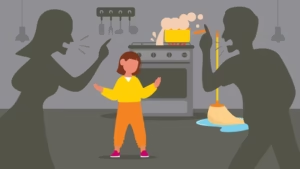
A child might be told about a parent’s marital struggles, financial fears, or depression, and expected to offer comfort in return.Many people experienced a blend of both types growing up, doing the practical work of an adult while also managing everyone’s emotions behind the scenes.
Parentification Trauma Symptoms in Adults
The effects of parentification rarely stay in childhood. They tend to quietly reshape personality, relationships, and self-worth well into adulthood.Understanding these parentification trauma symptoms in adults is often the first real step toward making sense of patterns that have felt confusing or exhausting for years.
These symptoms typically fall into three overlapping categories: emotional, relational, and behavioral. Let’s look at each one closely.
Emotional Symptoms of Parentification Trauma in Adults
Many adults who were parentified as children struggle with a persistent, low-level anxiety that’s hard to explain to others.This often comes from years of hypervigilance, constantly scanning for problems to solve or emotions to manage before they escalated.A deep sense of guilt frequently shows up too, especially around rest. Slowing down can feel wrong, even dangerous, when your nervous system learned that stillness meant something bad was about to happen.
Many also describe a quiet resentment they feel ashamed of. Loving your family while also grieving the childhood you didn’t get to have isn’t a contradiction, even though it can feel like one.A fragile sense of self-worth is common as well. If your value was tied to being useful, it can feel unsafe to simply exist without constantly proving you’re needed.Some adults describe feeling emotionally “old” even as children, and that feeling of being perpetually responsible often never fully switches off.

Perfectionism often develops alongside this pattern. If mistakes once meant real consequences for the whole family, even small errors as an adult can trigger outsized shame or panic.Many parentified adults also carry a quiet exhaustion that sleep doesn’t seem to fix. It’s less about physical tiredness and more about a nervous system that has rarely been allowed to fully power down.
Difficulty identifying your own emotions is another common thread. When you spend childhood monitoring everyone else’s feelings, your own can become unfamiliar territory, almost like a language you never got to learn fluently.Numbness can show up too, especially during moments that should feel joyful or relaxing. If your emotional energy was always directed outward, turning it inward can feel strange or even uncomfortable at first.
Relationship Patterns Linked to Parentification
Parentified adults often become the fixer in every relationship they enter, whether romantic, platonic, or professional.You might find yourself drawn to partners who need rescuing, recreating the same dynamic of being needed rather than simply being loved.
Asking for help can feel deeply uncomfortable, even humiliating, because your role was always to provide support, never to receive it.Many parentified adults struggle with boundaries, saying yes when they mean no, because disappointing others once felt tied to real consequences.
There’s often a strong instinct to manage other people’s emotions during conflict, smoothing things over before your own feelings have even been acknowledged.Trust can also be difficult. If the adults who should have cared for you needed caretaking instead, it can feel unsafe to fully rely on anyone else.

Many parentified adults gravitate toward one-sided friendships without realizing it, giving far more emotional support than they receive and rarely questioning the imbalance.Conflict can feel especially threatening. Because keeping the peace once felt essential to survival, even minor disagreements in adult relationships can trigger a disproportionate sense of danger.
Some adults swing the opposite direction instead, avoiding closeness altogether. If caretaking once felt like the price of connection, staying distant can seem safer than risking that role again.Romantic relationships often highlight this pattern most clearly, since they require both giving and receiving in ways that can feel deeply unfamiliar to someone who only learned how to give.
Parentification and Work or Burnout Patterns
The workplace often becomes another stage for the same script that started at home, just with different characters.Many parentified adults become the reliable one at work, the person everyone leans on, often at the expense of their own workload and wellbeing.
Delegating can feel nearly impossible, since taking care of everything alone was the survival skill that once kept the household functioning.Burnout is common, not because these adults lack ambition, but because rest has never felt like something they were allowed to have.
Praise for being “so responsible” or “so mature” can feel validating and exhausting at the same time, echoing the same role they’ve played since childhood.Some parentified adults chase achievement relentlessly, using success as proof of their worth in a way that never quite feels like enough, no matter how much they accomplish.
Others struggle with the opposite problem, feeling paralyzed by the pressure of always needing to perform, which can lead to procrastination or quietly avoiding new responsibilities altogether.Taking a real vacation, one without checking email or worrying about work, can feel almost impossible, since being needed has always felt safer than being unnecessary.
Parentification vs Normal Childhood Responsibility — How to Tell the Difference
Not every chore or responsibility given to a child counts as parentification. Healthy development includes age-appropriate tasks like small chores or occasional babysitting.The difference lies in scale, consistency, and emotional burden. Was the responsibility occasional and supported, or constant, unsupported, and beyond what a child should manage?
Healthy responsibility teaches competence. Parentification, by contrast, teaches a child that their needs come last, and that their value depends on what they provide to others.Another marker is whether the child had someone to turn to. Parentified children often had no adult available to help carry the weight they were given.
If you’re unsure whether your experience fits this pattern, ask yourself honestly whether your childhood needs were consistently sacrificed for someone else’s.It also helps to consider how you felt at the time, not just what you did. A helpful task done willingly, with support nearby, feels very different internally than a duty carried alone out of fear or obligation.
If looking back brings up more heaviness than pride, that emotional weight is often a more reliable signal than the tasks themselves.
Common Causes and Family Dynamics Behind Parentification
Parentification rarely comes from one single event. It usually develops gradually within a family system under strain.A parent’s untreated mental illness, substance use, or chronic illness can leave a gap that a child instinctively tries to fill.Divorce or single parenting under heavy financial or emotional pressure can also push a child into an adult-like support role earlier than expected.
Sometimes cultural or generational expectations play a role too, particularly around eldest children, and especially eldest daughters, being expected to help raise siblings or manage the household.In many cases, the parent isn’t intentionally harmful. They may be overwhelmed themselves, unconsciously leaning on the most capable, emotionally attuned child available.
Birth order often plays a quiet but powerful role. Oldest children are frequently handed responsibility by default, simply because they’re the most physically capable in the moment a gap needs filling.Immigration and language barriers can create their own version of this dynamic, where a child becomes the family’s translator, appointment scheduler, and cultural bridge long before they’re emotionally ready for that pressure.
Community and religious expectations sometimes reinforce the pattern too, framing a child’s caretaking role as admirable devotion rather than something that came at a real developmental cost.It’s worth remembering that recognizing these causes isn’t about assigning blame in a simplistic way. It’s about understanding the full picture clearly enough to finally make sense of your own experience.
How Parentification Affects Parenting Your Own Children
For those who become parents themselves, parentification can resurface in unexpected ways.Some adults overcorrect, becoming intensely protective of their children’s right to simply be children, sometimes to the point of struggling to ask their own kids for reasonable help.
Others unconsciously repeat the pattern, leaning on a child emotionally without realizing they’re recreating the same dynamic they once lived through.Noticing this tendency isn’t a failure. It’s actually a sign of the self-awareness needed to parent differently than you were parented.
Therapy and intentional reflection can help break the cycle, allowing you to build a family dynamic based on mutual care rather than role reversal.It can also help to watch for early warning signs, such as regularly discussing adult problems with a child or relying on them for emotional comfort you should be seeking elsewhere.
Modeling healthy help-asking in front of your children can make a real difference too. Letting them see you ask for support from other adults teaches them that needing help isn’t shameful.Giving children age-appropriate responsibility, paired with genuine choice and support, allows them to build real competence without slipping into the same overwhelming role reversal you once experienced.
How to Start Healing From Parentification Trauma
Healing begins with naming what happened, clearly and without minimizing it. What you experienced was real, even if others in your family don’t see it the same way.Learning to identify your own needs is often the next step, since many parentified adults were never taught to notice what they actually want or feel.
Practicing small moments of receiving help, rather than always giving it, can feel surprisingly uncomfortable at first, but it slowly rebuilds a sense of safety in relying on others.
Setting boundaries is essential, even when it feels unfamiliar or guilt-inducing. A boundary isn’t a punishment to others; it’s a form of self-respect.Reconnecting with rest without guilt takes practice too. Allowing yourself to simply exist, without producing or fixing something, is part of undoing years of conditioning.Working with a therapist who understands childhood trauma and family systems can make this process significantly more manageable and less isolating.
It also helps to grieve what wasn’t available to you as a child, whether that was protection, comfort, or simply the freedom to be carefree sometimes. Grief and healing often move together, not one after the other.Building a life with genuine rest, hobbies that have no productive purpose, and relationships that don’t require constant caretaking can feel foreign at first, but these experiences slowly retrain what safety and connection actually feel like.
Journaling can also be a useful tool during this process, giving you a private space to notice patterns, name feelings, and track small moments of progress that might otherwise go unnoticed.Connecting with others who share similar experiences, whether through support groups or trusted friendships, can also ease the isolation that often comes with realizing how much you carried alone for so long.
Reparenting yourself, offering your own inner child the patience and reassurance you may not have received, is a powerful tool many trauma therapists use in this specific kind of healing work.Progress rarely moves in a straight line. Old habits like over-functioning or guilt around rest may resurface during stressful periods, and that’s a normal part of the process rather than a sign of failure.
When to Seek Professional Help
If these patterns are affecting your relationships, career, or overall sense of self, it’s worth speaking with a licensed therapist who understands developmental trauma.A therapist can help you separate what was genuinely your responsibility as a child from what was unfairly placed on you.Approaches like inner child work, attachment-based therapy, or trauma-focused talk therapy are often especially helpful for parentification recovery.
This article is meant to offer understanding and language for your experience, but it isn’t a substitute for a full clinical assessment. Only a licensed professional can properly evaluate trauma symptoms and recommend the right treatment path for you.
Frequently Asked Questions
Is parentification considered a form of trauma?
Yes, many clinicians classify parentification as a form of relational or developmental trauma, since it disrupts a child’s natural need to be cared for rather than to provide care.
Can parentification cause anxiety or depression in adulthood?
It can contribute significantly to both. The chronic stress, hypervigilance, and suppressed needs involved in parentification often lay the groundwork for anxiety and depressive symptoms later in life.
What is eldest daughter syndrome, and is it the same thing?
Eldest daughter syndrome is a popular term describing a common pattern of parentification specifically affecting the oldest daughter in a family. It overlaps heavily with emotional and instrumental parentification.
Can you fully recover from parentification trauma?
Full recovery looks different for everyone, but significant healing is absolutely possible with therapy, self-awareness, and consistent practice of new relational habits.
Why do I feel guilty when I rest or say no to people?
This guilt often traces back to a childhood where your value was tied to being useful or available. Unlearning this takes time, but it does get easier with practice.
Is it normal to still love my parents even though this happened?
Yes. Many people hold both love for their parents and grief over what happened simultaneously. These feelings aren’t contradictory; they’re simply complex.
How do I know if I was parentified or just a helpful kid?
The key difference is scale and emotional burden. Occasional help is healthy. Constant, unsupported responsibility that outweighed your developmental stage points more toward parentification.
Can therapy really change these deep-rooted patterns?
Yes. While these patterns feel deeply ingrained, therapy focused on trauma and attachment has consistently shown real, lasting change is possible with time and commitment.
Does parentification only happen to the oldest child?
Not always. While eldest children are affected most often, any child, including middle or youngest siblings, can be parentified depending on family circumstances and their own temperament.
Conclusion
Parentification trauma symptoms in adults often hide in plain sight, disguised as responsibility, maturity, or simply “being the strong one.”Recognizing this pattern isn’t about blaming your childhood self or your family entirely. It’s about finally understanding why certain things have felt so heavy for so long.
You were never meant to carry an adult’s emotional weight as a child. That understanding alone can be the beginning of real relief.Healing is possible, and it often starts with the same quiet courage it took to survive that role in the first place.You deserve a life where your needs count too, not just everyone else’s.
Give yourself permission to move at your own pace. Understanding this part of your story is a process, not a single realization, and every small step toward self-compassion genuinely counts.There is no deadline for healing, and no version of your progress that counts as “too slow.” What matters most is that you keep choosing yourself, a little more each day.
The child who once held so much can finally learn what it feels like to simply be held instead.